

10 years of automating airborne intelligence

Overwatch Imaging celebrates a decade of supporting the special missions sector
Overwatch Imaging, a developer of autonomous airborne imagery intelligence systems, is marking its 10th anniversary this month, capping a decade-long evolution from a bootstrapped startup into a globally deployed provider of AI-enabled sensor autonomy for civil, commercial, defense and intelligence missions.
Founded in February 2016 in Hood River, Oregon, the company was created to address a persistent problem in airborne intelligence: traditional human-in-the loop imaging systems struggled to scale for wide-area, time-critical missions that require finding small but consequential objects quickly. Overwatch Imaging set out to automate that process by moving intelligence processing to the edge, exploiting computer vision and artificial intelligence to find key information in imagery streams, and reducing dependence on constant human attention.
Today, the company’s Smart Sensors and Automated Sensor Operator (ASO) software are deployed across six continents, supporting missions ranging from wildfire and disaster response to search and rescue (SAR), maritime interdiction, border security, and defense intelligence, surveillance, and reconnaissance (ISR) operations.
“After spending years working with airborne imaging systems, it was clear to me that asking highly trained operators to stare at imagery feeds and look for a needle in a haystack was not efficient, effective or scalable,” said Greg Davis, Overwatch Imaging Founder and CEO. “Those systems weren’t built for wide-area, time-critical search for small threats. Overwatch Imaging was founded to address that gap.”
Davis, an aerospace engineer by training, began his career as a software engineer at NASA and Lockheed Martin Space Systems before moving into uncrewed aircraft systems program leadership. His experience supporting defense missions in Iraq, Afghanistan, and Naval operational theaters exposed the limitations of traditional imagery workflows, particularly in environments where bandwidth is constrained and decisions must be made quickly.
Geography also played a role in shaping the company’s early direction. Hood River and the surrounding Columbia River Gorge sit at the intersection of a global drone and imagery intelligence innovation hub, a watersports mecca, and one of the most wildfire-prone regions in the USA. That combination influenced early development across both civil and defense use cases, with real-time wildfire intelligence, SAR and maritime domain awareness emerging as the company’s first operational applications.
SCALABLE, REPEATABLE, AND RELIABLE REAL-TIME INTELLIGENCE
When Overwatch Imaging was founded in 2016, wildfire management and disaster response were already high-stakes missions, but the stakes have only grown higher and the impacts more catastrophic. Focusing on wildfire specifically, we’ve watched increasingly destructive fire events unfold over the last several years not only in the western USA but around the world, from the 2020 Labor Day fires in Oregon and California, which burned more than a million acres and destroyed entire communities, to major Southern California incidents such as the Palisades, Eaton, and Gifford fires, as well as catastrophic fire seasons in Australia, Chile, and southern Europe. Together, these events underscore a shift toward larger, faster-moving, and more complex wildfires, with more people and critical infrastructure in harm’s way.
Airborne sensors were part of the response ecosystem a decade ago, but they relied almost entirely on human operation and interpretation. Data typically had to be offloaded, processed manually, and analyzed after the fact, meaning actionable intelligence often arrived hours after it was collected.
Thanks in large part to innovations over the last decade, the expectation today is that intelligence is available in real time, during the mission, not hours or days later. This shift has driven growing demand for onboard processing, autonomy, and software that reduces the cognitive load on pilots, operators, and analysts, while empowering decisionmakers with scalable, repeatable, and reliable real-time intelligence.
Beyond wildfire and disaster response, we’ve seen strong demand for this capability across missions such as maritime domain awareness, border security and monitoring, tactical intelligence operations, and large-area, small-object search. Across all of these use cases, the common challenges are the same: wide coverage areas, constrained bandwidth, time-critical decisions, and limited personnel. The missions differ dramatically, but the need for rapid, automated airborne intelligence is consistent across them all.
MATURE TECHNOLOGY
As its technology matured, Overwatch Imaging abstracted the sensor autonomy software from its own airborne sensors to enable compatibility with third-party full motion video systems. Capabilities originally developed for the company’s own sensors evolved into platform-agnostic edge software designed to automate detection, tracking, and prioritization directly onboard airborne systems. That transition greatly expanded the company’s addressable market and accelerated adoption across multiple mission types.
“We’ve been supporting real customer missions since almost the very first month,” Davis said. “We delivered our first Smart Sensor to a wildfire mapping customer before we even had a logo. That operational focus has stayed with us as the company has grown.”
The company’s growth has been reinforced by venture investment in multiple phases, starting with initial support from Tenax Aerospace, followed by Series A funding in 2022, led by Squadra Ventures and Shield Capital, with participation from L3Harris Technologies and Bridger Aerospace. These investments supported the transition from a sensor-centric business to a software-driven autonomy enabler. A subsequent growth round in 2025 helped scale development, deployment, and international reach.
GLOBAL MISSIONS
The need for real-time airborne intelligence, at scale, now cuts across nearly every ISR mission worldwide. Whether the task is responding to a natural disaster, searching for a small vessel across a vast maritime area, monitoring a remote border, or maintaining situational awareness over a contested environment, the challenges are strikingly consistent: intelligence must be available faster, with fewer resources, and with far less tolerance for human fatigue and error.
In that context, a wide range of operators stand to benefit from the kind of automation and workload reduction Overwatch Imaging focuses on. Public safety and disaster response agencies increasingly rely on airborne systems during wildfires, floods, and large-scale emergencies, where timely intelligence can directly affect life-safety outcomes. Maritime operators, including coast guards and SAR organizations, face similar pressures when searching enormous areas for small or fast-moving targets under tight time constraints.
In defense and security settings, where ISR operators must maintain persistent awareness in complex or contested environments, automation and edge processing help ensure consistency and reduce cognitive load during extended operations.
For years, pilots and analysts have carried the burden of manually managing sensors and workflows never designed for today’s scale or tempo. By introducing autonomy, AI, and edge processing in a way that meaningfully eases that burden, Overwatch addresses a challenge shared globally: doing more, faster, with fewer people, while maintaining confidence in the intelligence guiding critical decisions.
THE FUTURE OF AIRBORNE INTELLIGENCE
Looking ahead, Overwatch Imaging enters its second decade amid rising demand for real-time intelligence. From increasingly destructive wildfires to more complex security threats, the need for scalable, autonomous sensing continues to grow. Both traditional crewed aircraft as well as uncrewed aircraft systems are adopting autonomous sensing in response to expanding roles and data overload.
“Our focus hasn’t changed,” Davis said. “The challenges are still the same: how to deliver timely, actionable intelligence at scale for missions that matter. Our tools have evolved and the team has grown, but our focus on the mission remains at the center of our work.”
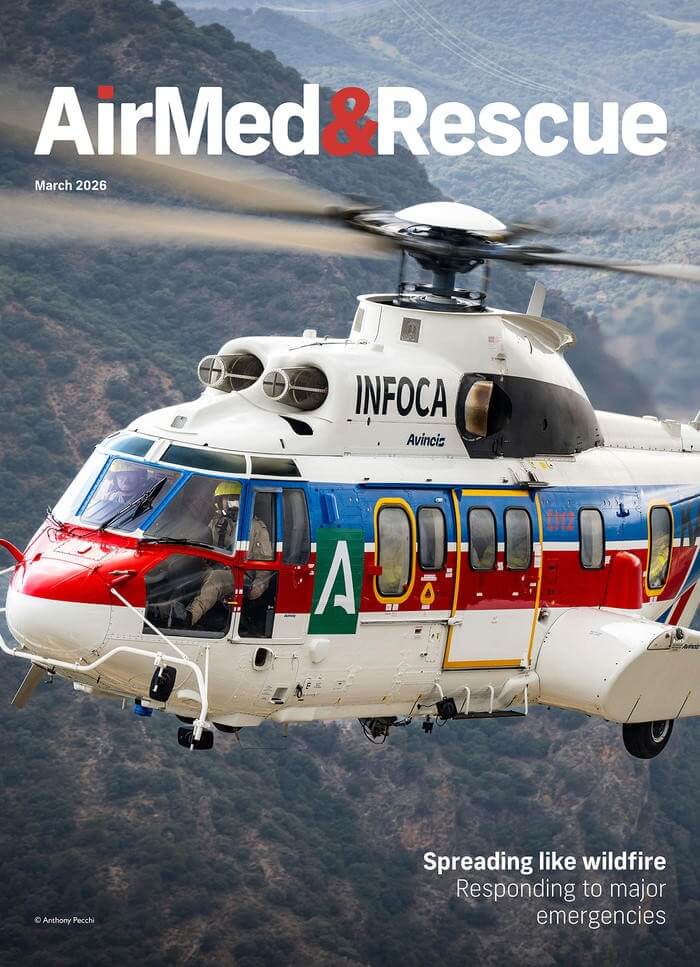
March 2026
Issue
This edition is bursting at the seams with articles from all corners of the special missions sector. We have features on the California wildfires that ravaged the state last year, what the cost–benefit analysis looks like for single-engine rotorcraft and autorotations, how the mission dictates the modification needed to the platform, and what can be done to further prevent the problems associated with inadvertent entry into instrument meteorological conditions.
Editorial Team
The AirMed&Rescue Editorial Team works on the website to ensure timely and relevant news is online every day. With extensive experience and in-depth knowledge of the air medical and air rescue industries, the team is ready to respond to breaking industry news and investigate topics of interest to our readers.