
Up against it: hoist rescue missions in extremis

Stories of dramatic hoist rescues are shared with Amy Gallagher, when using a hoist was the best and only way to extricate people from these conditions
No-one expects to be stranded in the middle of the ocean, at the base of a cliff on a rugged coastline, or desperate for rescue from a fiery explosion on a fishing vessel. But it’s good to know there are people like the aviators in this article who have been there in the moment of the mission to give that someone a second chance to live.
AirMed&Rescue heard daring stories of extraordinary hoist rescues, beginning with Retired US Coast Guard (USCG) Commander Kendall Garran, whose crew survived the multiple challenges of explosions on a fishing vessel in the Bering Sea.
The second pilot is Lieutenant Commander Cassandra Hawley, whose crew helped save two hikers stranded on the rugged coastline of Oregon. The third is Retired Commander and former US foreign diplomat Liz Booker, whose crew rescued a stranded surfer off the coast of California during a nighttime mission.
Based on government statistics, the USCG has approximately 170 female aviators out of 900 pilots, about 19% of its total pilot force of rotor and fixed-wing pilots. USCG rotor pilots CDR Garran, LCDR Hawley and CDR Booker represent this select group of aviators.
Explosion in the Bering Sea
CDR Garran made history in her family as the first female career pilot as well as the first and only one rotor pilot.
After completing her naval flight training in Pensacola, Florida, CDR Garran served her first tour as an HH-60J pilot at USCG Air Station Cape Cod, Massachusetts, where she had a notable rescue of five fishermen off the Fishing Vessel (F/V) Covered Wagon and flew the first eight hours of the search for John F Kennedy Jr off the coast of Martha’s Vineyard in 1999.
Her second tour was in the unforgiving environment of Kodiak, Alaska.
“I hadn’t yet fully grasped the enormity of the area of responsibility [AOR],” she said, explaining how her first weather briefing showed several low-pressure systems lined up. “It wasn’t just one low-pressure system – it was four all lined up,” she said. “I was thinking, ‘We’re not in Kansas anymore.’”
That weather briefing foreshadowed what was to come when CDR Garran would experience a historic rescue in the unforgiving Bering Sea. The F/V Galaxy experienced a fire and backdraft explosion 35 miles southwest of Saint Paul Island.
“During our three-hour flight to the F/V Galaxy from Cordova, we were informed there were 26 people on board,” she said. “In the meantime, USCG units in Juneau and Kodiak coordinated a C-130 escort and another HH-60 to start island-hopping down the Aleutian chain as a backup.
“Upon arrival, the vessel was fully engulfed in flames,” she said. “There were still six people on board – three in a huddle wearing everyday clothes on the stern, which was fully engulfed in flames, and three others wearing survival suits on the bow.”
It was so hot we could see the paint bubbling underneath the feet of those on the stern, said CDR Garran.
“We also saw a large life raft with someone waving out of the door, but didn’t yet know how many people made it to the raft,” she said. “Thankfully, three ‘Good Samaritan’ vessels cut their lines to help those on the raft while we focused on those on the Galaxy.”
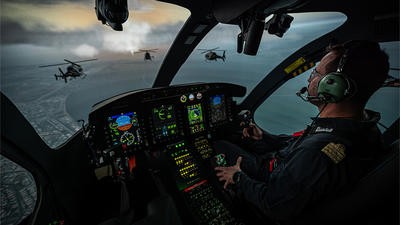
CDR Garran flew from the left seat while hoisting, given the position of the vessel and wind direction.
“Crew coordination is critical when hoisting,” she said. “I’m trusting the flight mechanic, who is conning me over the target, and he’s trusting me to position the helicopter where he needs it to complete the hoist.
“When you’re flying and hoisting from the left seat, not only is everything backward from how we train, but for the flight mechanic to see the hoisting area, he has to lay down on his belly, put his head down and look under the aircraft.
“It was challenging from every perspective,” she said. “Once we made the first approach to take survivors straight off the vessel, explosions from the superstructure shot straight up and nearly over the aircraft.”
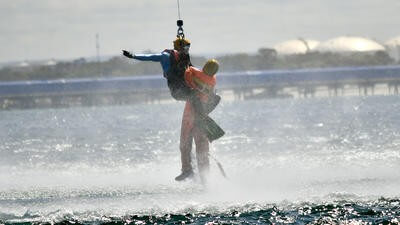
CDR Garran rapidly determined that the only way to safely effect the rescue was to lower the swimmer into the water.
“It was no small feat, given the 30ft seas in frigid water,” she said. “The hoist operator put the rescue swimmer down about 25ft off the stern to get the swimmer as close to the survivors as possible, knowing we had to ask them to jump to the swimmer.”
Upon arrival, the vessel was fully engulfed in flames
Through hand signals, the swimmer began holding up one finger to convey one person jumping at a time, explained CDR Garran.
“Initially, we planned to leave the swimmer in the water, but the winds were pushing the vessel away faster than he could swim, so we had to hoist our swimmer up to reposition each time to rescue the remaining people on board.”
Once the survivors from the F/V Galaxy were aboard the aircraft, CDR Garran and her team were informed by one of the Good Samaritan vessels that they had a critically injured survivor on board.
“During the hoist from that vessel, the crew experienced an automatic flight control system [AFCS] failure, which assists in the control and stabilization of the aircraft,” she said.
As they planned the hoist, the Aircraft Commander made a very smart, fairly rare decision to split the controls, said CDR Garran, who took over the collective to maintain altitude while the right-seat pilot focused on positioning the aircraft over the target.
“It was a wise decision as the conditions were deteriorating; it was now dark, fatigue was setting in, and we had a degraded aircraft,” she added.
As soon as they got the injured survivor off the Good Samaritan vessel, they headed for Saint Paul Island with the six crewmembers while coordinating with emergency medical services (EMS) to meet them at the airport.
“Once we landed in Saint Paul to offload everyone, we hopped in a C-130 that flew us back to Kodiak,” CDR Garran said. “Another crew took our aircraft and launched to search for two members of the Galaxy crew who were still missing.”
Hoists onto vessels at sea are exceptionally tricky, stated Eva Martinez, Director of Inservice Support at Bluedrop Training & Simulation, explaining that in their training they teach how to overcome some of the challenges: “In our training sessions we routinely deliver these scenarios using the AW139 single hoist configuration. The key training highlights include:
- Managing pitch, roll, and heave effects visually and behaviorally, reinforcing timing, voice marshalling and cable control skills
- Emphasizing communication between winch operator and instructor operating station (IoS) operator to maintain accurate aircraft positioning above a moving deck
- Developing judgment under pressure, especially when the casualty is on a wet, dynamic, or cluttered surface.
“The primary challenge lies in the unpredictability of movement and limited visual cues, which is why this scenario is critical in building operator confidence.
“While we do not train operators to hoist into flames, simulated proximity to heat and fire helps develop:
- Situational awareness in low-visibility and high-risk environments
- Decision-making under cognitive load
- Precision placement of the rescue device or winchman under pressure.”
Transitioning to civilian work
CDR Garran seamlessly transitioned from active duty to a civilian career in her role as the Deputy Program Manager with Metris Global at the USCG Training Center Yorktown, Virginia, where she oversees comprehensive contract management while also serving as the Site Lead/Manager. The key to her success, she said, has been the contributions of her Metris team, who are “highly experienced and valued by the active duty and civilian members of the Yorktown Training Center”.
“I've made it a priority to hire people who are good at their jobs – team players, easy to work with, and who are trustworthy. I also need to be fully accessible when they need support,” said CDR Garran, who has been in her civilian position for nine years, managing a staff of 28 instructors, curricula designers, and performance analysts in support of the USCG.
“It’s been a fantastic post-Guard career and I’m blessed to continue to support my former service,” she added.
Upgraded technology, diversified training
Based in Sector/Air Station North Bend, Oregon, LCDR Hawley decided that if she couldn’t fly as fast as her father, a retired US Marine F-18 pilot, then she’d have to fly something ‘cooler’. Since 2016,
LCDR Hawley has served as a rotor pilot, initially flying the MH-65 Dolphin ‘Delta’ model, before upgrading in 2022 to the MH-65 Echo.
“I immediately noticed the improved data display allowing for increased situational awareness while reducing cognitive load during rescue missions,” said LCDR Hawley.
The upgrade to a full-glass cockpit improved visibility, with a condensed view of instrumentation providing additional displays such as the hoist camera, thereby broadening abilities to execute the mission, she said.
“It’s like having four iPad screens across the cockpit with an enlarged radar image and map,” added LCDR Hawley. “It provides a clearer ‘sight’ picture as to what the crew is doing.”
Upgrading to the voice-operated exchange (VOX) has also streamlined internal communications among the crew, she explained.
In the recent nighttime missions, LCDR Hawley wore ‘green’ goggles but now uses white phosphorus goggles that present a delineated grayscale of objects, offering greater contrast and clarity.
The upgrades and her crew’s USCG training were put to task during a complex operation involving stranded hikers along the rugged coastline of Oregon and requiring a nighttime vertical cliff-type rescue. In 2021, LCDR Hawley was awarded the Air Medal for exceptional meritorious achievement while serving as the co-pilot for that mission.
Earning qualifications for the multiple roles she fulfills as a pilot, commander, instructor, and flight examiner while also conducting post-maintenance test flights, LCDR Hawley emphasized the USCG’s standardization across diversified units.
“Standardization visits conducted annually builds teamwork and trust, which is critical, especially in hoisting maneuvers and phraseology when the fleet from various units fly together during surge operations,” she said, adding: “Pilots from Port Angeles and Savannah could fly with a flight mechanic from Corpus Christi and a rescue swimmer from Detroit in Texas for a hurricane response without ever having flown together before.”
Trust served as a powerful force multiplier when LCDR Hawley and her crew were called out to rescue two hikers in a remote mountainous region near the coastline of Oregon, where the USCG was the only 24/7 rescue rotor asset in the region.
“Two hikers, one with serious injuries after falling about 100ft, were stuck on top of the snow-capped Grayback Mountain,” she said.
Upon arrival, the hikers had created a small fire, which helped the rescuers secure their position to inform their command center, knowing a ground crew was headed up the mountain to help out, added LCDR Hawley.
But with an altitude of roughly 7,000ft while mitigating winds at 40kts gusting up to 60kts, LCDR Hawley and her crew had to pause and consider they had never hoisted at that altitude.
LCDR Hawley – just returning to flying and hoisting after three months due to an injury and thinking back on a complex rescue mission six months prior that almost took the life of her and her crew – realized this mission would ultimately require them to accept they’d have to leave the swimmer and those stranded on the mountain overnight.
“This was my first rescue mission in which I would not bring back the survivors, nor my swimmer,” she said. “I had to reset, mentally.”
Once she reached 150ft above ground at the mountain, LCDR Hawley pulled into a hover position while conducting an atypical left-seat hoist to lower the swimmer down with hypothermic bags and equipment to set up an overnight camp until the ground crew arrived.
“I had to make huge power inputs on the collective to hold steady over the trees, knowing it’s at night, freezing, and approximately a 30° slope for our rescue swimmer to navigate once lowered,” said LCDR Hawley, who had also realized by that time that the aircraft was running low on fuel.
“We ended up heading all the way to Crescent City, California, for fuel, then flew back to the mountain to ensure our swimmer made it up to the hikers’ position safely,” she said.
That is when LCDR Hawley learned the ground crew had had to turn around due to severe weather conditions.
Facing high winds with fog building in the mountain valleys below, the crew headed back to the mountain to drop off another hypothermic bag and establish a comms plan. Plan B involved the rescue coordination center contacting an Oregon National Guard UH-60 crew to pick up the two survivors and the swimmer later that morning, she explained.
“Our swimmer had dug a wide trench in an area with few trees to clear out a hoisting platform on the side of the mountain for the UH-60,” she added.
At the end of the day, LCDR Hawley reflected on the importance of the unique skill set of each person on the team, strengthened by their joint rescue experiences and extensive trust through diversified training. Emphasizing the level of trust among the crew and the need for input from all crewmembers, LCDR Hawley said: “Incorporating the critical role of crew coordination ensures safety and effectiveness, especially during high-pressure situations that demand trust.”
Every person and every position matters; everyone has to have a voice, she said.
Martinez added that training for windy and gusty conditions is part of scenarios that Bluedrop caters for, and that learning when to not go because of extreme conditions is also an important learning outcome: “The training allows instructors to simulate:
- Sudden lateral shifts or turbulence
- Wind funneling in high altitude or coastal rescue environments
- Rotor wash interaction over water or structures.
“Trainees must manage gusts by maintaining spatial awareness through a thorough briefing process, adjusting their approach line dynamically, and communicating effectively with the IoS operator when aircraft repositioning is required. It reinforces the need for constant communication, reassessment and adaptation.” Martinez continued: “One of the key learning outcomes in our training is knowing when not to hoist. No-go decisions can be driven by:
- Hazardous terrain or obstructions
- Unstable casualties or dynamic loads
- Environmental or aircraft limitations (e.g. icing, fuel, power margins)
- Loss of visual references or degraded communications.
“In simulation, we use these events to provoke crew discussion, strengthen assertiveness, and ensure risk-based decision-making.”

Rescue pilot and foreign ambassador
CDR Booker earned her wings with training at Naval Air Station Pensacola, transitioning to the MH-65 Dolphin, conducting search and rescue, law enforcement, and humanitarian missions around the Caribbean Sea and the eastern Pacific Ocean. CDR Booker also served in a diplomatic role as the Senior Defense Official to Barbados and the Eastern Caribbean before retiring.
“My first operational assignment was in San Francisco, where the focus was on search and rescue missions,” said CDR Booker. “Then, 9/11 changed the nation, which created a shift in the unit’s mission to include port security.”
CDR Booker recounted specific rescue operations, including a challenging hoisting operation involving a stranded surfer, highlighting the teamwork and communication required for successful rescues in complex environments.
“We were launched for a nighttime rescue of a surfer stranded on a sliver of beach next to a 200ft vertical cliff,” she said. “Hoisting from that altitude requires smooth, precise control inputs to avoid swinging the swimmer and survivor.”
The primary challenge lies in the unpredictability of movement and limited visual cues
But the hoist was made more challenging as the red tail lights of passing vehicles on the adjacent road washed out the crew’s night vision goggles at regular intervals, CDR Booker explained.
The success of the mission depended on close coordination between the entire crew.
“During the hoist, the flight mechanic communicated on a ‘hot mic’ while operating the hoist, which was critical as I lost visual contact with the surfer and couldn’t gauge our tail position relative to the cliff,” she said.
Ultimately, a steady stream of conning commands ensured a slow, controlled approach and retrieval, added CDR Booker.
Conducting a mission at night has many factors for which appropriate training is essential, stated Martinez: “Key considerations include:
- Enhanced crew coordination and briefing
- Reduced margin for error in obstacle clearance
- Management of disorientation, especially for winch operators working with limited visual reference.”
Martinez added that teamwork and communication were “absolutely vital”, concluding that: “A successful hoist requires seamless communication and trust between the technical crew and flight crew. The pilot’s role in aircraft positioning is heavily dependent on:
- Clear, timely, and standardized commands from the winch operator
- A shared mental model of the mission objective
- The ability to speak up or stop a hoist when conditions change.
“Our training reinforces this by using guided scenarios and live instructor feedback, with structured post-mission debriefs to examine communication breakdowns or missed cues.”
‘Literary Aviatrix: The Power of Story’
To understand the present status of female aviators, we must know the history of such women. Good stories are written by good writers who bring great experiences to the storyline.
Former USCG helicopter pilot CDR Booker describes herself as a “connector” – inspiring the next generation of women in aviation as a stabilizing force built through the consistency of time and talent. CDR Booker has created a community of readers, writers, and aviation enthusiasts around ‘the power of story’ featuring women from around the world.
Transferring her USCG experiences to a new mission, ‘Literary Aviatrix’, CDR Booker inspires women in aviation with a website that serves as a source to search books featuring their stories, an author interview podcast where she talks about the books, and writing and publishing through the Aviatrix Book Club, which meets virtually a couple of times a month and welcomes participants with diverse backgrounds globally.
“I host in-person author events and participate in local outreach events to engage girls in aviation, emphasizing the need for creative methods to promote interest in the industry, while highlighting the experiences of female aviators to encourage young girls to pursue aviation careers,” said CDR Booker.
Winding down the high seas while winding up higher connections of female aviators, CDR Booker, who continues to fly recreationally ‘for research’, shares her signature sign-off: “Blue skies and happy reading!”
August 2025
Issue
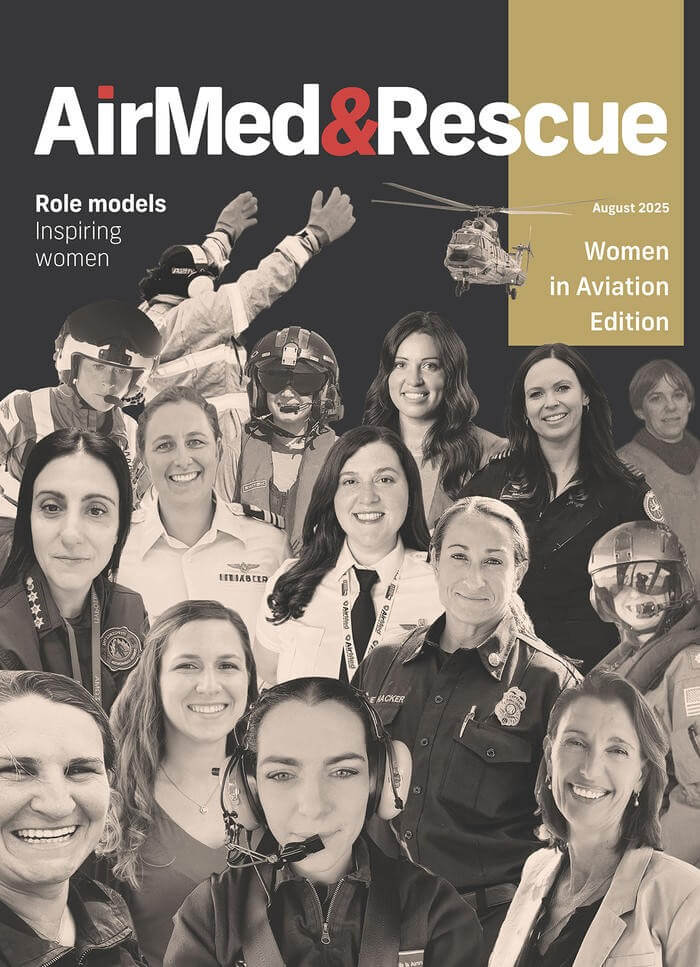
Our August magazine is the inaugural women in aviation edition, highlighting and showcasing female voices from the airborne special missions sector. We have features on blood products used in emergency medical services, challenging hoist rescues, pregnancy while flying, and portable water sources for firefighting. We also have interviews, a gallery, an industry voice, a news analysis piece, and a provider profile, as well as a review of the Paris Air Show.
Amy Gallagher
Amy Gallagher is an internationally published journalist covering aviation, rescue, medical and military military topics, including training and technology, as well as evidence-based research articles. As a journalist by education and certified English instructor, Amy has worked in both agency and corporate communications, providing educational and promotional writing and training services.