

Are we training technical crews for the mission – or simply to pass the check?

Trevor Abraham, Managing Director, Air Rescue UK, explores the approach to, and the importance, progression, and future of training crews for helicopter hoist operations
It’s dark. A helicopter is hovering above a vessel in difficult conditions. The winchman is descending towards the deck when an unexpected movement changes the situation. The cable begins behaving differently, communication becomes more demanding and the crew must decide what happens next.
Now imagine asking a trainee to manage that situation.
Would we deliberately create those circumstances beneath a live aircraft? Almost certainly not. But what if we could recreate the challenge without exposing anyone to the consequences?
Having spent much of my career involved in operational hoisting, technical crew training, and the management of search and rescue (SAR) services, one thing has become increasingly clear to me: the most demanding situations rarely unfold exactly as we imagined during training.
We rightly place enormous importance on qualifications, competency checks, and maintaining currency. But I believe we should challenge ourselves with a simple question.
Are we training people to complete prescribed exercises, or genuinely preparing them for the moment an operation no longer follows the plan?
Training beyond the aircraft
In November 2024, AirMed&Rescue explored the developing approaches to winch operator and paramedic training, highlighting the role of specialist facilities and simulated rescue environments.
Two years on, that conversation has moved forward.
Simulation is already an established part of training for personnel working beneath the helicopter. Facilities such as Meriturva in Finland recreate maritime conditions through wave simulation, vessel structures, and physical rescue exercises. Bristow’s investment in a dedicated SAR training centre at Lee-on-Solent reflects the importance of preparing crews for the physical realities of rescue work.
These environments remind us that simulation doesn’t necessarily mean virtual reality.
For a winch paramedic, learning to manage a casualty on a moving deck, work in difficult water conditions, or communicate effectively during a complicated recovery can be every bit as important as the technical act of being lowered from an aircraft.
Different tasks demand different training environments.
And that raises an interesting question: if we already recognise the value of simulation for those working beneath the aircraft, how should we be developing its role for those managing the operation above?
Teaching differently, not simply training differently
Live aircraft training remains essential. Nothing fully replaces the physical environment, aircraft dynamics, and operational pressures experienced during flight.
But live training has limitations.
Aircraft availability, weather, cost, and safety considerations inevitably influence what can be achieved. More importantly, there are emergencies we simply cannot recreate realistically without introducing unacceptable risk.
Simulation changes what is possible, but I would argue its greatest opportunity is not simply recreating difficult situations. It is changing how we teach people to manage them.
In an aircraft, an instructor must continually balance learning objectives against safety. Intervention is sometimes immediate and necessary.
In simulation, we can allow a situation to develop, observe the decisions being made, pause where appropriate, explore the reasoning, and repeat the exercise with a different outcome.
We can introduce complexity progressively. We can allow mistakes to become learning opportunities.
And perhaps most importantly, we can ask not just whether someone followed the correct procedure, but whether they understood why it mattered.
The value of simulation is not simply how accurately it recreates an aircraft. It is what the trainee learns from the experience.
Not every trainee needs the same lesson
At Air Rescue UK, we have been exploring these questions through our Hoist Mission Training System, established in the UK in partnership with Bluedrop Training & Simulation in Halifax, Nova Scotia, Canada.
Our Bespoke Optimised Learning Dynamics (BOLD) approach begins with the operator’s requirements and existing competencies, rather than assuming every trainee should follow an identical program.
But there is a difference between believing an approach works and being able to demonstrate why. That is one reason we have begun collaborating with researchers at the University of Essex.
Supported by the university’s Innovation Fund, an initial research phase has examined existing evidence on mixed-reality hoist training alongside feedback from trainees using our system.
The preliminary findings suggest something worth exploring further: experience may influence how individuals benefit from simulation.
Less experienced personnel may need carefully structured scenarios that build understanding progressively. Experienced operators, meanwhile, may gain greater perceived value from shorter, more demanding exercises involving time pressure and complex emergencies.
The research also identifies an important unanswered question: how effectively do skills developed in simulation transfer to live operations?
We should welcome that challenge. If we expect simulation to play a greater role in recognised training, checking, and currency, we must be prepared to demonstrate its effectiveness rather than simply assume it.
Is regulatory thinking beginning to change?
There are encouraging developments.
In September 2026, Germany’s DRF Luftrettung announced that its hoist training syllabus, incorporating the hoistAR simulator developed with Reiser Simulation and Training, had received approval from the German Federal Aviation Authority (Luftfahrt-Bundesamt).
That represents an important example of dedicated hoist simulation being formally incorporated into an operator’s approved training arrangements.
Meanwhile, the European Union Aviation Safety Agency’s (EASA’s) new capabilitybased framework for flight simulation devices introduces an interesting principle: matching specific training tasks to devices with the capabilities necessary to deliver them.
Although primarily directed towards pilot training, the underlying thinking deserves wider consideration.
Perhaps we should spend less time asking what a simulator can replicate and more time asking which operational competencies it can effectively develop and assess.
Of course, that requires evidence, appropriate standards, and regulatory oversight. Simulation cannot simply be declared equivalent to live flight. But the direction of travel is encouraging.
The measure that really matters
Aviation has continually improved its safety culture by learning, questioning established practices and embracing better methods when supported by evidence.
Technical crew training deserves that same curiosity.
This is not about replacing the aircraft, removing essential hands-on experience, or suggesting technology holds every answer.
It is about choosing the right environment, the right instruction and the right assessment for the skill we are trying to develop.
Because ultimately, our responsibility goes beyond ensuring that someone meets the required standard on the day of a check.
It is to prepare them for the day when the situation is unfamiliar, the pressure is real, and the next decision genuinely matters.
Passing the check matters. Being ready for the mission matters more.
Trevor Abraham
Trevor is Managing Director of Air Rescue UK, with extensive experience in helicopter search and rescue, operational hoisting and technical crew training. Having progressed through operational and senior leadership roles, he is passionate about developing safer, more effective training systems and improving mission readiness through operational experience, innovation and simulation.
November 2026
Issue
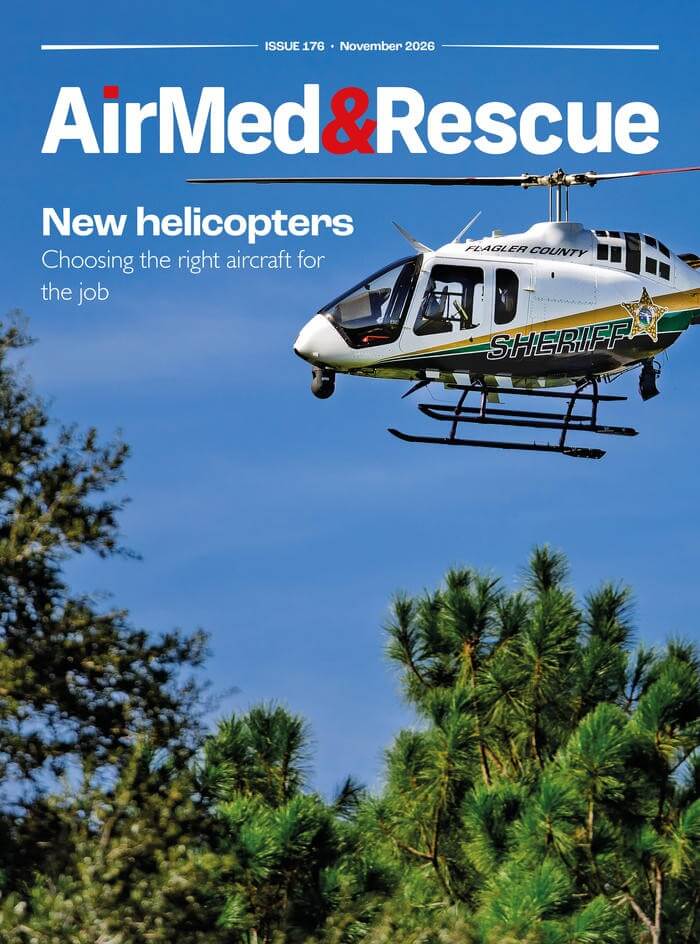
The November edition of AirMed&Rescue has a wealth of articles to keep you informed and engaged. We have features that explore the challenges associated with cable snag and entanglement; determine how and why special missions operators choose a new helicopter; look at the risks, regulation, and requirements of temporary helicopter landing sites; and examine the inroads that are being made by the drone industry into the medical sector.
Editorial Team
The AirMed&Rescue Editorial Team works on the website to ensure timely and relevant news is online every day. With extensive experience and in-depth knowledge of the air medical and air rescue industries, the team is ready to respond to breaking industry news and investigate topics of interest to our readers.
