
Artemis – redefining airborne search and rescue with a flying cell tower

Giving rescuers the ability to both find and talk to people in distress, ARTEMIS has shifted the mission dynamic, explains Andrew Munro, Managing Director of Smith Myers
When you’ve spent as much time as I have talking to the people who fly and support search and rescue (SAR) operations, one message is always the same: time is everything. Every minute saved in finding someone lost or in distress can be the difference between life and death. That simple truth has driven much of what we do at Smith Myers – and it’s what led to the development of ARTEMIS mobile phone detection and location system (MPDLS).
FROM IDEA TO INNOVATION
When we first set out to create ARTEMIS, our goal was to make it possible for aircrews to locate and communicate with mobile phones on the ground – even when there was no cellular network coverage. At the time, this had never been done before. ARTEMIS became the world’s first airborne MPDLS, and since then it has grown into the global market leader in its field.
Today, ARTEMIS is in service around the world on a huge variety of platforms – from large fixed-wing aircraft to helicopters and uncrewed aerial vehicles (UAVs) – supporting SAR, disaster relief, border security, and law enforcement missions every day.
Our motivation has always been straightforward: to help save more lives while reducing the risks faced by those doing the rescuing.
SPEED, ACCURACY, AND COMMUNICATION
Traditional sensors have limitations – whether it’s line-of-sight, range, weather, or terrain. ARTEMIS changes that equation completely. It can detect and locate mobile phones at ranges far beyond conventional sensors, and once a phone is located, the system allows the SAR team to communicate directly with that person via voice call or text SMS.
That means a rescuer in the air can now speak directly to someone on the ground, even when normal networks are down. They can confirm identity, offer reassurance, give instructions, and – perhaps most importantly – focus their efforts exactly where help is needed most.
This level of precision and communication has revolutionised how missions are planned and executed. It’s not only about finding people faster – it’s about making every search more intelligent, targeted, and effective.
PROTECTING THOSE WHO SERVE
Equally important is the impact ARTEMIS has on crew safety. In disaster zones such as wildfires or earthquakes, responders can assess the situation and locate people remotely before committing personnel or equipment to dangerous environments. That reduces exposure, lowers risk, and helps ensure teams return home safely.
The system is also being used in border and security operations, where it can recognise mobile phones and identify their nationality, providing valuable intelligence for safer, more controlled responses.
EFFICIENCY AND SUSTAINABILITY
Beyond its immediate operational benefits, ARTEMIS is also helping to make aviation more efficient and sustainable. By dramatically shortening search times, it reduces the number of flight hours required – and that means lower fuel consumption, fewer maintenance cycles, and a smaller carbon footprint.
In areas where disaster has taken out ground infrastructure, ARTEMIS can even serve as an airborne emergency communications system, broadcasting messages or warnings when no other network is available. That capability has proven invaluable in disaster relief operations.
A GLOBAL SUCCESS STORY
The success of ARTEMIS has come from a combination of innovation, collaboration, and feedback from the incredible operators who use it. Whether mounted on a heavy-lift helicopter, a maritime patrol aircraft, or a small UAV, ARTEMIS consistently delivers – because it was designed from day one to be rugged, flexible, and reliable.
We’re proud that the system has been adopted by organisations around the world, from government agencies to humanitarian teams, each finding new ways to use it to save lives and protect those in danger.
A NEW STANDARD FOR SEARCH AND RESCUE
Looking back, it’s clear that ARTEMIS didn’t just improve search and rescue – it changed the way teams think about it. By giving rescuers the ability to both find and talk to people in distress, we’ve shifted the mission dynamic from uncertainty to clarity.
For me, that’s what makes ARTEMIS special. It’s not just about the technology – it’s about the people it helps, both in the air and on the ground.
ARTEMIS MPDLS has become a true game changer – one that continues to set new standards for how we save lives from the sky.
Andrew Munro
From Glasgow, Scotland, Andrew served over 20 years in the British military, gaining extensive operational and leadership experience across multiple theaters of operation worldwide. He received commendations and was decorated for his service before transitioning in 2003 to the defense and aerospace private sector. Since then, he has founded and successfully led several businesses in the UK and North America. Andrew joined Smith Myers in 2013 and today serves as Managing Director, driving innovation in search and rescue technology.
November 2025
Issue
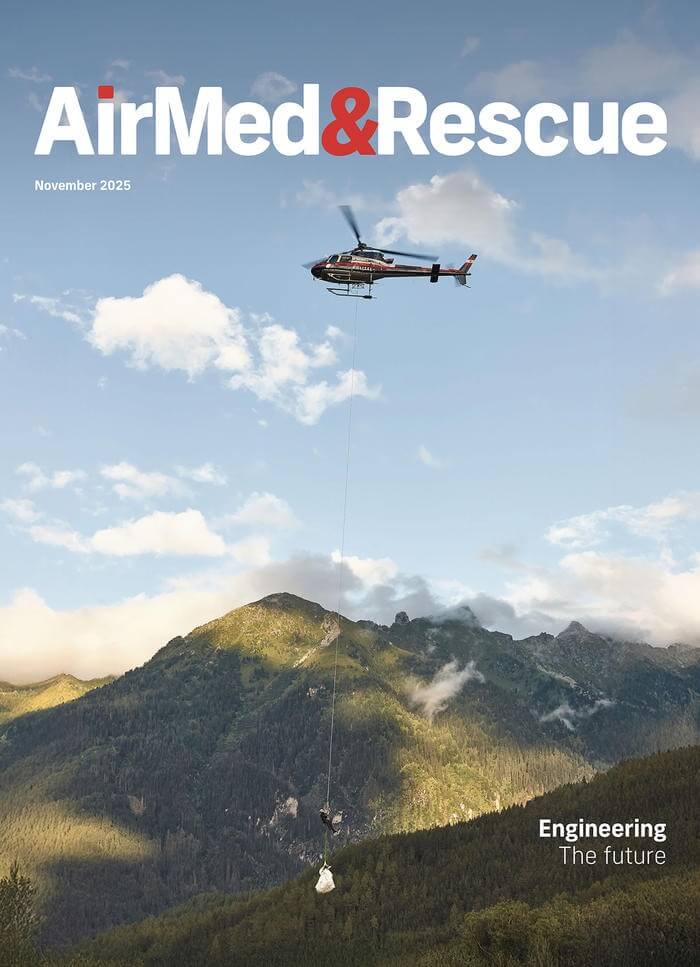
Our November edition is packed with content relating to special missions from around the world. We have features that explore the design and engineering that go into modern rotorcraft; the interactions between ground and air teams on helitack operations; the tools and attire needed for successful water rescues; and the new onboard technology that is revolutionizing special missions by detecting and communicating with cell phones.
Editorial Team
The AirMed&Rescue Editorial Team works on the website to ensure timely and relevant news is online every day. With extensive experience and in-depth knowledge of the air medical and air rescue industries, the team is ready to respond to breaking industry news and investigate topics of interest to our readers.