

Avoiding spinning during a hoist rescue

Caleb Carr, President and CEO of Vita Inclinata Technologies, describes his efforts to eliminate the risk of swing and spin during helicopter hoist missions

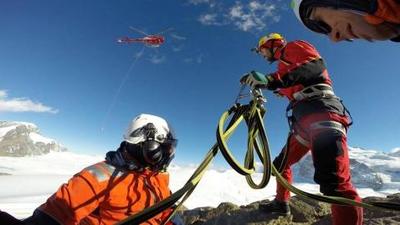
Vita Inclinata Technologies (Vita), an aerospace company based out of Denver, Colorado, is working to develop technology to eliminate the dangerous swing of helicopter hoist operations. The company originated from a hoist rescue gone bad, in which a SAR operator was pronounced dead due to cardiac arrest. Ultimately, the SAR operator was unable to be rescued because the swinging of the rescue basket was too extreme as the flight crew of the Oregon National Guard UH-60 was experiencing high cross winds and a dense tree canopy.
To solve this problem, Vita has developed the Load Stability System (LSS). The LSS leverages drone technology and control algorithms to eliminate the swing of hoist rescues (up to 1,000 lbs) in 60-knot winds. Utilising high-powered fans, the LSS provides thrust in the direction of the swing to bring the rescue basket to centre below the aircraft.
A collaborative effort
Currently the US Army and Air Force has supported the effort by providing over $2 million dollars in research and development funding to get the system operational on military rescue aircraft. On 3 July this year, representatives of the US Air Force joined Vita in ringing the opening bell of the NASDAQ, a testament to the amount of support and involvement the USAF has in the development of Vita’s technology.

Operator response
Meanwhile, the helicopter operator community is optimistic of the value that the LSS will bring to helicopter operations. “It’s a noticeable change, just from a pilot perspective. Technology like this is something that has needed to be infused into the industry for a long time. Having something that stabilises an unaccompanied load, has seemed like something that is a long time coming. I had a lot of fun flying (the LSS),” said Jon Bourke, Director of Quality Assurance, Helicopter Express.
Jon has decades of experience working as both a hoist rescue pilot and sling load pilot for the US Forest Service and had the opportunity to fly the LSS for its public unveiling at HeliExpo 2019. Jon’s sentiment is not the only reflection of the future of the LSS, many military operators have expressed an interest in seeing the system operational. One such group is the USAF 129th Pararescue squadron out of Moffet Field, California who will be trialing the system in March of 2020.
Multiple applications
The LSS’s value has also been identified as a solution for helicopter sling load operations. Following an incident on an MH-60S aircraft, pilot Lt Brian Miller, MH-60S Pilot, US Navy HSC 23, articulated the value that the LSS can bring to sling load operations: “The team at Vita Inclinata Technologies is the first to successfully demonstrate a Load Stability System that can attach to the cable of a suspended load and effectively counteract rotation and pendulum swing. With Vita’s technology, the types of incidents I experienced will be a thing of the past. The ability to precisely and effectively control an external load will save millions of dollars by preventing potential airframe and cargo damage. Plus, operating efficiencies gained by moving external loads faster and more accurately will tally up to significant cumulative savings on fuel and airframe maintenance costs.”
Looking forward
The future is bright for Vita’s LSS. With applications both in helicopter hoisting and sling load operations, plus partnerships with the US Army, US Air Force, and many more brewing internationally; the LSS will make a strong market debut in the years to come on commercial and military aircraft, saving lives, money, and time.

August 2019
Issue
In the issue:
Paris Air Show Review
Simulation training taken to the next level
Staking a claim in the Chinese rotorcraft market
Industry Voice: A crash course in risk management for SAR crew
Breaking the mould: A new anti-spin device for hoist rescues is being tested
Interview: Nicole Kunter, Managing Director, Air Ambulance Technology
Subscribe to be notified by email when the latest issue is published each month.
Caleb Carr
Caleb is President & CEO - Vita Inclinata Technologies