
In the bag: how optimized kit bags are enhancing operations

Medical kit bags must be robust, lightweight and ergonomic to ensure crew can easily carry them, even in challenging terrain. The contents – namely lifesaving equipment – must be suitably protected and easily accessible to expedite patient care in situations where every second counts. Experts share with Lauren Haigh the most crucial kit bag considerations
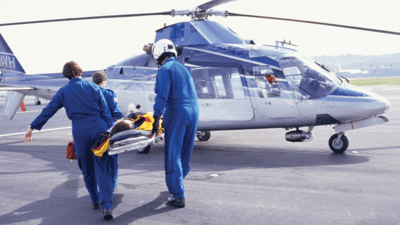
Speed and immediacy of care are two essential requirements when it comes to treating a critically ill patient. Upon arrival at a scene it is often necessary for air medical teams to walk a certain distance from a landing site to get to a patient and the path isn’t always easy to navigate. Think challenging terrains, long distances and all types of weather. The medical crew will be carrying medical kit bags supplied with everything they require to provide essential care to the patient in need. Not only do these bags need to be ergonomic and easy to carry, they also need to be organized in such a way that lifesaving equipment is readily available, allowing care to be administered with speed and agility.
Considering the key requirements for an efficient kit bag, Steffen Kruse, Global Head of Application Specialists at Weinmann Emergency, said: “From our point of view, the most important requirements for a medical kit bag are efficiency, ergonomics and easy handling for rescue service personnel.” Weinmann is a medical technology company that develops solutions to support emergency medical services (EMS) field providers and help patients. There is high demand for air medical services, and challenges such as staff shortages are impacting the industry. Combining this with the high-pressure, high-skill and time-sensitive nature of the role of air medical personnel means the work is inescapably challenging. “As everyday life in the emergency services is becoming increasingly challenging and landing sites are often in rough terrain, products such as backpacks are particularly suitable for this,” Kruse underlined. “They are practical for users, as ergonomic carrying is more efficient and sustainable.”
Careful considerations
There needs to be capacity for the equipment taken directly to the scene of medical emergencies, correct governance, and future-proofing for changes in the contents carried.
AirMed&Rescue also spoke with Gary Steward, Operations Manager, East Anglian Air Ambulance (EAAA). EAAA is a UK charity providing advanced critical care 24 hours a day, 365 days a year to the most seriously ill and injured people in the region by air and road. The charity is now being called to an average of eight critical care emergencies every day from its Norwich and Cambridge bases. Steward pointed out that there are also legal requirements to factor in. “This includes infection prevention and control (IPC) and manual handling considerations,” he stated. “There needs to be capacity for the equipment taken directly to the scene of medical emergencies, correct governance, and future-proofing for changes in the contents carried.”
The material of kit bags is a key consideration as they need to be waterproof and have high visibility, among other requirements. “The bags need to be robust and sufficiently constructed to protect the equipment in a wide range of environments, from somebody’s living room to town centers, beaches and farmland – in all weather conditions,” said Steward. Meticulous hygiene and maximizing the use of space are further important considerations that Kruse underlined. “The material of a medical kit bag should be lightweight, hygienic to prepare and have a space-saving interior layout,” he said. “This ensures improved user ergonomics and more flexibility during operations. A rucksack also has the advantage of having reflective strips to increase safety.”

Ticking all the right boxes
In collaboration, operators and kit manufacturers can work together to devise designs that are fit for purpose and able to expedite and enhance the delivery of patient care. “We are proud to have an excellent relationship with the suppliers for our main response bags, who are hugely supportive of our requirements,” said Steward. Kruse also attested to the importance of a synergistic relationship, with Weinmann working closely with users to meet specific requirements. “We are in constant communication with the users of our products and have developed a backpack based on their feedback that meets these requirements, the Rescue-Pack Plus,” he told AirMed&Rescue. “The backpack enables intuitive operation and the best possible support for the workflow. The emergency equipment is neatly stowed away, leaving the paramedics with both hands free to tackle even difficult terrain. Abseiling with the rucksack is also no problem. During development, we paid attention to a high level of ergonomics. The rucksack is also robust and lightweight.”
We can swap the individual modules rather than the entire bags, which has so many benefits, including the time efficiency when the crew is re-tasked quickly to another medical emergency
For EAAA, a modular design and color-coding ensure things work seamlessly. “The design of EAAA primary response bags, supplied by PAX, meets our needs and requirements very well,” said Steward. “They are modular inside, with removable pouch areas. This means we can swap the individual modules rather than the entire bags, which has so many benefits, including the time efficiency when the crew is re-tasked quickly to another medical emergency.
“As EAAA operates 24/7 out of Cambridge and Norwich, there could be incidents which are attended by crews from both bases. Other than blood products and medication, equipment carried needs to be interchangeable between the bases. The kit bags and contents are clearly marked, making them identifiable to each critical care team.”
Every second counts
A kit bag that was once perfectly optimized to meet a crew’s needs may no longer be suitable in future years, hence the need for continuous monitoring. “We always strive to improve and develop through innovation and research, and this includes monitoring our kit bags to ensure they remain fit for purpose,” stated Steward. “EAAA doesn’t receive any regular government funding, relying almost entirely on the generous donations of the public; therefore we always ensure best use of charity funds by reviewing the marketplace regularly. The equipment we carry (and how we carry it) needs to remain appropriate to the interventions EAAA critical care teams carry out at scene. While cost is always a consideration, we are proud to work with our kit bag suppliers to deliver EAAA’s 24/7 service. Through development and partnership working, we learn, adapt and change as we need to in order to improve outcomes for patients.”
Through development and partnership working, we learn, adapt and change as we need to in order to improve outcomes for patients
This is also the case for Great Western Air Ambulance Charity (GWAAC). As the service evolved, it was necessary to carry more and more equipment, and the UK charity’s second-generation kit bags that had been in service since 2014 were no longer fit for purpose. A revamp was in order. “We wanted to streamline processes,” said Matt, a Critical Care Doctor quoted in a 2023 GWAAC article about the crew’s new kit bags. “There are hundreds of steps to take, from arriving on scene to giving a patient treatment and getting them into an ambulance. With an overhaul of the bags, we hoped that by knocking a few seconds off each step, this would add up to meaningful minutes overall.”
GWAAC collaborated with bag manufacturer PAX to create bespoke kit bags, with funding from the County Air Ambulance Trust’s HELP Appeal. Over two years, a new kit bag system was developed, with features including a modular system with equipment organized by task and the likely order of necessity, an intuitive layout, and a pouch system to speed up re-stocking and turnaround between missions, enhancing patient care. Tim Ross-Smith, Operations Officer at GWAAC, spoke with AirMed&Rescue about the new kit bags: “The PAX bags have revolutionized how we operate. The wipe-down material allows easy and quick cleaning between calls and the modular system means that the internal pouches can be quickly swapped for a stocked spare, allowing the team to be available almost immediately for another call. Having the system on the helicopter, our three critical care cars and our training suite means everything is in the same place regardless, saving precious seconds.”

Adapt and grow
GWAAC has different bags for different requirements, with bag one, which is blue, providing essential kit for immediate care; bag two, which is green, containing additional follow-on critical care equipment; a yellow neonatal bag containing equipment required to resuscitate a newborn baby; a red blood bag containing blood transfusion equipment; and additional bags for specialist devices. Similarly, EAAA has different bags for different requirements. “We have several bespoke bags for equipment for certain interventions, including specialist percutaneous endovascular aortic resuscitation (SPEAR), and ventilation,” Steward explained.
In the future, carrying systems will become more ergonomic and flexible
Future innovations may mean new possible materials for kit bags that are more durable, waterproof and lightweight than ever before. As the kits that medical teams are using become progressively more advanced and different types of equipment are developed, kit bags will need to adapt in order to best accommodate this equipment and ensure it is readily available to medical crewmembers. “In the future, carrying systems will become more ergonomic and flexible,” said Kruse. “More and more flexibility will be required, particularly in terms of device management and charging interfaces. In addition, innovative materials will make them even lighter and more robust. Medical technology is constantly evolving, and medical kit bags must also adapt to this.”
A readiness to collaborate and innovate, along with the funding that charities require to continue their lifesaving operations, means that kit bags can remain optimized and lifesaving patient care maximized.
May 2024
Issue
In our special training edition for May, find out how operators of all sizes are using new tools and equipment to train their pilots; discover what is the latest in technology for training hoist and winch operators; learn how air medical crew remain current and up to date with the latest techniques and procedures; and find out what goes into the essential medical kit bags that are carried into the skies; plus more of our regular content.
Lauren Haigh
Lauren has worked in the publishing industry for eight years and reads and writes about healthcare, science and travel insurance on a daily basis. Her favourite aircraft is the plane from the title sequence of British educational children’s TV series Come Outside.