

The big picture: sensors in aerial policing

Police forces are upgrading their aviation assets, and more capable sensors are a key part, writes Rob Coppinger
Police forces from Europe to Australasia are improving their aircraft sensor suites, sometimes even replacing the aircraft as well, and the immediate distribution of their sensors’ data is increasingly important. Whether rotary or fixed-wing, crewed or remotely piloted aircraft, law enforcement wants electro-optical and infrared (EO/IR) video combined with location data to aid patrols and the monitoring of suspects, and for supporting other emergency services. In addition to the sensor payload technology itself, connectivity solutions are also delivering the in-demand images to police forces and their partners.
Ohio State Highway Patrol is in the process of upgrading its air assets to be able to transmit video statewide for itself and other users. A live video feed can be sent by a downlink to officers to help them direct and communicate with the same and other air units. In addition to the technology on board the aircraft, there are now nine downlink receivers across Ohio. “Essentially what we’re doing is taking data from the aircraft, in this case the video feed, those video images, and we’re sending them down to the ground and making them accessible to anybody with internet access,” said Ohio State Highway Patrol Captain Justin Cromer.
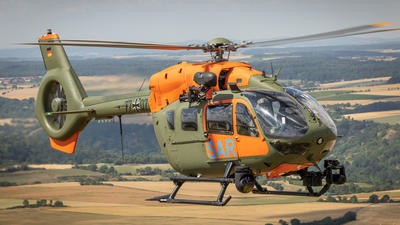
Upgrading a force's capabilities doesn’t have to be complicated or expensive, said a spokesperson from Trakka Systems: “Before Trakka, upgrading legacy assets or acquiring new technology was a complex and costly process. Our product offerings simplify this by enabling customers to upgrade their mission suite – either partially or fully – at a significantly lower cost. Additionally, we offer flexible split payment options, which allow customers with constrained budgets to invest in upgrades now and manage the remaining payments over time.”
It’s not only Ohio that is using video in a different way. “We have one product that some law enforcement are looking into – it is around video capturing,” said Flightcell Marketing Director Jonathan McWatt. “We have a product called the SmartHUB, which captures video, audio and flight data” from within the aircraft. “The cameras are still in the cockpit [and] we can add multiple cameras that can also be installed in the aircraft cabin. So that’s another product
that is gaining traction in aerial policing,” he explained.
So far, two of the helicopters and two of the fixed-wing aircraft are fitted with the video downlink technology. As we move forward, every replacement aircraft will be outfitted with it
Ohio State Highway Patrol has a long-term plan for its air units, including video for its three helicopters and 13 fixed-wing aircraft. “So far, two of the helicopters and two of the fixed-wing aircraft are fitted with the video downlink technology,” Cromer explained. “As we move forward, every replacement aircraft will be outfitted with it. We currently have a new helicopter on order.”
Capabilities and limitations
The custom aviation technology and wireless communication specialist CNC Technologies won the bid for the aircraft upgrades and the downlink infrastructure. The camera systems will be operable in rainy or foggy conditions, but there is a limit. “Generally, the limitation is if the weather’s IFR [instrument flight rules], if we can’t see physically from the aircraft to the ground, then the camera equipment is not going to be useful.”
Airborne crews also need to be able to communicate what they see in addition to the raw visual imagery, and Flightcell has also served other highway patrols with this capability. “California Highway Patrol would probably be our largest and most visible aerial policing client,” McWatt said, referring to the company’s DZMx product line. Flightcell’s DZMx is an all-in-one voice, data, and tracking system designed for rotorcraft and fixed-wing aircraft.
In Ohio, they are also giving their new aircraft the “entire mission suite”, according to Cromer, as well as the downlink technology. This includes daytime low-light EO cameras and forward-looking IR imagers. The helicopters have and will continue to have searchlights in addition to the new camera technology.
Smith Myers’ ARTEMIS product is another example of a solution selected by the emergency services to combine data services. “Law enforcement is an area where ARTEMIS is used,” Smith Myers’ Managing Director Andrew Munro confirmed. “We’ve got many law enforcement customers in Europe and North America, with a real mix of fixed-wing and rotary-wing aircraft.
“ARTEMIS is used to identify and locate people using their mobile phones. The system works without any involvement of the cellular network operators, and even in areas where there is no cellular network or the network is down for some reason. We’ve introduced different styles of capability enhancement based upon user feedback. We can now respond to and locate emergency and personal locator beacons.”
Cromer’s mission suites include search and rescue (SAR) equipment with the ability to detect personal locator beacons and identify where the emergency service units are. “We run an accident system, which is a transponder-based system, that’s able to see where the units on the ground are and pinpoint them on the mission management system so that the tactical flight officer can see where those units are.” With the location data that can be sent along with the video, the nearest units can be quickly directed to their nearby trouble spots.
We run an accident system, which is a transponder-based system, that’s able to see where the units on the ground are and pinpoint them on the mission management system so that the tactical flight officer can see where those units are
Simplicity of operation is also high on the priority list for operators and suppliers: “Trakka’s products are designed to work seamlessly together, delivering an intuitive and user-friendly experience for operators. For example, our TM-100 system simplifies mission guidance, enabling operators to lock a camera onto a location or suspect with just one button. We’ve also introduced a ‘Road Following’ feature, which allows for true hands-off vehicle tracking. These innovations reduce operator workload while increasing successful capture rates, embodying the mission-driven focus behind Trakka’s products and services,” explained a spokesperson from Trakka.

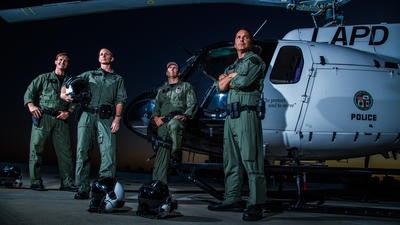
Another airborne sensor system of interest to the emergency services is Centum’s airborne search and rescue system, Lifeseeker, which uses cellular technology to locate missing persons. Spain’s Guardia Civil, France’s Gendarmerie and Germany’s Lower Saxony Police have integrated Lifeseeker into their fleets. “The system has already been certified and installed in various helicopters, including Airbus H135, [Airbus] H145, and Bell 429, allowing for easy deployment without complex modifications,” said Centum’s Digital Marketing Manager, Olalla Varela. Lifeseeker does not rely on traditional emergency beacons; it detects people’s mobile phones, even in areas without network coverage.
Our TC-300 and TC-375 camera packages, along with the TLX and TL-360 searchlight packages, are multi-spectral, ensuring visibility in any weather condition – be it sand, dust, haze, fog, rain, or snow
The weather and other meteorological confounders can limit mission success, so there have to be adaptations and systems to help penetrate and circumvent these obstacles, added a spokesperson from Trakka: “Our TC-300 and TC-375 camera packages, along with the TLX and TL-360 searchlight packages, are multi-spectral, ensuring visibility in any weather condition – be it sand, dust, haze, fog, rain, or snow. These systems enable operators to maintain clear visibility and effectively put eyes on the target, no matter the environmental challenges.”
Fleet improvements
The Western Australia Police Force Air Wing is planning to upgrade its air assets for a total cost of A$15.8 million. The upgrade is a mixture of purchasing a faster jet and completing other aircraft improvements. The Air Wing has Airbus H145 helicopters, a Cessna Caravan and a Pilatus PC-12. The PC-12 is used for transportation. Western Australia Police Superintendent Paul Daly explained that Western Australia is the world’s largest police jurisdiction. With such a vast territory, the Air Wing can take six hours to get to any destination, hence the need for speed. The expectation is that the first of the new improved aircraft will be delivered in the first quarter of 2026.
The Air Wing is also planning to invest in a large drone for higher-altitude surveillance, intelligence deployment and other intelligence, surveillance and reconnaissance tasks. The Wing already uses small drones, such as DJI products, and has up to 100 of what Daly calls the “civil type”. For the large drone, the Western Australia Police Force is working with Airservices Australia, which manages the country’s controlled airspace, and the civil aviation regulator, Civil Aviation Safety Authority. “We’ll need to do a proof of concept. So that should be 18 months, two years,” Daly said.
The increased use of drones is a way of carrying out more surveillance at less cost. “Law enforcement are always craving situational awareness. You don’t want to go into a job not knowing everything, so drones [supply] that stream of intelligence that provides that situational awareness,” Daly said.
Law enforcement are always craving situational awareness. You don’t want to go into a job not knowing everything, so drones supply that stream of intelligence that provides that situational awareness
Large drones offering more extensive surveillance and other capabilities is a focus for UK policing. National Police Air Service (NPAS) Futures and Innovation Head David Walters explained: “We’re hoping early to mid-July is when our [drone] flight trials will start. We’re just going through all the regulatory processes with the regulator,” he said, referring to the Service’s plans to test fly a beyond visual line of sight (BVLOS) capable Schiebel helicopter drone. The regulator is the UK’s Civil Aviation Authority. “The trial itself is really enabling us to validate that an uncrewed aircraft, which the Schiebel is categorized as because of its weight and its size, has an ability to carry an equivocal payload.”
NPAS wants to continue using the WESCAM MX-type payloads it already uses.
“The [EO/IR] MX-10, MX-8, that’s what we have on our existing H135s and also on our fixed-wing systems as well,” Walters said, explaining that they need to use the same sensors because, in his view, any reduction of sensor capability puts the public at a higher risk. “If it’s a missing person, if there is a slight chance that we would downgrade our payload capability, then, for me personally, I am putting a potential missing person at risk.” So, using the sensor payloads will be an important part of the trials to take place over Avonmouth Docks at the Port of Bristol.
The future drone’s sensors may be an improved product, new to the market, because of the importance NPAS places on them, especially with BVLOS operations. Walters foresees a procurement process to select future sensor payloads and he noted that the WESCAM MX-15 is now out on the market. This has EO and shortwave IR and a thermal imager. “It would likely be something around the MX family that would be adopted for the uncrewed aircraft,” he said. He expects artificial intelligence (AI) to be employed for image analysis too.
Demonstrations of AI and its application to imagery from WESCAM MX EO/IR systems were carried out last year by L3Harris in collaboration with Overwatch Imaging and its Automated Sensor Operator software. The demonstrations took place in Loveland, Colorado, and involved an AI detecting objects, targets and situations in imagery collected through L3Harris’ sensor systems.
Mission suitability
Another company offering AI is Italy’s FlySight. Its OPENSIGHT Mission Console is equipped with the company’s Automatic Target Recognition that enables real-time detection of individuals or unauthorized drones, for example. Offered for border surveillance and SAR operations, FlySight states that OPENSIGHT can be integrated with third-party AI solutions, enhancing its adaptability to various missions.
As law enforcement agencies make use of the range of platforms, so manufacturers of equipment respond to making sure the tools are suited and applicable on each, explained a spokesperson from Trakka: “The TrakkaCam product line is extensively utilized by law enforcement and federal government agencies on fixed-wing, rotary-wing, and drone systems. What distinguishes our camera systems is their unparalleled ease of integration, driven by standard aviation connections, ethernet communication capabilities, and a small cable diameter design. This allows us to seamlessly connect with the majority of aircraft in service today.”
While the Schiebel has been chosen for the NPAS trial, Walters expects another, unidentified, drone platform to be selected, which will still be rotary wing. He expects it will have a de-icing capability and will be able to cope with higher wind speeds than crewed aircraft can, and lower cloud levels. Urban pursuit is one particular activity he sees a future large drone participating in, and flight time endurance for this mission is important. The UK police’s H135 helicopters are limited to around two hours of flight time, depending on crew and fuel.
The fixed-wing aircraft that they also operate have a longer endurance of about six hours, while the Schiebel can fly for six to eight hours, according to Walters. But the plan is for an endurance of almost double that. “The [drone] aircraft that we’re identifying potentially for the future can fly up to 12 hours.” The longer the endurance, the better, as when “you have a large search and rescue operation going on for a vulnerable missing person, especially over a day, you really want to maximize the number of hours that you can be on scene,” he added.
The longer the endurance, the better, as when you have a large search and rescue operation going on for a vulnerable missing person, especially over a day, you really want to maximize the number of hours that you can be on scene
And when will this new rotary-wing BVLOS uncrewed platform be operational? “We're not envisaging until probably 2028, 2029. If the trials are successful, that is when this capability might come into play,” Walters predicted.
From urban pursuit to extreme weather, where law enforcement plays a central or supporting role its air assets are growing in number and capability. Not just accessible to the flight crew, airborne imagery can also now be shared with the other emergency services for a more rapid response. Small drones have played an increasingly large part in police work, but now the prospect of BVLOS remotely piloted rotary craft will extend the reach of their operations. With more capable aircraft and more sensors, law enforcement is guaranteed a bigger picture.
July 2025
Issue
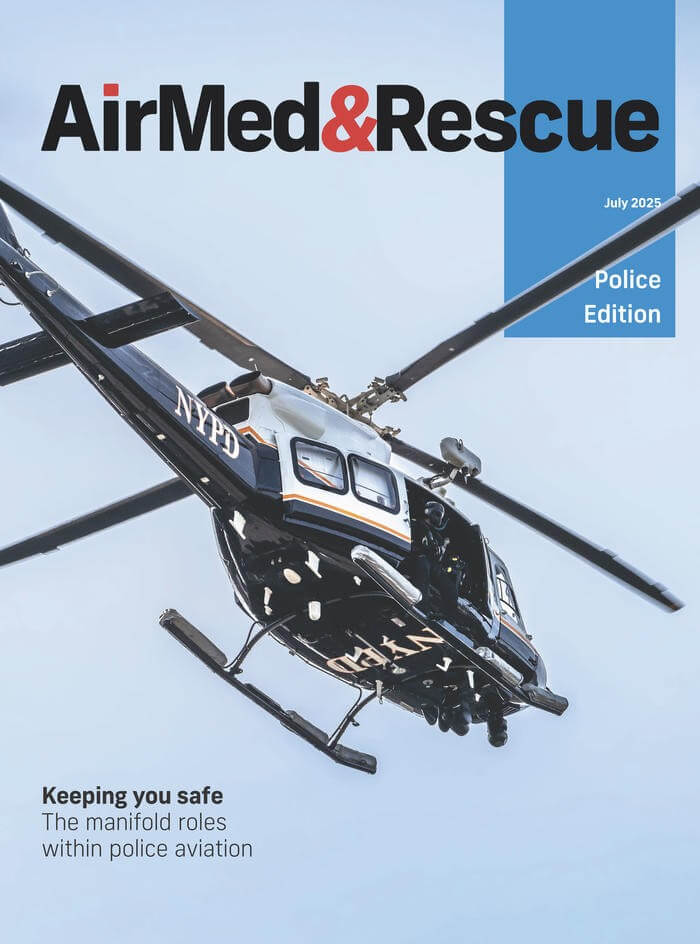
Our July edition highlights police aviation with features on how sensor technology is being used, the other aspects of policing beyond law enforcement, and the challenges of border control. We also have an interview with a police inspector, a gallery from the US Customs and Border Protection, and a provider profile of the US Park Police. Additional features include recruitment and retention, and manikins for special missions and medical training; plus we have more of our regular content.
Rob Coppinger
Rob Coppinger is a veteran aerospace writer whose work has appeared in Flight International, on the BBC, in The Engineer, Live Science, the Aviation Week Network and other publications. He has covered a wide range of subjects from aviation and aerospace technology to space exploration, information technology and engineering. In September 2021, Rob became the editor of SpaceFlight Magazine, a publication by the British Interplanetary Society. He is based in France.