
Bluedrop’s flexible solutions for rear-crew training

Jean-Claude Siew shows how the demonstration of rear-crew training simulation systems led to immediate benefits, and a flexible approach meant that these advantages were able to be attained quickly
A defense organization facing mounting operational demands and constrained training capacity found itself at a critical inflection point. Its aircrew and mission specialists were expected to perform increasingly complex hoist and gunnery operations in dynamic environments, yet access to live training assets was limited, costly, and often logistically impractical. The gap between required proficiency and available training opportunities was widening and prompting the organization to explore alternative solutions.
The turning point came when the organization was introduced to Bluedrop’s mixed reality (MR) / virtual reality (VR) Hoist Mission Training System (HMTS) and Multipurpose Gunnery Mission Trainer (MGMT). Initially approached as a demonstration, the experience quickly evolved into a revelation. Unlike traditional simulators, these systems delivered a high-fidelity, immersive training environment that replicated real-world mission conditions with remarkable accuracy. Aircrews could practice hoist procedures in challenging scenarios – night operations, confined spaces, maritime rescues – while gunners engaged in realistic target acquisition and engagement exercises, all within a safe and controlled setting.
What stood out immediately was not just the realism, but the flexibility. Training scenarios could be rapidly configured, repeated, and adapted to specific mission profiles. Instructors were able to pause, debrief, and reset exercises in ways that are impossible during live training. The organization quickly recognized that these systems could dramatically accelerate skill acquisition while reducing reliance on limited flight hours.
However, a significant challenge remained. Like most advanced training systems, HMTS and MGMT require a build and delivery timeline of approximately 10 to 12 months. For an organization already facing urgent training shortfalls, waiting nearly a year was not a viable option.
Rather than allowing this constraint to stall progress, Bluedrop proposed an alternative approach: Sim-as-a-Service (SaaS). This model enabled the organization to access fully operational training systems without the delays associated with procurement and manufacturing. By deploying readyto-use simulators through a service-based offering, the organization could begin training almost immediately.
The impact was immediate and measurable. Personnel who previously had limited exposure to complex hoist and gunnery operations were now training regularly in high-intensity, scenariodriven environments. The frequency and consistency of training increased, and instructors gained new tools to assess performance and tailor instruction.
As the systems became integrated into the organization’s training ecosystem, a deeper transformation began to take shape. Training methodologies evolved. Rather than relying primarily on live exercises supplemented by occasional simulation, the organization shifted toward a simulation-first approach. Foundational skills and advanced mission scenarios were developed and refined in the virtual environment before transitioning to live operations. This not only improved readiness but also optimized the use of costly flight assets.
Eventually, the success of the SaaS deployment led to a long-term commitment. The HMTS and MGMT systems are now permanently installed at the organization’s training location, forming a central pillar of their training infrastructure. What began as a solution to an immediate availability problem has become a strategic capability.
This case illustrates a broader shift in defense training: the move from assetlimited, schedule-constrained models to flexible, technology-enabled ecosystems. By combining high-fidelity simulation with innovative delivery models like Sim-as-aService, organizations can rapidly close training gaps, adapt to evolving mission requirements, and ensure their personnel are prepared for the complexities of modern operations.
Jean-Claude Siew
Jean-Claude has accumulated over 35 years’ experience in the aerospace and defense industry. He is currently the Executive Vice President for Technology and Simulation at Bluedrop Training & Simulation.
Jean-Claude has expertise in training and simulation, and technology leadership. At Bluedrop, his main focus is on business development, innovation and leading edge training products for aerospace and defense.
Jean-Claude has successfully held key roles at CAE including Director of Business Development, Vice President for Visual Systems, and Vice President Systems Engineering. He has experience in setting up affiliate companies outside Canada and more recently in Orlando, Florida, for Bluedrop.
Jean-Claude earned his bachelor’s degree in Mechanical Engineering, Aeronautics from l’École Polytechnique de Montréal in 1986.
May 2026
Issue
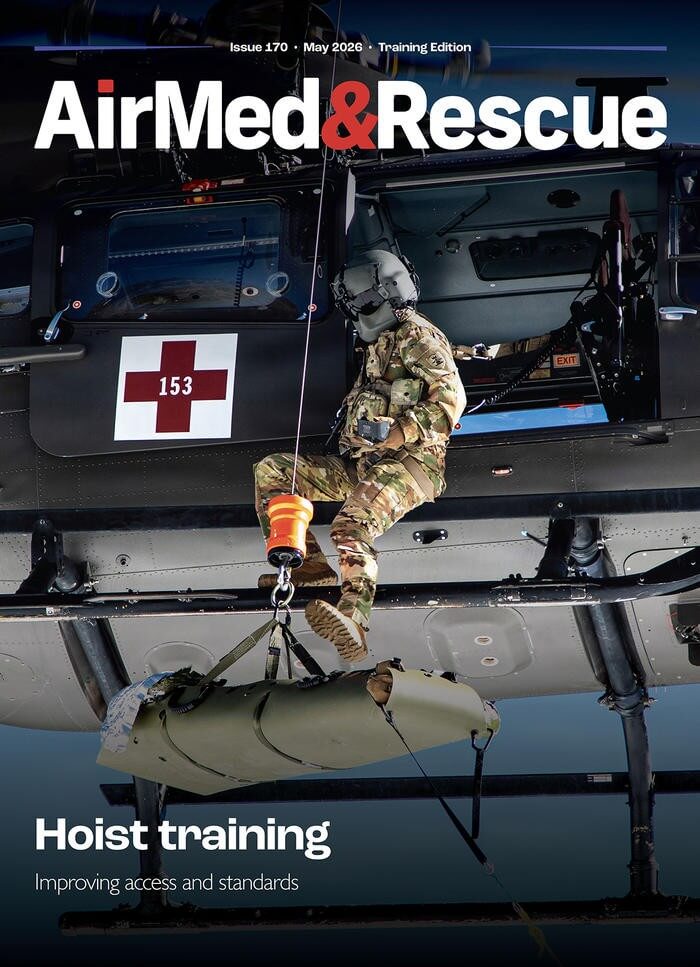
Training for special missions is on another level, so it’s a great pleasure to bring you the training edition of AirMed&Rescue for May. We have features on night flights for police aviators; the simulators for military special missions training; the systems and scenarios for hoist operations; and engineering training for airframe and powerplant mechanics.
Editorial Team
The AirMed&Rescue Editorial Team works on the website to ensure timely and relevant news is online every day. With extensive experience and in-depth knowledge of the air medical and air rescue industries, the team is ready to respond to breaking industry news and investigate topics of interest to our readers.