
Building the next phase of connected operations at Vellox Group

Since bringing together five aviation software providers under one group, Vellox has focused on a fundamental industry challenge: how to better connect the systems that underpin day-to-day operations. Aleks Banas, CEO of Vellox Group, talks about the company’s roadmap and what operators can expect next
Over the past year, Vellox has brought together multiple platforms. What is the focus as you move into this next phase?
The first phase was about bringing strong products together under one group – across dispatch, operations, safety, fleet tracking, and maintenance.
We’ve already built strong integrations across those products, and customers are seeing real value from that connectivity today.
The next step is to bring those capabilities together into a truly unified platform – where teams aren’t just connected, but operating within a single, consistent system.
That means making it easier for information to move across workflows, and ensuring every team is working from the same operational picture.
What are the key areas of development within the Vellox roadmap?
There are three main priorities.
First is platform unification – things like single sign-on and shared data foundations. That creates a more consistent experience across products.
Second is operational visibility. We’re investing in reporting and dashboards that bring together operational, safety, and fleet data, so teams can see what’s happening across the organisation in one place.
Third is workflow continuity. Today, different stages of a mission – from initial request through to dispatch and execution – can sit across multiple systems. We’re focused on connecting those steps into a more seamless flow.
Alongside that, we’re continuing to invest in each product area – dispatch capability, fleet tracking, maintenance, and safety – so every part of the platform continues to evolve in its own right.
How do these developments translate into practical improvements for air medical and rescue operators?
It comes down to clarity and coordination.
In air medical operations, teams are working with a lot of moving parts – aircraft readiness, crew availability, operational constraints – often across different tools.
For example, when a mission request comes in, dispatch needs to quickly understand aircraft status, crew legality, and any operational limitations. When that information is connected, decisions can be made faster and with greater confidence.
As systems become more unified, it becomes much easier to bring that information together into a shared operational picture.
That allows dispatchers, operations teams, and maintenance teams to make faster, more informed decisions, with greater confidence in the data they’re working from.
Where do you see the industry heading over the next few years?
We’re seeing a clear shift toward more integrated operational platforms.
As operations become more complex – particularly in emergency medical services (EMS) and multi-mission environments – the ability to connect data across dispatch, operations, safety, and maintenance becomes increasingly important.
At the same time, there’s growing focus on data-driven decision-making, especially in areas like safety and risk management.
That’s where technologies like AI and automation will play a role – helping teams process information more effectively and support better decisions.
But the goal isn’t to replace human expertise. It’s to give operators better tools, better visibility, and a more connected foundation to work from.
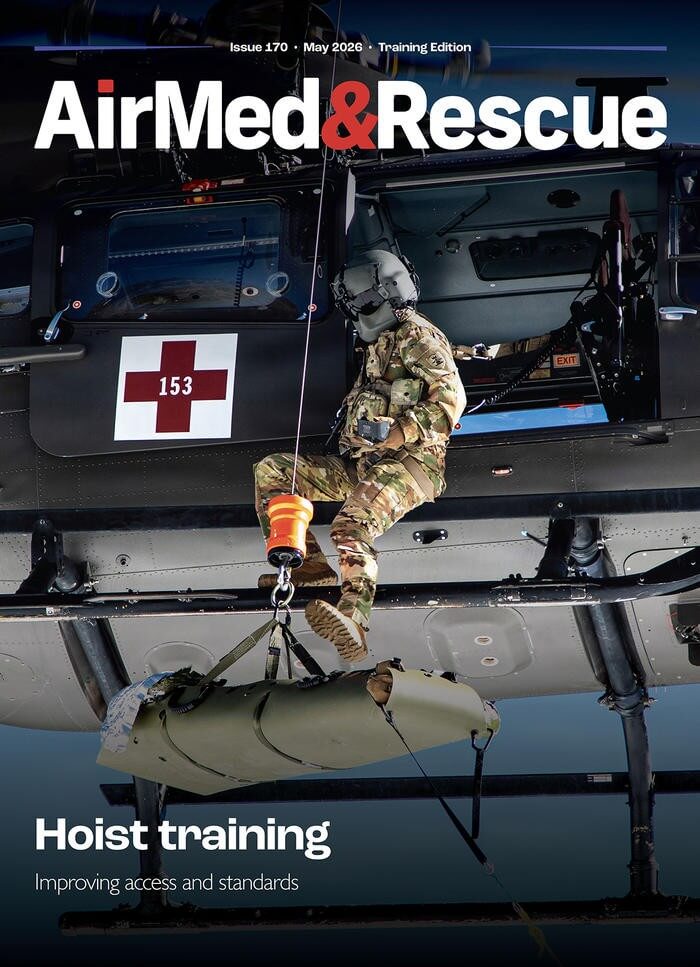
May 2026
Issue
Training for special missions is on another level, so it’s a great pleasure to bring you the training edition of AirMed&Rescue for May. We have features on night flights for police aviators; the simulators for military special missions training; the systems and scenarios for hoist operations; and engineering training for airframe and powerplant mechanics.
Editorial Team
The AirMed&Rescue Editorial Team works on the website to ensure timely and relevant news is online every day. With extensive experience and in-depth knowledge of the air medical and air rescue industries, the team is ready to respond to breaking industry news and investigate topics of interest to our readers.