
Changes to ICAO Annex 14 - helipad firefighting standards

The current ICAO Annex 14 will likely be amended next year to include significant changes, especially in terms of firefighting requirements for helicopter landing platforms. Sébastien Hingant, Area Sales Manager for Bayards Heliport Solutions details the changes, and asks: is your helipad’s firefighting system going to meet the new regulations?
In the wake of existing national regulations such as CAP437, new-generation firefighting equipment is progressively recommended in order to meet with the new applicable requirements for response times. According to the anticipated amendment of ICAO Annex 14, chapter 6, the main objective here is ‘[…] to be effective in bringing a fire under control within […] one minute’, with activation of the firefighting equipment within the first 15 seconds of fire ignition. The firefighting equipment in this case can consist of both active and passive systems, the latter being described as ‘[…] a perforated surface, containing numerous holes that allow burning fuel to rapidly drain through the surface into the deck chambers which function to remove the heat from the fire and starve it of oxygen’.
Deck Integrated Fire Fighting Systems (DIFFS) and passive fire-retarding surfaces have proven their efficiency in reaching this goal, as their automatic activation offers a safer solution to fight fires, even when no firefighters are present. Traditionally being used on offshore helidecks, DIFFS and passive fire-retarding surfaces have now become more common on onshore helipads as well. ‘Given the efficiency of passive firefighting systems in addressing running fuel fires, especially when combined with an ‘active’ water-only DIFFS’ the new ICAO Annex 14 will pave the way for onshore decks to be equipped according to these standards as well.
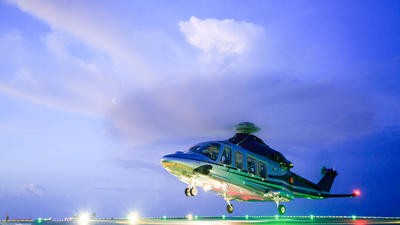

Bayards Heliport Solutions has developed a fire-retarding surface called SafeDeck, which is less environmentally hazardous, as it requires smaller quantities of liquid to put out on-deck fires. Since it doesn’t require foam either, fewer chemicals are used. This system allows a quasi-instantaneous drainage of all liquids at the surface. Despite the fact that a foam blanket can’t be formed on the perforated surface, the system is still very efficient, thus allowing it to be supplemented with a water-only DIFFS. Consequently, the use of a water-only DIFFS reduces the treatment of sewage after activation of the system, which is environmentally beneficial as well.
the use of a water-only DIFFS reduces the treatment of sewage after activation of the system
Case study
An example of SafeDeck can be found in Sweden. The city of Umeå’s university hospital helipad is the first hospital helipad to be equipped with a combination of both passive and active firefighting equipment, combined with electrical heat-tracing. Bayards Project Manager Jaap-Adriaan Jongekrijg: “The Norrlands universitetssjukhus’ helipad is a truly eco-friendly heliport solution, as it is insulated from the bottom, guaranteeing minimal heat loss and thus maximum efficiency when the electrical heat-tracing is activated during fall and winter. In addition, its water-only DIFFS uses smaller quantities of liquid to activate the system. And because there is no environmentally hazardous foam involved, there is no need for specific and expensive treatments such as a dedicated tank for foam storage, apart from the standard fuel water separator.”
September 2019
Issue
In this issue:
When the lights go out: The challenge of nighttime rescues
Digital dream: MRO software solutions
Interview: Samir Mehta, President of Collins Aerospace’s Mechanical Systems
Case Study: TrustAir reports on a neonatal mission
Industry Voices:
- ICAO Annex 14 amendment – is your helipad ready?
- The cost of reimbursement of emergency medical flights in the US
Special report: Blood delivery by zipline
Med Insight: Airway management training