

Complexity, data, and the wildland firefighting operation

Todd O'Hara, CEO of TracPlus, explains the value of data for airborne special missions, such as aerial firefighting, and why it shouldn’t be overlooked in an increasingly complex and challenging operational landscape
When a government agency asks its operations leadership to account for a season of aerial firefighting, the question is straightforward: what did we get for the money we spent?
The answer, in most programs, is harder to give than it should be. There is cost data. There are acres burned and fires managed. What is largely absent is a verified operational record of what aircraft actually did, where, when, and to what effect. The information that would connect spending to performance either does not exist in a usable form or has to be reconstructed from manual logs after the fact.
This is not a technology gap. It is a data infrastructure gap, and it exists because the systems that run aerial firefighting were never designed to answer performance questions. They were designed to track hours flown.
THE INDUSTRY BUILT FOR HOURS, NOT OUTCOMES
Aerial firefighting has operated on a simple commercial model for decades: agencies contract aircraft, and they pay for hours. The information systems that grew around that model reflect it. They record who flew, how long, and at what rate. They were not built to capture what happened operationally during those hours.
That model worked when seasons were shorter, budgets were smaller, and public scrutiny was less intense. It is not working now. Suppression costs have increased materially over the last 15 years. Seasons are longer and operations are larger. Governments, oversight bodies, and the public are asking whether increasing spend is delivering proportional results. The data to answer that question does not exist in most programs.
The people managing these operations feel this gap daily. Dispatch teams assemble fleet pictures from sources that were never designed to talk to each other. Training coordinators check crew currency against flight records held in a separate system. Finance teams reconcile costs across aircraft types and jurisdictions using spreadsheets that are out of date before they are finished. None of this is done badly. It is done as well as those tools allow.
The problem is that when accountability arrives, the sum of those individual efforts does not add up to a defensible record.
WHAT CHANGES WHEN THE DATA IS CONNECTED
A system of record that captures operational data at the point of activity changes what an organization can do with that information.
A dispatch team working from a connected operational picture knows not just where an aircraft is, but what it is doing, how long it has been in that state, and what comes next. A training coordinator checking crew currency draws from the same flight data the finance team uses for cost reconciliation. A base manager responding to an inquiry pulls from the same dataset going into the formal report; no transfer, no reconstruction.
Connected records also make it possible to reconstruct what actually happened after a significant incident or a demanding season. What was where, what was done, when decisions were made. That operational account is what turns a difficult post-season conversation into a defensible one.
CAL FIRE manages one of the world's largest aerial firefighting programs. Australia's National Aerial Firefighting Centre coordinates operations across every state and territory. Both run TracPlus as their system of record, using our FireFlyte platform to connect operational data across their programs, apply business logic at the point of capture, and deliver information to the teams that need it in a form they can use.
THE QUESTION THAT IS NOT GOING AWAY
The accountability pressure on aerial firefighting leadership is intensifying globally. Agencies that cannot connect what they spent to what they achieved are carrying an exposure that grows with every season. Gaps in performance records and data that cannot be independently verified take time and credibility to recover from.
The organizations that have addressed this have done it by treating operational data as infrastructure, not reporting. They capture it automatically, apply context at the point of entry, and make it available across every function that depends on it.
The complexity is real for every team in an aerial firefighting operation. Pilots, ground crews, training coordinators, finance teams, and the leadership above all of them are carrying more than they were a decade ago, and the pressure is not easing. The question is whether the information infrastructure beneath them is making that complexity manageable or adding to it.
June 2026
Issue
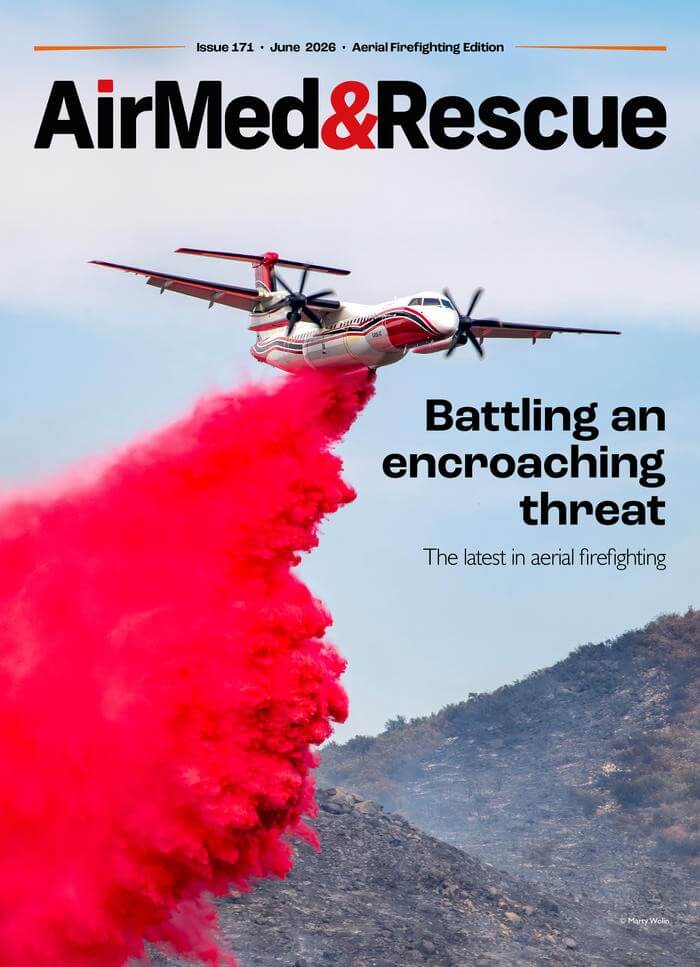
As the northern hemisphere heats up for another hot summer, I’m pleased to bring you the aerial firefighting edition of AirMed&Rescue. We have features on how climate change is accelerating firefighting technology; the improvements in Australian firefighting capacity; and getting ahead of wildfires before they become unmanageable.
Editorial Team
The AirMed&Rescue Editorial Team works on the website to ensure timely and relevant news is online every day. With extensive experience and in-depth knowledge of the air medical and air rescue industries, the team is ready to respond to breaking industry news and investigate topics of interest to our readers.