
The craft of fire suppression

The extraordinary demands placed on aerial firefighting craft must be taken into account when selecting or fitting out aircraft for this purpose. Mario Pierobon finds out how firefighting organizations ensure their fleets are best equipped for safe and successful missions
Aerial firefighting aircraft have very specialized requirements and different needs for different situations. There are specific considerations to be made for purchasing aircraft to fight fires or modifying existing aircraft. In this feature, we have reached out to industry experts to assess the operating environment, options and upgrades available, and hear how upgrades are implemented.
A different, more demanding, environment
Large land-based airtankers are made by taking civilian or military aircraft and converting them into airtankers by stripping unnecessary weight, such as seats, and incorporating a tank and drop system. To understand the unique criteria required to modify an aircraft into an airtanker, one has to consider the different flight environments both are exposed to in order to evaluate which aircraft type might be best suited for conversion. Michael Benson, Director of Business Development at Conair Aerial Firefighting, illustrates, for example, that a civilian aircraft could be fully loaded with passengers and enough fuel to make a one-hour flight. “It takes off, it climbs to 25,000 feet, it is pressurized and cruises in roughly a straight line. Just prior to arrival, it depressurizes while it descends for landing. The aircraft is assumed to be subjected to average turbulence and relatively minor flight maneuvers. This is a very typical flight profile for a certified civil aircraft,” he said.
With the science of fracture mechanics, cracks in metals grow at a predictable rate when the magnitude of the load and the number of cycles the aircraft has been subjected to are known, observed Benson. “When an aircraft is flown within the defined safe flight parameters for which it was certified, a straightforward maintenance program is implemented,” he said. “This civil flight environment is predictable, and so is fatigue damage. A civil certified aircraft maintenance program, supplied with the aircraft, is based on this assumed standard flight.”
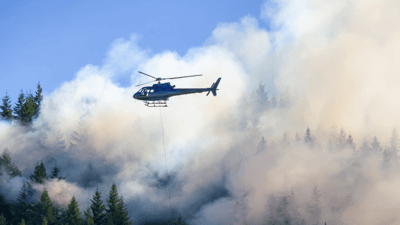
If the same aircraft is converted into an airtanker, responding to a wildfire, the airtanker takes off with a full tank of retardant and enough fuel for three hours of flight, explained Benson. “The airtanker takes off from Abbotsford, climbs to 25,000ft, it descends about half an hour later to 3,000ft – partially depressurizing, it flies over a forest fire in a relatively gusty environment. It then performs a series of low-level maneuvers and descends to 125 feet above ground level. It performs a retardant drop, instantly losing 30% of the airtanker’s total weight; this is followed by a pull-up and bank maneuver, then the airplane ascends and repressurizes to 25,000ft,” he explained. “The airtanker then returns to Abbotsford to land for a reloading of retardant and possibly to refuel. The firefighting cycle involves multiple pressurization cycles, more low-altitude maneuvers, and is exposed to a gustier environment. It is clear that the typical aerial firefighting cycle flown by a tanker is more damaging to the airframe than the typical civil cycle flown by a commercial aircraft.”
The mission of an airtanker exposes the airframe to a significant increase in both the magnitude and frequency of g loading above the passenger/cargo mission, affirmed Benson. “Transport Canada requirements ensure that this more challenging environment is taken into account both in the static strength of the aircraft and in the maintenance inspection program for the entire life of the product,” he said. “Recognizing this different role, Transport Canada has mandated, as part of the special conditions, a specialized maintenance program that assists the operator in finding and repairing fatigue damage that may occur as a result of flying in the extraordinary conditions and roles seen by aerial firefighting aircraft.”
The correct application of Transport Canada’s special conditions requires that the limit of validity, or life, of a tanker is reduced compared to the same aircraft used for exclusively civil purposes
In addition to leading to increased structural inspections, the more severe firefighting flight environment typically also results in a reduction in the safe operational life of the aircraft, explained Benson. “The correct application of Transport Canada’s special conditions requires that the limit of validity, or life, of a tanker is reduced compared to the same aircraft used for exclusively civil purposes,” he said. “These considerations, both limited life and increased maintenance, ensure safe operations.”
In the helicopter domain, when purchasing a new aircraft, most of the time the ideal is for the helicopter to have multi-role conditions so that it can be used in several missions, according to Loreto Moraga, president of the Chilean Helicopter Association (ACHHEL). “If, however, it is an aircraft intended for a specific mission such as firefighting in different areas, then to obtain the best water launch performance compared to operating time it is necessary to consider three variables,” she said. “Firstly, it is necessary to evaluate whether the aircraft has additional equipment or accessories that will not be used for this mission; secondly, it must be considered that the aircraft must be equipped with hardpoints or firefighting provisions, so that with the acquisition of the mobile equipment (removable parts), the equipment is ready to operate. Finally, consideration must be given to the location of the operation in terms of terrain elevation as it is different to operate water launch at sea level or in mountainous areas at 5,000ft or more.”
The equipment must guarantee flexibility of movement, speed of loading and unloading, but the formula is completed with a correct estimate of the operating and maintenance costs associated with the type of aircraft, affirmed Moraga: “It is based on this figure that a better decision can be made to determine the appropriate equipment and aircraft type.”

Options for aerial firefighting
Indeed, wildfire agencies use both fixed-wing and rotary-wing aircraft for aerial fire suppression. “In British Columbia, Canada, the government agency air attack officer commands the aerial firefighting strategy over a fire, directing airtankers where and when to drop, communicating with all pilots in the air plus firefighter personnel on the ground,” said Benson. “Conair operates bird dog aircraft, from which the air attack officer monitors the fire, plus both small and large airtankers, each type appropriate to specific geographies, vegetation, urban interface, and water sources. We have amphibious aircraft, including 15 Fire Bosses, which fly in groups of four, skimming from smaller water sources, consecutively dropping water on the fire to cool flames. We also have a CL415 fleet of four, which fly in pairs, operated by our subsidiary in the USA, Aero-Flite.”
The land-based airtankers operated by Conair also include smaller AT802 wheelies and large RJ85 and Dash 8-400AT airtankers, all of which drop retardant, explained Benson. “Retardant is delivered around the perimeter of a fire to slow combustion, slowing fire spread, while waterbombers drop directly on flames to cool the intensity, buying firefighters time on the ground to contain the fire,” he said. “Both water and retardant are needed on extreme wildfires, which generate so much heat and wind that water is evaporated sometimes before hitting the ground.”
Both water and retardant are needed on extreme wildfires, which generate so much heat and wind that water is evaporated sometimes before hitting the ground
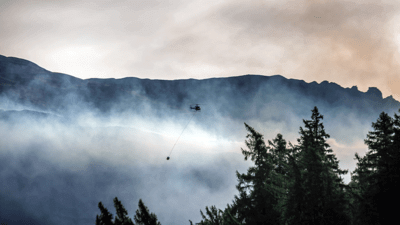
In terms of rotary-wing assets, there are several options for aerial firefighting organizations, the convenience of which depends on the areas of operation and what is required by the contracting party for the services, according to Moraga. “As basic equipment, a bag is required to transport water that will hang under the helicopter (Bambi Bucket). This can be found with different capacities and of different types, for example allowing the pilot to select whether to release the product or water in a progressive or regulated manner and/or all at once,” she said.
There is also the cable that supports the Bambi Bucket, which can be a standard short line or long line, highlighted Moraga. “Its use will be determined by the aircraft that uses it, the type of product or water launch, the maneuverability or flexibility of movement provided by the length of each line, and the orography of the area,” she said. “Regarding water extraction, there are also various ways. The standard is inserting the Bambi into a water collection pond, in a lake, or in a river where there are pools of water. There is also the possibility for the Bambi Bucket to be equipped with the PowerFill shallow water pumping system.”

An example of aerial firefighting equipment upgrade is the Flight Envelope Advisory System (FEAS) developed by Conair and certified by Transport Canada, which uses modern technology to enhance safety in firefighting operations. “The proactive tool is designed to let pilots know when an airtanker is approaching flight envelope exceedances and excessive G loads, thus minimizing the impact to the airworthiness of the airframe,” said Benson. “We are continually looking for ways to improve, whether it is through new materials to make the aircraft lighter, allowing it to carry a greater payload, or technologies that help keep our crews safe.”
We are continually looking for ways to improve, whether it is through new materials to make the aircraft lighter, allowing it to carry a greater payload, or technologies that help keep our crews safe
Aircraft manufacturers and specialized equipment suppliers constantly carry out research to obtain improvements for the different stages of the extinguishing operation. In this process, the feedback from operators is important, allowing areas of improvement to be highlighted, affirmed Moraga. “Currently, fire extinguishing is carried out by large, medium, and small aircraft, and the differences between them are the payload and product launch capacity, the maneuverability for entry to launch depending on the orography of flat or mountainous terrain,” she said. “With these considerations, it is very important that the contractors in general observe that the operating limits of the aircraft are not exceeded, the current regulations are observed, crew rest times are respected and, finally, the state of maintenance of the aircraft and the launch equipment is verified in terms of respecting the maintenance schedule rigorously.”
Implementation of upgrades
Aerial firefighting equipment upgrades are motivated by the contracting party and/or the air operator based on water launch safety and efficiency in order to obtain a better index or performance, said Moraga. “Certainly, the upgrade initiative will be influenced by the contracting conditions of the services; when they are longer-term, there will be an incentive and the certainty of income flows that will motivate the operator to make long-term improvement decisions,” she said. “If the contracts are short-term, only for a season or ‘spot’ contracts, operators will only see the immediate operational needs, possibly ignoring longer-term investments.”
Conair performs technical services in-house under Transport Canada’s delegation and authority. “This oversight provides wildfire agencies the security of knowing airtankers are maintained to the most stringent levels in the world to ensure safe operations,” affirmed Benson. “We have an in-house staff of aeronautical engineers, meaning we can design, build, and certify innovative products which improve an airtanker’s operation and effectiveness. Our in-house expertise allows us to better manage and mitigate risk for both Conair and our customers. We want to ensure the tanker is ready to respond when called out and not grounded for repairs.”
March 2024
Issue
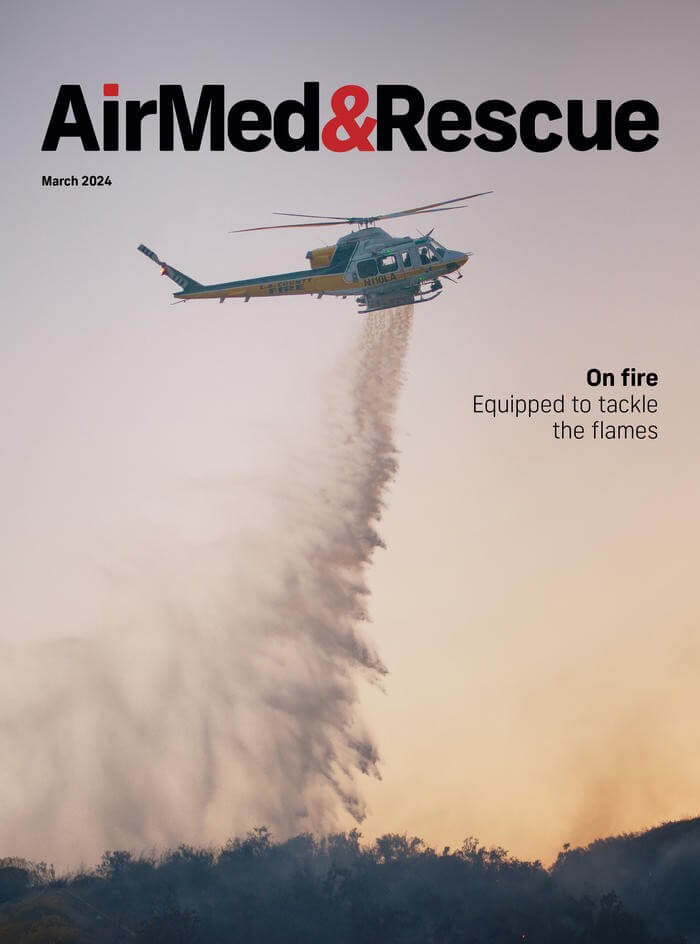
In the March edition, get transported in flying medical units; see how digital cockpits can improve your workload; discover how different firefighters use different tools, equipment and craft; and discover the innovations and improvements to aerial firefighting coming out of the American west coast; plus more of our regular content.
Dr Mario Pierobon
Dr Pierobon is a safety management professional in low probability, high consequence industries, with a focus on fixed- and rotary-wing aviation operations. He supports organizations through systemic risk assessment, customized training, procedural development, compliance verification, and documentation support. Holding a PhD in Transport Systems from Cranfield University and having worked at IATA headquarters in Montreal, he writes widely for industry publications and is recognized for his systemic approach to safety.