
Creating pathways that develop competence, confidence, and resilience

With 20 years of experience in aircraft, Trevor Abraham, Managing Director of Air Rescue UK, is leading Air Rescue UK to become the gold standard for professional hoist operations and training
The official announcement that you were going to take over the role as Managing Director coincided with the opening of Sentinel House and it was quite emotional; was it a role that you had been working up to and saw yourself doing one day?
I don’t think I ever set out with an ambition to become Managing Director, but I’ve always been very clear about the responsibility I feel toward the company and the work we do. My background is operational. Over 20 years spent in aircraft, in challenging environments, and that experience now shapes how I view leadership.
Sentinel House felt emotional because it represented a turning point. It wasn’t just a building opening; it was a statement of intent. Taking on the Managing Director role at the same time felt like fulfilling a succession plan rather than a promotion. I’ve spent much of my career focused on standards, training, and people development, and this role simply allows me to influence those areas at a wider, more strategic level.
So no, it wasn’t something I’d been ‘aiming at’ in the traditional sense, but it was something I welcomed, to take responsibility for, when the time came.
What have been the main responsibilities in the last six months and how has Sentinel House affected or influenced the work?
The last six months have been about securing and outlining our company growth path. That’s included governance, clarity of roles, strengthening training pathways, and ensuring that our growth is sustainable rather than reactive.
Sentinel House has had a significant impact. It has allowed us to bring training, simulation, decision-making development, and leadership thinking under one roof. That changes the conversation from ‘How do we deliver the next course?’ to ‘How do we build capability over the long term?’.
It has also improved collaboration internally. When instructors, operational leaders, and technical specialists are physically and culturally aligned, the quality of discussion improves. We’re seeing better preparation, more consistency, and stronger feedback loops, all of which ultimately benefit the crews we train and support.
Air Rescue UK is growing quickly; is this a deliberate response to the increasing need for trained helicopter hoist operatives?
Very much so. There is a global shortage of suitably qualified and experienced helicopter hoist operatives, and that gap is only widening. Aircraft capability has advanced rapidly, but the investment in people, particularly specialist rear crew, hasn’t always kept pace.
Our growth is deliberate and measured. We’re not chasing volume for its own sake. We’re responding to a genuine need for better selection, better training, and better decision-making support across the sector. That includes initial training, recurrent training, emergency procedures, and, increasingly, simulation-based assessment and development.
We’re also conscious that experience takes time to build. You can’t shortcut judgement. Our focus is on creating pathways that develop competence, confidence, and resilience, not just ticking boxes or filling a line on a roster.
What do you want to achieve in the next six months, and beyond in the longer term?
In the next six months, the priority is consolidation. That means embedding systems, refining our training and appraisal frameworks, and ensuring Sentinel House is being used to its full potential. We want consistency, clarity, and confidence, both internally and with our partners.
Beyond that, the longer-term goal is to position Air Rescue UK as a reference point for professional hoist operations and training. Not just in terms of technical skill, but in leadership, decision-making, and human performance.
Ultimately, success for me isn’t measured by size alone. It’s measured by trust, from crews, operators, regulators, and partners, and by knowing that the people we train and support are better prepared when it matters most.
Trevor Abraham
Trevor is Managing Director of Air Rescue UK, and SAR Technical Crew with over 25 years’ experience across military and civilian helicopter operations worldwide. His focus is on professional standards, simulation-led training, leadership, and developing the next generation of critical decision-makers in the rotary environment and beyond.
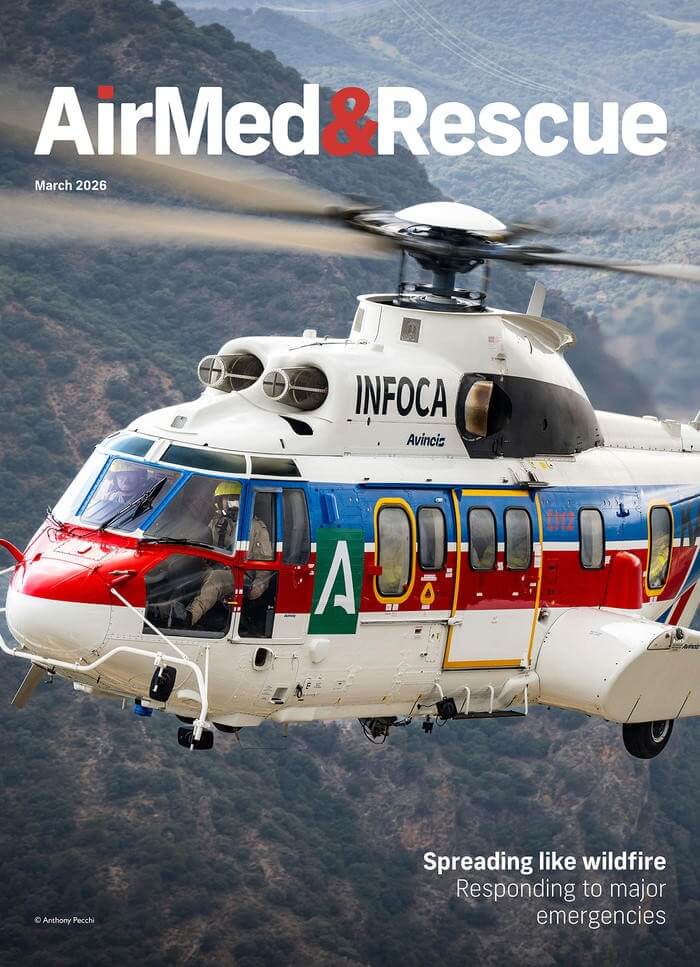
March 2026
Issue
This edition is bursting at the seams with articles from all corners of the special missions sector. We have features on the California wildfires that ravaged the state last year, what the cost–benefit analysis looks like for single-engine rotorcraft and autorotations, how the mission dictates the modification needed to the platform, and what can be done to further prevent the problems associated with inadvertent entry into instrument meteorological conditions.
Editorial Team
The AirMed&Rescue Editorial Team works on the website to ensure timely and relevant news is online every day. With extensive experience and in-depth knowledge of the air medical and air rescue industries, the team is ready to respond to breaking industry news and investigate topics of interest to our readers.
