
Data-informed readiness: Strengthening CRM in wildfire aviation

Todd O’Hara, Chief Commercial Officer at TracPlus, explains how modern CRM begins with preparation and is enhanced by effective connectivity
Crew resource management (CRM) in wildfire aviation is usually discussed in terms of communication, cockpit coordination, and decision-making under pressure. And rightly so. In steep terrain, heavy smoke, and congested airspace, how crews communicate and manage workload matters. But CRM doesn’t start in the cockpit. It starts with readiness.
FIREFIGHTING READINESS
Aerial firefighting is not routine flying. Retardant drops at low level. Repeated cycles from tight dip sites. Hoist operations in reduced visibility. Night operations during extended attack. These are perishable skills. If they are not practiced and applied regularly, performance degrades, even in highly experienced crews. #
We tend to manage readiness through recency rules: flight-hour thresholds, calendarbased currency, and scheduled training events. Those mechanisms are necessary. They establish compliance. But they don’t always reflect operational reality.
A pilot may be technically current on paper yet have flown very few live drops this season. Another crew may have executed dozens of operational missions, then still be required to complete repetitive training because the system doesn’t recognize real-world exposure.
CRM is fundamentally about human performance: communication, situational awareness, workload management, and decision-making in high-risk environments. But those behaviors are shaped by how prepared crews are when they launch. If a maneuver hasn’t been flown recently, workload increases. As workload rises, communication tightens. Margins shrink.
Wildfire aviation generates detailed operational data every day: aircraft position, drop locations, hover time, hoist cycles, night vision operations, engagement time versus transit time. Historically, much of that data has been used for oversight during live missions or post-mission reporting, then archived.
The real opportunity is to connect it.
CONNECTIVITY
When operational exposure is linked directly to training management, agencies can see precisely what tasks were flown, how often, and under what conditions. Instead of relying solely on calendar recency, training reflects actual mission experience.
If a crew has been actively performing water delivery all month, that proficiency is visible. If hoist activity has been limited, that gap is visible too. Training resources can then be directed where they genuinely add value.
CRM remains a human discipline built on communication, judgment, and shared awareness. The quality of preparation behind those behaviors determines how well they hold up under pressure. When operational exposure feeds directly into training, crews launch with recent, verifiable experience behind them.
There is also a practical reality. Training flights carry cost and exposure. Operational data can show where proficiency has already been demonstrated in the field and where reinforcement is genuinely needed.
The leading wildfire aviation agencies are already moving this way. Operational data is being connected across systems to inform readiness, resource planning, and performance improvement. Compliance remains the table stakes within the organizations, but these agencies want more than compliance for their people.
MAKING SOUND DECISIONS
Through its signature agency platform FireFlyte, TracPlus works alongside many of these organizations as they bring operational insight closer to training and preparedness. The value comes from using information that already exists to support the people responsible for mission outcomes.
Wildfire aviation will always depend on experienced professionals making sound decisions in demanding conditions. Better information strengthens that judgment and gives crews firmer footing when the workload rises.
When readiness reflects real operational exposure, CRM is reinforced long before the aircraft leaves the ground. Over time, that shows up in safer, more consistent mission outcomes.
That is where data-informed readiness delivers measurable impact.
Todd O’Hara
Todd is Chief Commercial Officer at TracPlus, the company behind the FireFlyte platform and the global leader in mission-critical tracking and analytics trusted by the California Department of Forestry and Fire Protection (CAL FIRE), New South Wales Rural Fire Service (NSW RFS), and other major aerial firefighting agencies worldwide. With more than 15 years across aviation, defense, and technology, Todd combines hands-on flying experience as a certified flight instructor with a focus on simplifying complex operational challenges through smart, data-driven solutions.
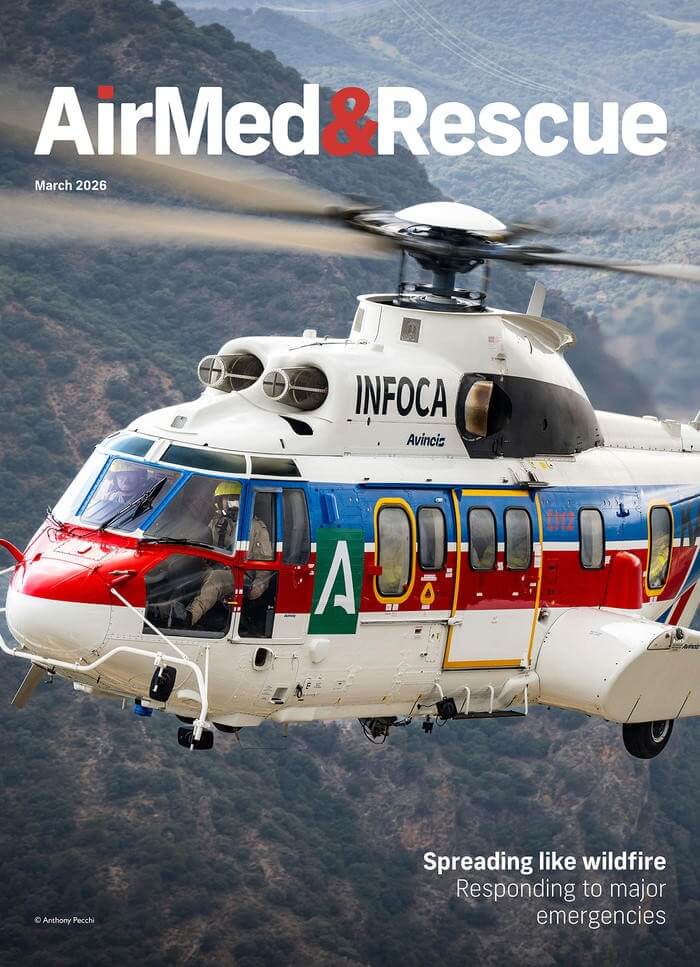
March 2026
Issue
This edition is bursting at the seams with articles from all corners of the special missions sector. We have features on the California wildfires that ravaged the state last year, what the cost–benefit analysis looks like for single-engine rotorcraft and autorotations, how the mission dictates the modification needed to the platform, and what can be done to further prevent the problems associated with inadvertent entry into instrument meteorological conditions.
Editorial Team
The AirMed&Rescue Editorial Team works on the website to ensure timely and relevant news is online every day. With extensive experience and in-depth knowledge of the air medical and air rescue industries, the team is ready to respond to breaking industry news and investigate topics of interest to our readers.