
Designing the future of simulation: a woman’s vision for lifesaving education

Midlands Air Ambulance Charity and Emily Browne, Head of Education and Training, explain how using simulation-based education with a pedagogy-first design ensures that helicopter medical emergency service (HEMS) training is brought to life
In the fast-paced world of pre-hospital emergency care, preparation is everything. For Midlands Air Ambulance Charity, simulation-based education is not just a training tool, it’s a lifeline that prepares teams for low-frequency, highacuity clinical incidents.
Emily Browne is a nurse and a former RAF 4626 Squadron flight nurse. Her career has taken her from the emergency department to the forefront of simulation in undergraduate and postgraduate healthcare education. Now combining her passions for aviation, critical care and teaching, Browne describes her current role as a ‘dream job’, a reflection of the growing influence of women in both aviation and educational leadership.
Browne’s journey has shaped the belief that technology must serve pedagogy, not the other way around. “Simulation is powerful,” she explained, “but only when it’s used with purpose. It’s not about having the flashiest kit, it’s about creating meaningful, humancentered learning experiences.”
As healthcare education evolves, simulation has become a cornerstone of both undergraduate and postgraduate training. Midlands Air Ambulance Charity has embraced this shift, investing in purpose-built facilities and cutting-edge tools. But Browne was quick to caution against a tech-first mindset: “There’s a real risk of becoming ‘all the gear and no idea’.
The best simulation environments are those where technology enhances, not replaces, the educator’s intent.”
From high-fidelity manikins and immersive 360° environments to virtual reality and dynamic monitoring systems, the organization’s simulation suite is designed with one goal in mind: realism that prepares clinicians for the unpredictable. Yet, Browne insisted that the most important element remains the human one: “Simulation is about people; how they think, communicate, and make decisions under pressure. Technology can replicate scenarios, but it’s the educator who brings them to life.”
Not every technology is right for every student or course; a grounded, pedagogy-first design is key. Every tool should be chosen with care, balancing realism, scalability, and cost-effectiveness. For example:
- Automated manikins, like the CAE Ares, support foundational training
- SimBodies offer hyper-realistic trauma simulation
- Task trainers enable repetitive skill development
- Immersive rooms replicate real-world environments without physical sets
- Standardised patients bring empathy and unpredictability into the room
- Simulation authoring tools, like IRIS, ensure rigor in scenario design
- DIY solutions and skilled technicians keep innovation agile and affordable.
Thoughtful integration of technology and teaching is what sets Midlands Air Ambulance Charity apart, not just as a charity, but as a leader in simulation-based education.
As one of the UK’s longest serving and busiest air ambulance services, Midlands Air Ambulance Charity’s commitment to excellence extends beyond the skies. It’s also about inspiring the next generation, especially women, to see themselves in aviation, critical care, education and leadership roles. Browne’s work is a testament to what’s possible when expertise, empathy, and innovation come together.
“Simulation isn’t just about training,” she said. “It’s about saving lives before the mission even begins.”
To find out more about training courses delivered by Midlands Air Ambulance Charity, visit www.midlandsairambulance. com/education/clinical-education.
August 2025
Issue
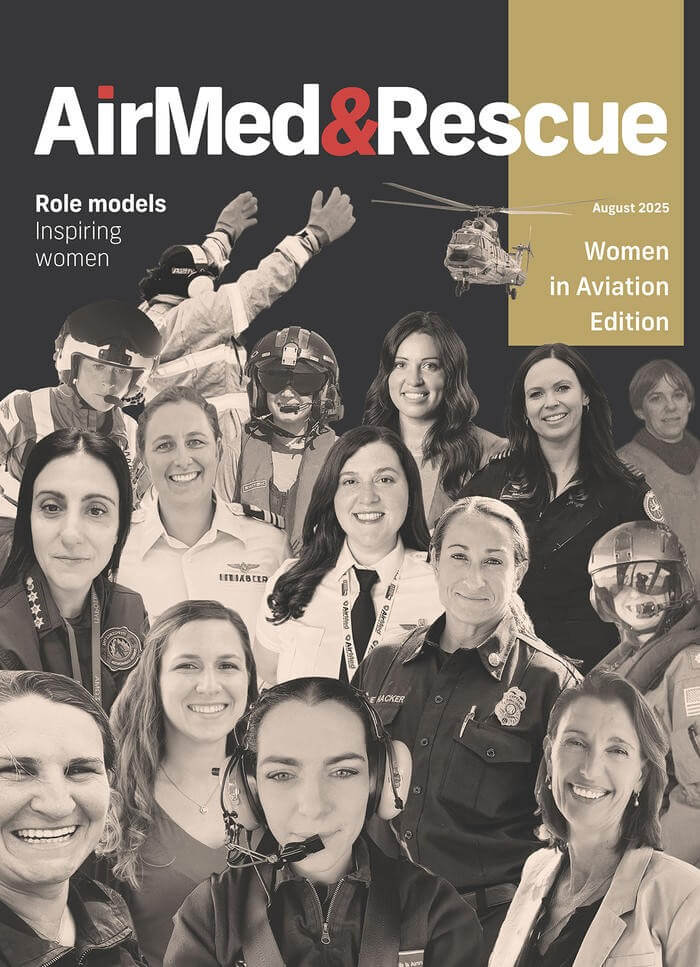
Our August magazine is the inaugural women in aviation edition, highlighting and showcasing female voices from the airborne special missions sector. We have features on blood products used in emergency medical services, challenging hoist rescues, pregnancy while flying, and portable water sources for firefighting. We also have interviews, a gallery, an industry voice, a news analysis piece, and a provider profile, as well as a review of the Paris Air Show.
Editorial Team
The AirMed&Rescue Editorial Team works on the website to ensure timely and relevant news is online every day. With extensive experience and in-depth knowledge of the air medical and air rescue industries, the team is ready to respond to breaking industry news and investigate topics of interest to our readers.