
Drones for Emergency Services

Bryce Allcorn, service delivery manager for UK-based Consortiq, which offers UAV training and consultancy services, considers the variety of drones now on the market that are suitable for emergency services use
Since 2008/9 in the UK, unmanned air vehicles have started to be used by the emergency services to provide aerial situational awareness at large, complicated, or protracted incidents. This started off with one or two fire and rescue services using relatively basic (by modern standards) single or quad-rotor systems to provide both live video and thermal imagery feeds to support incident resolution.
As time progresses, there has been a very traditional approach with regards platform selection, with a couple of platforms in the lower price bracket and one main contender in at the very high end of the market. The last year has seen a large development in the UAV platform market, mostly taken from the excellent innovation and utilisation within the commercial operators market sector, and which has led to extremely compelling improvements in UAV technology to the benefit of all market sectors, not least the emergency services.
Commonly used platforms tend to include the DJI Inspire 1, which has an excellent range of sensors (cameras) including good quality thermal and zoom sensors. Yuneec provides the very affordable Typhoon H with both good quality 4k/HD camera and basic thermal capability, but at a price point well below the DJI Inspire. Then the sector generally jumps to the Aeryon Sky Ranger, which tolerates much harsher weather conditions, provides longer flight times and provides a range of quality daylight and thermal integrated sensors, but at a cost that reflects its military sector background.
This traditional approach does tend to sit around the quadcopter (four motors/rotors) methodology, with the exception of the Yuneec range of hexacopters that provide a degree of redundancy that a quadcopter traditionally cannot offer should a motor or prop fail mid-flight.
The last year or so has seen great steps when it comes to UAV innovation – companies like DJI being able to produce a platform like the Mavic which has an amazing specification for its size and, while not necessarily suited to the emergency services sector (though you’d be quite blinkered if you dismissed it from every scenario), does highlight how quickly technology advances and how sectors such as the emergency services need to be receptive to this technology and consider different options.
UAVs fit into two main categories (multirotor and fixed-wing) and each of these is split into two main weight categories (0-7 kg and 7-20 kg). Most emergency services use a multirotor in the 0-7 kg category, mainly because it allows them to be operated in controlled airspace without the requirement to gain permission from the controlling air traffic centre, although good practice is to advise the ATC of the deployment. In addition, sub-7 kg allows deployment within congested areas (50 m from vehicles, vessels and property not under control).
Fixed-wing UAVs offer much greater flight duration, can carry greater payloads, have obvious redundancy that a multirotor can’t offer and prove very useful in large-area search deployments. Developments for hybrid platforms allow the advantages a multirotor provides, such as vertical take-off/landing and the ability to hover if required, but also provide long flight duration along with loiter modes that allow them to circle a particular point for very long periods of time.
Looking at the available multirotor platforms, we have selected six that offer different opportunities to the emergency services, all multirotor and below 7 kg, with approximate prices in UK pounds.

DJI Inspire 1 or 2
The inspire has been around for a couple of years now, which in UAV terms is an eternity. A number of iterations of the Inspire 1 were released, followed by the Inspire 2 in early 2017. The Inspire 1, in its most basic format, can be purchased for £1,800, but this rapidly increases towards £13,000 by the time a thermal camera has been added to the daylight camera, and spare batteries and associated equipment have been added. The Inspire 2 offers longer flight times (up to 27 minutes), much higher flight speeds, intelligent obstacle avoidance and higher quality optical/thermal sensors. By the time an Inspire 2 has been equipped with spare batteries, quality daylight and thermal sensors and so on, £15,000 will be easily spent.
| Positives | Negatives |
|---|---|
| Flight duration 27 minutes | Weather capability max wind 10m/s* |
| Variety and quality of sensors | Security of downlink (live feed link) |
| Deployment time | Regular firmware updates |

Yuneec Typhoon H (or H520)
The Yuneec Typhoon H was released to the UK market in June 2016 offering an immediate degree of redundancy not seen with the current ready-to-fly products, in addition to the ability to have a separate camera operator using a second controller. The full three-axis gimbal at this price point was extremely impressive.
The Typhoon H offers similar flight times to the DJI Inspire 1 while at a similar price point the Phantom 3 and the Phantom 4. The H520 is due for release imminently. While prices have not been released, it’s expected to compete directly with the DJI Inspire 2, but be aimed at the industrial end of the commercial spectrum, which could be good news for the emergency services as it will be offered with a superior range of sensors, both thermal and video, compared to the Typhoon H.
| Positives | Negatives |
|---|---|
| Flexibility and ease of use of the sensors | Weather capability (Basic Typhoon H) |
| Deployment time | No live streaming function |
| Ease of waypoint flying | Flight duration just under 20 minutes |
| Value for money | |
| Dual image with thermal camera (HD &Thermal) overlaid | |
| UK-based Yuneec support/repairs |

Aeryon SkyRanger
Considered the ultimate platform by some emergency services, the SkyRanger offers a solution for most needs, can operate in heavy wind and rain, boasts high-quality optics (30x optical zoom/60x digital zoom) and offers advanced thermal capability. A genuine military sector product which has obvious benefits in the emergency services sector and, until recently, limited obvious market competion. The price is in the range of £55k.
| Positives | Negatives |
|---|---|
| Flight duration | Lack of downlink options |
| Quality of sensors | Cost |
| Weather capability | Possible reluctance to deploy due to cost |
| Ease of waypoint operation (not physically flown in the traditional UAV sense) | |
| Onboard no-fly-zone configuration | |
| UK |
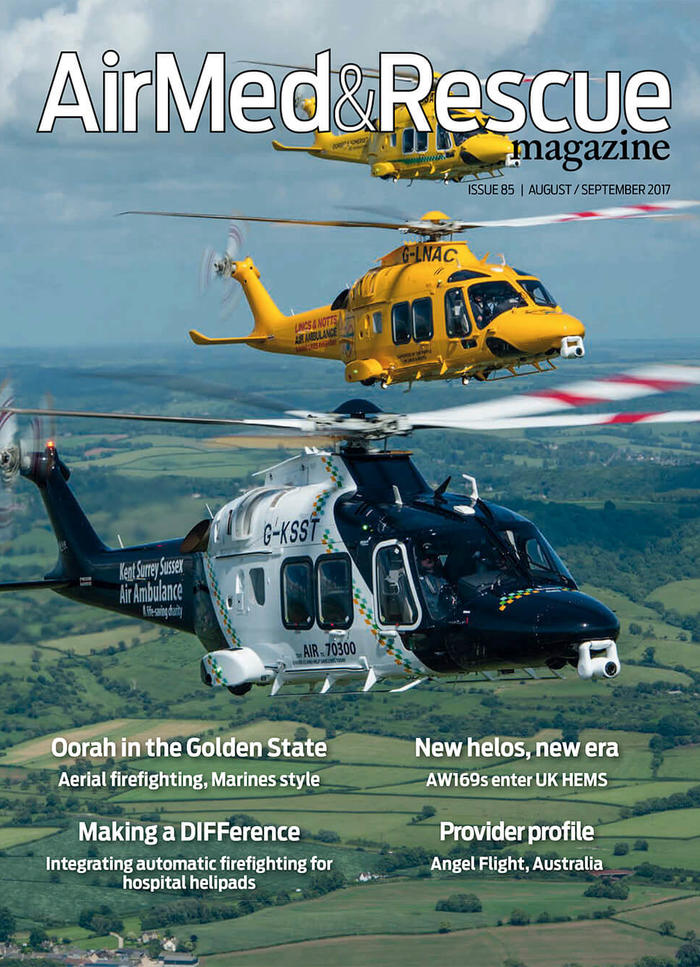
August 2017
Issue
In this issue:
Oorah in the Golden State - Aerial firefighting Marines style
Making a DIFFerence - Integrating automatic firefighting for hospital helipads
New helos, new era - AW169s enter UK HEMS
Provider profile - Angel Flight, Australia
Kenya anniversary - AMREF Flying Doctors turns 60
Why HEMS pilots do it backwards - Take-off and landings explained
From Iran to Germany - How not to relive the hippy trail
ITIC Asia Pacific Bangkok - The air medical sessions from the International Travel & Health Insurance Conference
Editorial Team
The AirMed&Rescue Editorial Team works on the website to ensure timely and relevant news is online every day. With extensive experience and in-depth knowledge of the air medical and air rescue industries, the team is ready to respond to breaking industry news and investigate topics of interest to our readers.