
Effective and proven instructor-led special missions training solutions

Priority 1 Air Rescue explains how an integrated, comprehensive and complete training solution provides the safest and most effective way to train rear crews for the challenges that will face them in their daily work
Training new personnel to conduct helicopter search and rescue (SAR) and special operations poses many common challenges to agencies looking to provide safe, capable, and standardized mission-ready aircrews. The significant costs associated with live flight training and aircraft availability, aggravated by limited staffing and availability of experienced instructors not standing duty to train new aircrews are major challenges commonly faced by most operators today.
To significantly decrease the cost and time required to train ‘new hires’, an increasing number of helicopter operators are turning to outsourced training service providers; specifically, with capabilities for providing instructor-led training options and employing synthetic devices to provide a more effective, affordable, and safer mission training solution.
“Many in our profession recognize there is a current gap for rear-crew training,” said Brad Matheson, President of Priority 1 Air Rescue (P1AR). “There is a need to change the dynamics of mission training from solely live flight training to a more graduated and systematic approach leveraging simulation, which provides demonstrable progress and tangible metrics for increased student performance, compounded with the benefits of being safer and more cost effective.”
A ONE STOP SHOP
Commonly referred to as the “one stop SAR shop,” P1AR is solely focused on helicopter SAR and tactical operations and training. P1AR provides full-service helicopter mission training offering the entire bandwidth of mission training programs and is only focused on perfecting its methods and technology to improve the student learning process and increase their mission safety and capability. With over 25 years of experience, P1AR has provided industry-leading SAR and tactical training to over 12,000 civilian and military pilots and crews in 40 countries worldwide.
P1AR is a highly specialised external service provider that delivers proven and effective aircrew mission training services to commercial, para-public, and government defense operators at its Search and Rescue Tactical Training Academies (SART/TACs).
COURSE DELIVERY METHODS AND MODALITIES
The P1AR training course modalities include, but are not limited to: computer-based training (CBT) for distributed learning, instructor-led ground school, virtual and physical synthetic trainers, commercial off-the-shelf / bespoke manuals and student workbooks, e-learning iPads, and student management software.
Training courses can be provided at:
• The customers’ venues using their own facilities for ground school, and aircraft for live flight training • P1AR’s SART/TACs employing integrated virtual and physical synthetic mission trainers
• Both of the above combined forming a ‘blended’ training with the first phase of ground school and synthetic practice conducted at either SART/TACs in Mesa or Bordeaux, and then continuing with the next phase of the course held at the customers’ venues, utilizing their aircraft for integrated live flight and scenario-based training.
SART/TAC
P1AR operates two world class SART/TAC facilities that are solely dedicated to providing a full spectrum of initial to advanced synthetic mission training solutions located in Mesa, Arizona, USA (established in 2011), and Bordeaux, France (established in 2014).
Each SART/TAC employs full-time instructors operating cutting-edge synthetic training devices including two advanced aircrew mission simulators (AAMS) and two hoist procedural towers (HPT). P1AR’s HPTs are reconfigurable to multiple types of helicopters and use actual single/dual Breeze Eastern and Goodrich (Onboard Systems) rescue hoists. Additionally, P1AR’s SART/ TACs offer an aviation life support equipment (ALSE) training area, fast-rope/rappel tower, advanced life support synthetic medical training with manikins, and a complete domestic/international array of SAR and air ambulance mission equipment.
SYNTHETIC TRAINING DEVICES
One of the most unique and specialized tools used for training aircrews is the AAMS. The AAMS is a reconfigurable virtual simulator, able to be configured for multiple aircraft types, cabins, rescue hoists, weapons, forward-looking infrared (FLIR), and cockpits. The AAMS software is high fidelity with realistic cable physics and is custom configured to recreate a myriad of locations, environments, aircraft models, and missions during the day or at night, unaided or with night vision.
It is well known that there are many benefits to synthetic helicopter flight training for pilots; from levels of standardization, range and depth of specific skills practice and mission training capabilities, cost savings, employing ‘green’ technology, and the ability to practice high-risk evolutions to proficiency. This includes specific techniques and training tasks that cannot be practiced in the aircraft, hazardous environmental conditions, and the ability to practice emergency procedures that cannot safely be practiced during live flights, regularly and repeatedly. These emergency procedures include engine failures while hoisting, load pendulums, spins, cable entanglement, and emergency cable cuts. Aircrews should then progress to challenging and relevant full mission scenarios that require immediate decisions for the rear crew under extreme pressure.
Providing synthetic training to rear crews for conducting hoist, fast-rope, and SAR requires a very different approach from training a pilot to learn to fly utilizing virtual simulation. Hoist operators and rescue specialists must be able move around to physically prepare the cabin to assemble and position rescue equipment, physically connect rescue devices to their exact hoist hook, move rescuers in and out of the cabin, employ taglines, deploy and recover fast-ropes, and position casualties by lifting/maneuvering real hoist loads. It is also crucial to ensure that the rear crews operate with the actual helicopter hoist system that they will be using in the field to practice operational procedures and techniques. It is not possible to effectively train these core physical competencies in a strictly virtual synthetic environment.
With a cohesive and integrated course of learning employing virtual and physical synthetic trainers, combined with comprehensive courseware, P1AR has achieved European Union Aviation Safety Agency (EASA) approval for an ab initio winch operator SAR training program.
Another vital element when providing synthetic training is device reliability. Due to key factors such as experience, spares, and student throughput, P1AR’s AAMS and HPT have an audited reliability of over 99% for each device, having performed over 100,000 hoist evolutions with just one customer alone.
SUMMARY
Truly understanding the customer’s needs and challenges to get safe and capable rear crews trained and available right now allows P1AR to deliver relevant and comprehensive training options. By incorporating the optimal combination of instructor-led training, comprehensive courseware, virtual and physical synthetic training devices, along with two fully equipped SAR/TAC facilities allows customers the immediate option of an unmatched value proposition to get their aircrews trained safely and effectively
March 2025
Issue
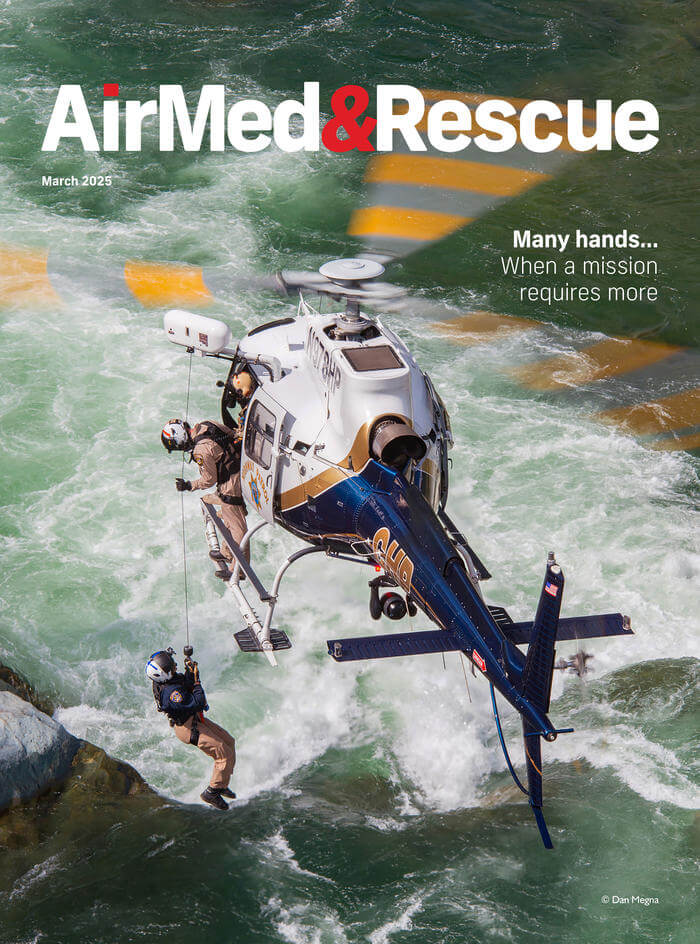
Our March edition has features that let you discover the level of training provided by simulators; learn the ins and outs of medical interiors in aircraft; find out about how health and usage monitoring systems are changing special missions; and see how aerial firefighters communicate and coordinate their missions across multiple agencies and stakeholders; plus more of our regular content.
Editorial Team
The AirMed&Rescue Editorial Team works on the website to ensure timely and relevant news is online every day. With extensive experience and in-depth knowledge of the air medical and air rescue industries, the team is ready to respond to breaking industry news and investigate topics of interest to our readers.