
Effective and proven mission training capability

Priority 1 Air Rescue has a mission to perfect methods and technology to improve the student learning process and increase mission safety and capability as a ‘One-Stop SAR Shop’
Training helicopter aircrews for special mission operations presents a range of common challenges for agencies striving to deliver safe, capable, and standardized programs. One of the most significant hurdles is the high cost of flight training, further compounded by the limited availability of qualified instructors and aircraft. At the same time, the need to develop newly assigned ab initio aircrews while maintaining flight currency for existing personnel places additional pressure on already constrained staffing resources. As a result, many agencies are seeking innovative, non-traditional approaches to overcome training bottlenecks and reduce the associated costs of flight operations.
Priority 1 Air Rescue (P1AR) has earned a global reputation as a trusted partner to law enforcement, emergency search and rescue (SAR) services, and Department of War operators. Renowned as an innovative ‘OneStop SAR Shop’, P1AR delivers integrated solutions encompassing aircrew training, mission-specific equipment, and operational staffing. The company is recognized for designing comprehensive programs grounded in industry best practices and meticulously tailored to each client’s mission profile and aircraft platform.
In addition to delivering standardized courseware through instructor-led ground school and live flight training at customer locations, P1AR also operates two world class Search and Rescue / Tactical Training Academies (SART/TAC). Located in Mesa, Arizona (established in 2011), and Bordeaux, France (established in 2014), these academies are exclusively dedicated to offering a comprehensive range of synthetic mission training solutions from initial qualification to advanced mission training solutions.
Both SART/TAC facilities are staffed by full-time instructors and equipped with state-of-the-art synthetic training systems. These include advanced aircrew mission simulators (AAMS) designed for SAR and tactical operations such as aerial gunnery and use-of-force scenarios; hoist procedural towers (HPT) for physical synthetic trainers that can be reconfigured to simulate over 20 helicopter types using actual Breeze-Eastern and Goodrich hoists; an aviation life support equipment (ALSE) training area; a fast-rope/ rappel tower; advanced life support synthetic medical mannequins; and a comprehensive inventory of domestic and international SAR and air ambulance mission equipment.
The AAMS features high-fidelity software with realistic cable physics and is customconfigured to replicate a wide range of operational environments, geographic locations, aircraft models, and mission profiles – both day and night, with or without night vision goggles. Its aerial gunnery module incorporates ballistic simulation technology that meets NATO Armaments Ballistic Kernel (NABK) standards and supports training on weapon systems including the M240, M134, GAU-21, and HK417/SR25. These systems can be positioned on either side of the cabin or at the tail ramp, allowing multiple students to participate simultaneously. Additionally, the AAMS is fully reconfigurable to support various aircraft types and cabin layouts, including single and dual cockpit configurations.
Synthetic helicopter flight training offers a wide array of well-recognized advantages for pilots. These include enhanced standardization, comprehensive skill development, expanded mission training capabilities, significant cost savings, and the adoption of environmentally friendly technologies. One of its most valuable benefits is the ability to safely and repeatedly rehearse high-risk maneuvers and emergency procedures that are impractical or unsafe to perform during live flight. This encompasses specialized techniques and scenarios such as operating in hazardous environmental conditions and executing emergency responses like engine failures during hoisting, load pendulum effects, spins, cable entanglements, and emergency cable cuts. Once foundational skills are mastered, aircrews should advance to complex, mission relevant scenarios that demand rapid decision making and high-pressure coordination, particularly from rear crew members.
“There’s a widely acknowledged gap in rear-crew training within our industry,” noted Brad Matheson, President of P1AR. “To address this, we must shift away from relying exclusively on live flight training and adopt a more structured, progressive approach that incorporates simulation. This method not only delivers measurable improvements in student performance, but also enhances safety and reduces costs.”
In addition to offering standalone live and synthetic training programs, P1AR provides blended training solutions designed to support seamless transitions to operational aircraft. This approach begins with ground instruction and synthetic mission practice at either of the SART/TAC Mesa or Bordeaux facilities, followed by the next phase of integrated live flight training conducted at the customer’s location using their own aircraft. This progression enables scenario-based mission rehearsal tailored to real-world operations, enhancing crew readiness and operational effectiveness.
P1AR’s program milestones include securing and actively performing multi-year contracts for several high-profile initiatives for instructor-led training: the US Coast Guard’s MH60T/MH65D/E Flight Mechanic Helicopter Hoist Operator “C” School, the Special Mission Aviator School supporting the US Air Force Global Strike Grey Wolf program, French Ministry of Defence, and joint rear-crew training programs previously executed for the Royal Netherlands Air and Space Force, and Navy.
“Our exceptionally well trained and experienced team focuses on perfecting our methods and technology to improve the student learning process and increase their mission safety and capability. While our specialty is whole crew mission training, we are more rear-crew centric,” explained Matheson. “We have the initiative in the market providing full-service helicopter mission training, offering the entire bandwidth of programs with integrated synthetic mission training for rear crews, along with the remarkable advantage of having very professional and high-profile customers showcase our proven performance and experience. P1AR is unmatched, offering a proven capability versus a proposal concept.”
By deeply understanding each customer’s mission objectives, operational standards, and common challenges, P1AR delivers tailored training solutions that combine the ideal mix of course design, training assets, and facility selection. This approach ensures that every program aligns with missionspecific requirements while remaining costeffective and operationally relevant.
Priority 1 Air Rescue
Priority 1 Air Rescue (P1AR), commonly referred to as a ‘One-Stop SAR Shop’, is solely focused on helicopter search and rescue (SAR) and tactical operations and training. With 25 years of experience, P1AR has provided industry-leading SAR and tactical training to over 12,000 civilian and military pilots and crews worldwide. In addition to its full-time training and support staff, P1AR provides full-time hoist system operators, helicopter rescue swimmers, and paramedics for SAR/medevac programs, providing 24/7, 365 days a year coverage on government and commercial SAR contracts around the world. The P1AR Search and Rescue Tactical Training Academy (SART/TAC) facilities are located in Mesa, Arizona, USA, and Bordeaux, France. Both SART/TAC facilities employ the latest virtual hoist SAR and aerial gunnery synthetic training device with the advanced aircrew mission simulators (AAMS) to include hoists, GAU-21, M134 and M240 weapon platforms and HK417/SR25 sniper domes, coupled pilot SAR flight training device, hoist procedural towers using BreezeEastern and Goodrich single and dual hoists, fast-rope and rappel tower, and multi-media classrooms. For more information, contact us at [email protected].
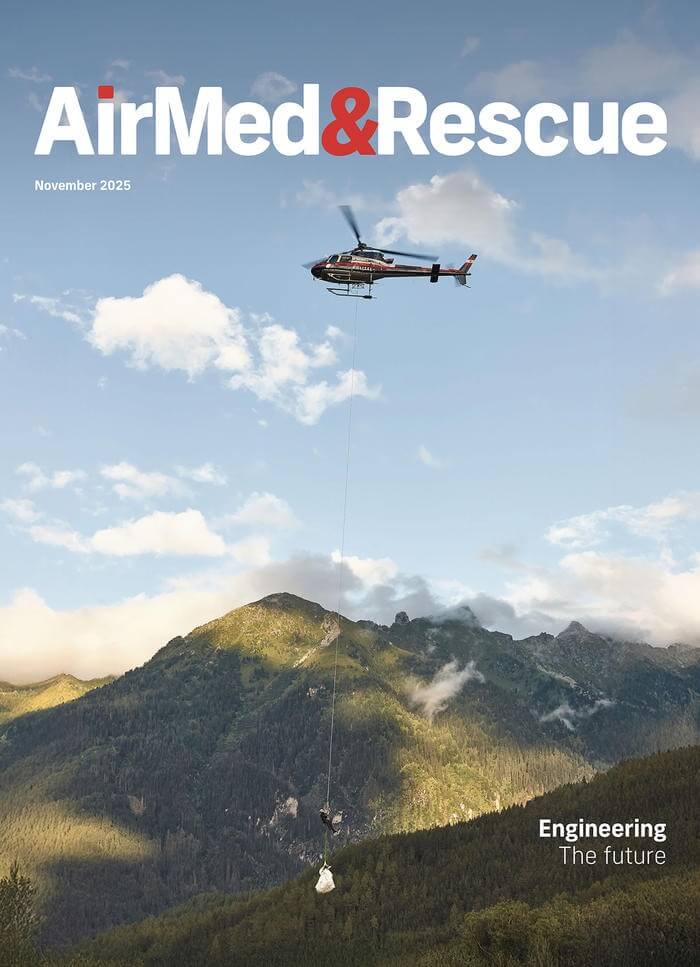
November 2025
Issue
Our November edition is packed with content relating to special missions from around the world. We have features that explore the design and engineering that go into modern rotorcraft; the interactions between ground and air teams on helitack operations; the tools and attire needed for successful water rescues; and the new onboard technology that is revolutionizing special missions by detecting and communicating with cell phones.
Editorial Team
The AirMed&Rescue Editorial Team works on the website to ensure timely and relevant news is online every day. With extensive experience and in-depth knowledge of the air medical and air rescue industries, the team is ready to respond to breaking industry news and investigate topics of interest to our readers.