

Event review: Aerial Fire Fighting Europe 2025

Experts and stakeholders from all over the world came to Bordeaux, France, to attend the European edition of the Aerial Fire Fighting conference series. AirMed&Rescue was a media partner and delegate bag sponsor for the event. Jon Adams shares an overview of the conference
The conference sessions were led by moderator Lieutenant Colonel Fabrice Chassagne, Forest Fires Project Manager for the French General Directorate of Civil Security and Crisis Management (DGSCGC). His extensive experience and knowledge of the sector meant he was well suited to drive the agenda and manage the sessions.
The introductory address was a recorded message from Alain Rousset, President of the Nouvelle-Aquitaine Regional Council. He said that the three main problems that his region were facing regarding forest fire combat were initial attack, dropping large volumes of water on fires, and the human-machine interface, which was why he was proud and happy of the work that his region was instrumental in supporting, helping to develop new technology in the war against wildfires.
Following Rousset’s speech was a welcome address in person by Julien Marion, Director General of DGSCGC. He said that firefighting preparedness was of “crucial importance to us as we face the problem of climate change” and that aerial firefighting (AFF) “already comprises a vital role in civil security and will only become more important in the future”. He said: “Forward planning is at the top of our list of priorities,” highlighting the strategic positioning and mass deployment of resources. He added that accurate weather and operational forecasting was of importance and that to be able to react to the upcoming wildfire threats, “we need to be agile, to be responsive in the short term, and to prepare for the future”.
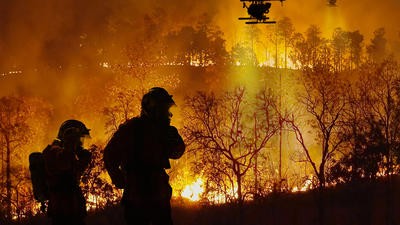
Themes emerged that ran as throughlines across all the sessions over the two days, notably the evident trend for worse and longer fire seasons that are blending into one another; the challenges of funding, resource management and acquiring AFF assets; future planning, both in the short term and longer into the future; and the importance of collaboration to share knowledge, assets, information and good working practices.
The two panel discussions on the morning of the first day focused on the problems of ‘capacity’, the troubles with shortages of airframes, aircraft parts, pilots, mechanics and engineers, and funding. There was a notable mention of the disparity of pay for people working in AFF, not only compared with commercial operations, but also across borders, and so the challenge of attracting and retaining staff in a tiring, stressful and extreme sector (which is only getting worse) is becoming harder when staff can take their skills elsewhere for better remuneration and conditions. In order to help alleviate some of the issues, solutions were suggested, such as the optimization of firefighting, namely putting “water where needed, when needed”, for example during night operations, said Luc Dugas, Senior Director, Stratégic and Air Operation for Canadian forest fire protection nonprofit SOPFEU. Matteo Monterosso, Province Commander for Firefighters in Fermo, Italy, highlighted that another challenge was that vegetation was also changing due to climate change, and that the AFF strategies that worked in one region in the past may no longer be applicable.
What needs to occur to help introduce and employ new technologies is demonstrations
Professor Vaios Lappas, Department Head, Aerospace Science and Technology at the University of Athens, was clear that innovation was needed if countries are going to be able to appropriately combat the threat of wildfire, and that what needs to occur to help introduce and employ new technologies is demonstrations, as the technology is already available.
Technology showcase
New technology and strategies showcased in the sessions included the introduction of Conair’s new Daher TBM 960 command and control platforms; De Havilland Aircraft of Canada’s progress of the DHC-515 program; Aria Firefighting France’s MultiFireScan system for reporting and predicting fire behavior; a new tank system from Recoil Aerospace; the development of the MAFFS system on other platforms; Entrol’s new LED screens and simulators for AFF training; and many more.
Other sessions covered the recent wildfires in California, and how even states such as Washington can go from a non-existent budget for AFF in 2022 to having access to 44 air resources in 2025. The changes in such a short amount of time to regions that are not historically known to be prone to wildfires show that regions and countries need to prepare now in case of catastrophic wildfire events both in and out of ‘season’. But the resources also have to be applicable. The Bavarian firefighters representative showed that there was little ability for scoopers to operate across most of Germany due to the geography of the country, so helicopters were the primary asset needed, while Soraya Imperial, Senior Officer at the Agency for Integrated Rural Fire Management in Portugal, made clear that having more aircraft is not always the most economical answer, but that for countries with a mature air fleet, adding data-gathering resources can be a much better return on investment than adding more waterbombers.
We cannot attack and we cannot prepare for these fires if we don’t know how they work
Information and data gathering, analysis and sharing was a strong theme of the conference, as Fire Colonel Zisoula Ntasiou, Chief of Aerial Firefighting Operations, National Coordination Center for Operations and Crisis Management, at the Hellenic Fire Service, highlighted: “We cannot attack and we cannot prepare for these fires if we don’t know how they work.” This supports the collaboration aspect of the conference, also emphasized heavily in the data-sharing element brought up in the panel discussion on uncrewed aerial systems and space operations, and the reviews of the California wildfires, whereby multiple agencies and organizations all shared information and coordinated to make best use of the people, tools, and aircraft at their disposal.
As well as the sessions, there were the exhibitors; operators like Avincis were present, and manufacturers, service providers, and representatives from the whole aerial firefighting sector had booths and were available during the networking events.
The two-day conference had so many insights and opportunities that it is impossible to cover them all here. If you wish to attend next year, it will be held in Rome on 25–26 March 2026, and there will also be the Asia Pacific edition on 22–23 July 2026 in Cairns, Australia.


May 2025
Issue
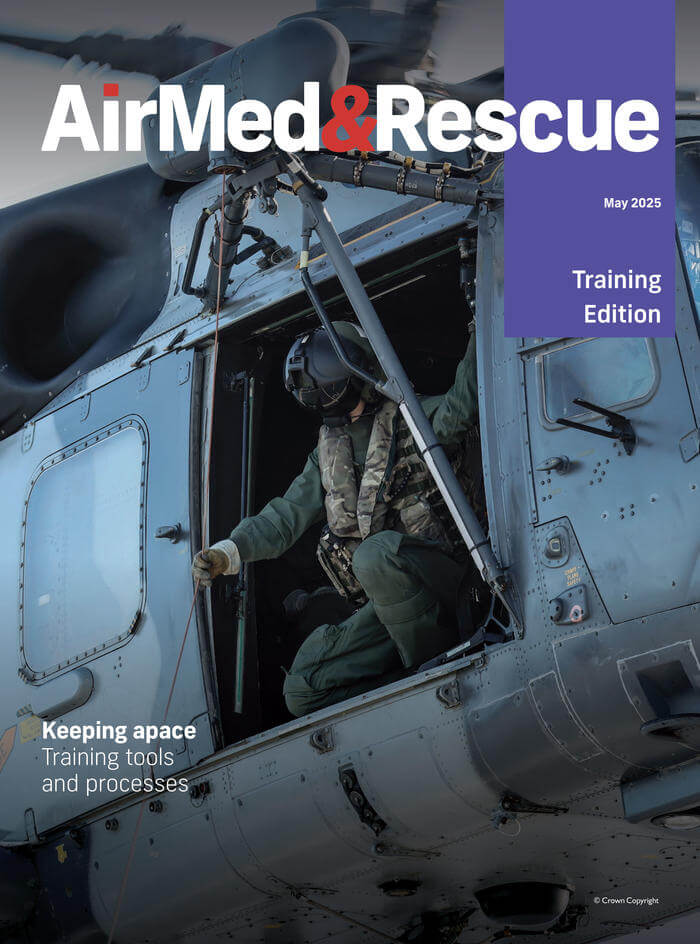
Our May edition is full of articles centered around training, with features covering pilot training, winch and rear-crew training, and air medical training; as well as a feature in the trend towards longer-range air ambulance transfers; plus we have more of our regular content, with lots of articles highlighting different aspects of training, from startle and surprise management to simulation centers and everything in between.
Jon Adams
Jon is the Editor of AirMed&Rescue. He was previously Editor for Clinical Medicine and Future Healthcare Journal at the Royal College of Physicians before coming to AirMed&Rescue in November 2022. His favorite helicopter is the Army Air Corps Lynx that he saw his father fly while growing up on Army bases.