

Event review: Farnborough International Airshow 2026

Industry professionals, stakeholders, and enthusiasts from around the world converged on a little town in southern England for the Farnborough International Airshow 2026. Jon Adams attended the show and reports on some of the news that affects the special missions sectors
With 141,580 trade and public visitors, and approximately 1,200 exhibitors, the Farnborough International Airshow (FIA) 2026 is an event to be marked in the calendar. These numbers represent 41% growth over the previous edition, and this is reflected in the size and number of the displays, deals, and deliberations that came out of the event. With world firsts, representatives from government, and commercial deals worth over US$84.7 billion, FIA was an event worth attending, and it will return to Farnborough on 17–21 July 2028. Here are some of the highlights from this year’s show.
Airbus
Airbus Helicopters and Voyageur Aviation signed an agreement for the first purchase order of the Airbus U030 Flexrotor uncrewed aerial system (UAS) in Canada. The contract marks Voyageur as the official Canadian launch customer for the platform. The order includes three of the physical drones and the control and command system.
“This purchase represents a significant advancement in Voyageur’s ISR strategy and an important first for the Canadian market,” said Cory Cousineau, President of Voyageur. “As the first Flexrotor operator in Canada, Voyageur is well positioned to introduce and operationalize this new technology within the realities of Canada’s operating environment.”
Marty Rogers, Director of ISR Business Development and Strategy at Voyageur, told AirMed&Rescue that a primary use case for the first system in Canada would be to help tackle the rising incidences of wildfires across the country. He also said that another core determining factor for choosing the U030 over platforms from other manufacturers was its proven capabilities in extreme cold where the others failed, showing its true ability as a versatile UAS for Canada’s varied environmental conditions.
Airbus also announced that the U030 Flexrotor had officially started maritime surveillance operations in the Baltic Sea on behalf of the European Maritime Safety Agency (EMSA). Operations began after a series of successful test flights to validate technical and regulatory milestones ahead of the entry into service, and to support operator handover to Extensee.
Victor Gerin-Roze, Head of UAS Business at Airbus Helicopters, said: “The start of operations in the Baltics demonstrates its ability to operate effectively in diverse maritime theatres while supporting critical coast guard functions.” The support of coast guard functions includes search and rescue (SAR), fisheries control, environmental monitoring, and the detection of illicit maritime activity.
Airbus Helicopters and Saudi Arabia’s The Helicopter Company (THC) announced a firm order for eight additional Airbus H145 helicopters. The helicopters are scheduled for delivery between 2027 and 2028, and fall under the framework agreement signed between THC and Airbus at Verticon in 2024. The original framework agreement between THC and Airbus included up to 120 Airbus helicopters of various types set to be delivered over the next three to five years.
The H145s will support THC’s expanding range of services, including emergency medical services (EMS), and other mission-critical operations across the Kingdom and beyond.
Locally, the UK’s National Police Air Service (NPAS) placed an order for an additional two H135 helicopters, bringing the total fleet renewal program to nine H135s. The firm order, which follows the arrival of the first two fleet renewal aircraft at Airbus Helicopters in the UK in April for extensive policing customization, comes under the original 2025 framework contract signed with the BlueLight Commercial procurement agency.
“These aircraft will provide a modern, resilient, and effective capability for policing, supporting our crews as they respond to incidents, assist officers on the ground, and protect the public,” said Chief Superintendent Fiona Gaffney, NPAS Accountable Manager. “Together with our partners, we are building a fleet that will serve policing and the public for many years to come, ensuring NPAS remains ready to meet the evolving demands of operational policing.”
These aircraft will provide a modern, resilient, and effective capability for policing, supporting our crews as they respond to incidents, assist officers on the ground, and protect the public
NPAS currently operates 16 H135 and four H145 helicopters from 14 locations on behalf of the 43 police forces in England and Wales. The new helicopters will arrive at Airbus’ Oxford site in 2028 ahead of their completion to NPAS’ configuration.
Aviation for Good
Aviation for Good launched its first two humanitarian projects, supporting flights to restore sight in remote African communities and reconnect a village isolated after a cyclone destroyed its bridge.
Its first campaign will enable surgeons and volunteer medical teams to reach people living with preventable blindness in remote parts of Africa. Cataract operations can take as little as 15 minutes, but patients are often separated from treatment by poor infrastructure and long, difficult overland journeys.
The second project will support the reconstruction of a bridge destroyed by a cyclone earlier this year. The loss of the crossing has left an isolated community cut off, preventing children from reaching school and restricting residents’ access to essential services. Aircraft will be used to carry engineers, personnel, and construction materials into the area so the bridge can be rebuilt.
Aviation for Good does not own any aircraft or conduct flights itself. Instead, it will raise money from aerospace companies and individuals before working with established humanitarian aviation organizations that already possess the aircraft, pilots, and local expertise required.
“We’re not planning to become an airline,” Aviation for Good Chair Rachel Gardner-Poole OBE said in a presentation at the airshow. “We are a fundraising charity working with partners that already have the aircraft and the operational expertise.”

Bell Textron
Bell Textron went into FIA after a recent announcement for the order for two Subaru Bell 412EPXs by Texas A&M Forest Service, a wildfire and forest management organization in the southern US state. These will be the first Bell aircraft to join the Texas A&M Forest Service fleet as part of a master purchasing agreement, which includes options for additional aircraft.
Texas A&M Forest Service provides air support to homeowners, forest landowners, local communities, and fire departments across Texas. As conservationists, the agency is dedicated to preserving forests and natural resources while protecting lives and property. The addition of these Subaru Bell 412EPXs will support this mission by delivering rapid response and reliable performance. Each aircraft will also be equipped with a hoist for rescue operations and a belly tank for firefighting.
“Protecting lives and property is a priority in Texas,” said Jared Karns, Fire Chief, Texas A&M Forest Service. “This agreement is the first of many steps to develop a state-managed wildfire aviation program that will give Texas greater control over the timing, positioning, and deployment of fire suppression aircraft, helping keep Texas prepared.”
Protecting lives and property is a priority in Texas. This agreement is the first of many steps to develop a state-managed wildfire aviation program that will give Texas greater control over the timing, positioning, and deployment of fire suppression aircraft, helping keep Texas prepared
Bell Textron announced during the show that it had delivered its 700th Bell 505 to a private VIP operator, highlighting the platforms’ popularity in the corporate aircraft segment.
“Our team is honored to ring in this Bell 505 milestone right here at the Farnborough International Airshow,” said Robin Wendling, Managing Director, Europe, Bell. “The Bell 505 is an incredible multi-mission aircraft, and we continue to see operators choosing this platform to join their fleet. We look forward to welcoming our newest operator to the Bell family, while also celebrating all of our Bell 505 operators across the different mission segments throughout the world.”
Although this was a corporate sale, the Bell 505 is popular as a training platform in the defense sector, and is used extensively in the militaries of Jordan, Bahrain, United Arab Emirates, Albania, Montenegro, Indonesia, Iraq, and South Korea, preparing pilots for mission readiness in modern warfare. The open cabin design, with its stadium seating for passengers in the back, makes it ideal for students to follow what is happening from all seats, maximizing the training capability that makes the aircraft feel like a flying classroom.
Conair
Conair Group went to FIA promoting a recent announcement that the company was providing four Dash 8-400AT airtankers plus one TBM 960 Air Attack aircraft to Canada this wildfire season, alongside experienced aerial firefighting pilots and trained aircraft maintenance engineers. The operational contract period runs until 27 September 2026.
The aircraft are contracted to the Canadian Interagency Forest Fire Centre (CIFFC), which has secured the aerial assets to improve provincial and territorial wildfire response during periods of elevated wildfire activity, as part of the Government of Canada’s commitment to increase Canada’s aerial wildfire firefighting capacity.
“For six decades, Canada has been at the forefront of designing, building, and operating specialized aircraft to combat wildfires,” said Chris Niemann, President and CEO of Conair. “Today the nation is building upon that legacy. For the first time, Canada has its own national fleet to bolster provincial and territorial firefighting capacity.”
De Havilland Canada
De Havilland Canada showcased the Sherpa (known colloquially as the Pack Rat), introducing the aircraft to a new generation of operators while highlighting its proven capabilities and versatility across special mission, tactical transport, and humanitarian operations, as well as its ability to support firefighting capabilities such as deploying smoke jumpers.
The Sherpa is a unique aircraft with capabilities that remain highly relevant today. Its ability to operate where other aircraft cannot, combined with its versatility and durability, continues to make it an attractive platform for a wide range of operators
“The Sherpa is a unique aircraft with capabilities that remain highly relevant today,” said Rob Mobilio, Chief Commercial Officer for De Havilland Canada. “Its ability to operate where other aircraft cannot, combined with its versatility and durability, continues to make it an attractive platform for a wide range of operators. We’re pleased to bring it to Farnborough and reconnect customers with everything this aircraft has to offer.”
The Sherpa joined the De Havilland Aircraft of Canada family in 2019. De Havilland Canada brought the Sherpa to Farnborough to reintroduce the aircraft to the global aerospace community, engage directly with operators and industry partners, and explore future opportunities for this proven utility platform.
De Havilland Canada also announced that the Twin Otter Classic 300-G has received certification from the European Union Aviation Safety Agency (EASA).
The certification enables deliveries of the Twin Otter Classic 300-G to operators throughout Europe and other regions that recognize EASA certification. The first EASA-certified aircraft has already been delivered to Switzerland-based Zimex Aviation and is now in commercial operation.
Zimex Aviation, a long-time Twin Otter operator, is the launch customer and first operator of the EASA-certified Twin Otter Classic 300-G. The aircraft supports the company’s global operations, which include humanitarian aid, government support, cargo transport, and special mission flying in remote and challenging environments.
“The Twin Otter has long been an important part of our fleet,” said Daniele Cereghetti, Chief Executive Officer of Zimex Aviation. “The Classic 300-G builds on everything we value about the aircraft while adding modern technology and improved efficiency. We are proud to be the first operator flying the EASA-certified aircraft and look forward to putting it to work supporting our customers around the world.”
Embraer
Embraer announced an agreement to provide C-390 Millennium training devices to the air forces of Sweden and Austria. The Swedish Air Force will receive a comprehensive training package, including a full flight simulator (FFS), a cargo handling station trainer (CHST) developed in partnership with Rheinmetall, and a computer-based training (CBT) solution developed with ETI. The Austrian Air Force will receive a CBT solution to support theoretical instruction and crew qualification.
The set of training devices will provide pilots, loadmasters, crewmembers, and maintenance personnel with modern, high-fidelity training environments designed to maximize operational readiness and mission effectiveness across their C-390 Millennium fleets.
“Delivering advanced training capabilities to our European C-390 Millennium operators reinforces Embraer’s commitment to mission readiness and operational excellence over the long term,” said Carlos Naufel, President and CEO of Embraer Services & Support. “Together with our partners, we are building a comprehensive training ecosystem that enables Sweden and Austria to maximize the C-390 Millennium’s capabilities, while strengthening their interoperability and commonality.”
The FFS, designed to achieve Level D qualification, enables training under normal, abnormal, and emergency conditions, supports military mission scenarios, and incorporates more than 350 malfunctions for pilot training. The CHST provides comprehensive training for loadmaster procedures and cargo operations. Utilizing advanced visualization technology, it offers realistic representations of both the cargo compartment and the external aircraft environment, supporting mission preparation and execution training. Finally, the CBT solution delivers theoretical instruction for pilots, loadmasters, additional crewmembers, and maintenance personnel through a learning management system compatible with SCORM standards, enabling flexible and efficient training delivery.

HeliOperations
HeliOperations signed an agreement with Reiser Simulation and Training to acquire an AW139 flight training device (FTD) and a stationary hoistAR extended reality training system, expanding its rotary-wing training capabilities for military aircrews.
The agreement was announced at FIA and will support HeliOperations’ seven-year Basic Flight Training program for German Navy pilots transitioning to the NH90 Sea Lion and NH90 Sea Tiger helicopters.
The AW139 simulator will be built on Reiser’s Next Generation-FTD platform and replicate the helicopter in its Phase 8 configuration. Designed with a modular architecture, the device can be tailored to meet specific aircraft, mission, and training requirements.
Horizon Aircraft
Horizon Aircraft announced it had signed a letter of intent (LOI) with V-Star Powered Lift Aviation, an Australian-based aircraft operator, to purchase five Cavorite X7 hybrid-electric vertical takeoff and landing (VTOL) aircraft with options to purchase up to an additional 95 aircraft.
V-Star provides innovative, cost-effective aviation solutions with particular expertise in critical emergency services. The addition of Cavorite X7s into V-Star’s fleet will significantly reduce medevac response times and patient transfers, and SAR missions can be executed faster and more cost-efficiently.
Flying at nearly twice the speed of helicopters, the addition of Cavorite X7s to our fleet will be a critical advantage to help people in need when minutes matter
V-Star CEO Tony Laws commented: “Flying at nearly twice the speed of helicopters, the addition of Cavorite X7s to our fleet will be a critical advantage to help people in need when minutes matter. V-Star is committed to delivering leading powered-lift technologies across Australia to improve outcomes on critical missions, and this LOI with Horizon Aircraft brings us one step closer to a new standard for emergency services operations and cost-effective transport solutions in regional Australia.”
Leonardo
Leonardo, PT Esystem Solutions, and the Ministry of Defense of the Republic of Indonesia signed an LOI for the supply and support of naval helicopters for the Indonesian Navy. The agreement also includes plans to develop local technical assistance, maintenance, completion, and training capabilities.
This could lead to the supply of AW149 helicopters for SAR and disaster relief, for both land-based and embarked operations. The program supports Indonesia’s naval modernization program, strengthening its emergency response capabilities. It would also further expand the presence of Leonardo in the Indonesian helicopter market, particularly in rescue, law enforcement, and passenger transport requirements.
THC announced an additional order of 11 Leonardo AW139 helicopters. The intermediate twin-engine helicopters are scheduled for delivery between 2027 and 2028, under the framework agreement signed between THC and Leonardo at Verticon in 2024. This additional order represents a key milestone under the multi-year framework, which allowed for the potential acquisition of up to 130 aircraft.
The new AW139s will further solidify THC’s position as one of the world’s largest operators of the type, enhancing its capacity to deliver its expanding range of services, including emergency medical services (EMS), VIP transport, and offshore services.
Regarding the order, Captain Arnaud Martinez, CEO of THC, said: “We are proud to expand our long-standing partnership with Leonardo, which strengthens our leadership and operational capabilities in the region and beyond. Building on our existing AW139 fleet, which has made THC one of the largest and most recognized operators worldwide, this new order will contribute to our fleet optimization strategy while supporting our plans to grow our global footprint.”
Loft Dynamics
Loft Dynamics announced the release of the world’s first Airbus H145 Multi-Pilot VR Simulator. The simulator allows H145 pilots and crews to train together in virtual reality (VR) for the first time, expanding access to advanced multi-crew training.
Babcock France, France’s largest helicopter emergency medical services (HEMS) operator, is one of the first operators to commit to the newly released platform by signing an LOI at the airshow.
Babcock France plans to use the simulator across its H145 training program, with a strong focus on mission rehearsal and specialized HEMS and SAR operations. The company also intends to make simulator capacity available to operators and pilots across France and neighboring countries, helping address the growing shortage of H145 simulator access in the region.
Our mission is to ensure our crews are fully prepared for the complex and critical operations they perform every day
“Our mission is to ensure our crews are fully prepared for the complex and critical operations they perform every day,” said Pierre Basquin, Chief Executive Aviation and CEO of Babcock France. “Loft Dynamics’ H145 Multi-Pilot VR Simulator will significantly enhance our training capabilities by enabling more frequent, realistic, and collaborative training for pilots and technical crewmembers. It will strengthen operational readiness, support the highest standards of safety and performance, and expand access to advanced H145 training for operators across France and the region.”

MD Aircraft
MD Aircraft and ST Airborne Systems signed an LOI taking a significant step toward integrating electric aircraft technology and advanced airborne mission systems. The LOI was signed as part of ST Airborne Systems’ 50th anniversary celebrations.
The collaboration reflects the companies’ shared commitment, using MD Aircraft’s electric aircraft technology to develop reliable platforms for ST Airborne Systems’ advanced airborne mission and surveillance solutions.
Tim Markwald, Founder and COB of MD Aircraft, emphasized that the aviation industry must continue to evolve and that the company is committed to contributing to this transformation. With the development of a new aircraft concept in the ‘counter-class’, MD Aircraft is establishing the foundation for solutions that have not been possible with conventional large-scale aircraft to date.
This LOI represents an exciting opportunity to explore how electric aircraft technology can support our long-term sustainability ambitions while maintaining the capabilities our customers require
“This LOI represents an exciting opportunity to explore how electric aircraft technology can support our long-term sustainability ambitions while maintaining the capabilities our customers require,” said Carl-Fredrik Hammarbäck, CEO of ST Airborne Systems. “By combining advanced surveillance systems with low-emission aircraft, we can contribute to more sustainable monitoring of coastal and maritime environments.”
Orbis
Immediately after leaving FIA, global eye care nonprofit Orbis International marked three decades of collaboration with Vietnam’s eye health community, a long-term partnership that has helped build local expertise, strengthen institutions, expand access to care, and support Vietnam’s growing leadership in eye health across the Asia-Pacific region.
The arrival of the Orbis Flying Eye Hospital in Da Nang represented the next chapter of that partnership. At the invitation of Da Nang Eye Hospital and with approval from the People’s Committee of Da Nang City, and support from Da Nang Department of Health, and other relevant departments and local authorities, the project will serve as a platform for hands-on training, innovation, and knowledge exchange. Through clinical training and mentorship across key specialties, the project will help approximately 230 eye care professionals build skills that will benefit communities for years to come, while supporting access to specialized services for nearly nine million people in Central Vietnam and the Central Highlands.
“This project is not a standalone intervention; it is the latest chapter in a long-term partnership to advance Vietnam’s eye health system,” said Ngoc Pham, Orbis Vietnam Country Director. “The most important outcome is not what Orbis has done in Vietnam, but what Vietnamese institutions and eye care professionals now lead themselves. Our role at Orbis is increasingly to support, convene, innovate, and accelerate that local leadership so progress continues long after the Flying Eye Hospital departs.”
Shield AI
Shield AI presented at FIA after a recent announcement that the V-BAT had achieved the highest EASA authorization issued to date in Europe for uncrewed maritime operations and completed a pilot project with Frontex, the European Border and Coast Guard Agency, and the Italian Coast Guard, flying from the patrol vessel Dattilo in the Central Mediterranean. The authorization, reaching SAIL III under the EASA specific category framework, was issued by ENAC, Italy’s Civil Aviation Authority, to Global Sat Tech, the UAS operator of record, with Shield AI providing technical documentation, crew training, and operational support toward the authorization effort.
Results were demonstrated when senior Frontex and Italian Coast Guard representatives watched a live SAR simulation in which one of the V-BATs located a small inflatable boat and helped coordinate its rescue.
Reaching SAIL III validated V-BAT’s safety case, procedures, and technical documentation against the most demanding standard applied to unmanned systems in Europe to date, and this trial with Frontex and the Italian Coast Guard put that validation to work in a real operational environment
“Reaching SAIL III validated V-BAT’s safety case, procedures, and technical documentation against the most demanding standard applied to unmanned systems in Europe to date, and this trial with Frontex and the Italian Coast Guard put that validation to work in a real operational environment,” said Armor Harris, Senior Vice President of Aircraft Engineering at Shield AI. “That combination shows what V-BAT can deliver as countries using the SORA [Specific Operations Risk Assessment] framework evaluate options for maritime surveillance and border security.”
Sikorsky
Sikorsky, a Lockheed Martin company, announced that it had completed initial ground and flight testing of its Nomad 100 UAS in collaboration with the Defense Advanced Research Projects Agency (DARPA) Early VTOL Aircraft Demonstration (EVADE) program.
The milestone marks another step forward in delivering high-performing uncrewed systems to service members operating in rapidly evolving, contested environments. Lockheed Martin’s innovation investments are accelerating next-generation autonomy and crewed-uncrewed teaming capabilities that provide operators at the tactical edge with decisive advantages: speed, precision, and mission-critical reliability in the most demanding conditions.
“Nomad 100’s ongoing flight testing reflects our commitment to advancing autonomous technology while delivering safe and reliable mission capabilities that equip customers to fill critical operational gaps,” said Rich Benton, Vice President and General Manager, Sikorsky. “Nomad will serve as part of a crewed-uncrewed team complementing missions anywhere from austere forward operating bases to ship decks and unimproved landing zones.”

Smith Myers
Smith Myers Communications announced the introduction of ARTEMIS AI, a powerful new artificial intelligence capability for the ARTEMIS product family. Designed specifically for mission-critical environments, ARTEMIS AI will deliver secure, embedded intelligence directly at the operational edge, helping operators make faster, smarter decisions while reducing workload and complexity.
Unlike conventional AI solutions that rely on cloud connectivity, ARTEMIS AI will operate entirely within a fully closed system, using an onboard large language model (LLM) that requires no internet, cloud, or third-party connections. This architecture ensures complete data sovereignty, operational security, and reliability, even in disconnected or contested environments.
By embedding intelligent decision support directly into the ARTEMIS platform, we are enabling operators to achieve more with less effort, while maintaining complete control of the system at all times
“ARTEMIS AI represents the next evolution of operational capability,” said Andrew Munro, Managing Director of Smith Myers. “By embedding intelligent decision support directly into the ARTEMIS platform, we are enabling operators to achieve more with less effort, while maintaining complete control of the system at all times.”
ARTEMIS AI will act as an intelligent operational assistant, providing natural language interaction, automated system optimization, real-time mission support, health monitoring, mission planning assistance, and post-mission analysis. Operators can configure complex missions using simple conversational commands, allowing the system to automatically optimize parameters based on mission requirements, historical performance, and environmental conditions.
During operations, ARTEMIS AI will be able to continuously support operators by identifying anomalies, highlighting potential threats or opportunities, recommending actions, and providing safeguards against ineffective decisions. The system will also have the capability to monitor hardware and software performance, automatically address certain faults, and offer clear troubleshooting guidance when intervention is required.
Following mission completion, ARTEMIS AI automatically generates reports, charts, briefings, and after-action reviews, enabling organizations to extract valuable operational insights and drive continuous improvement.
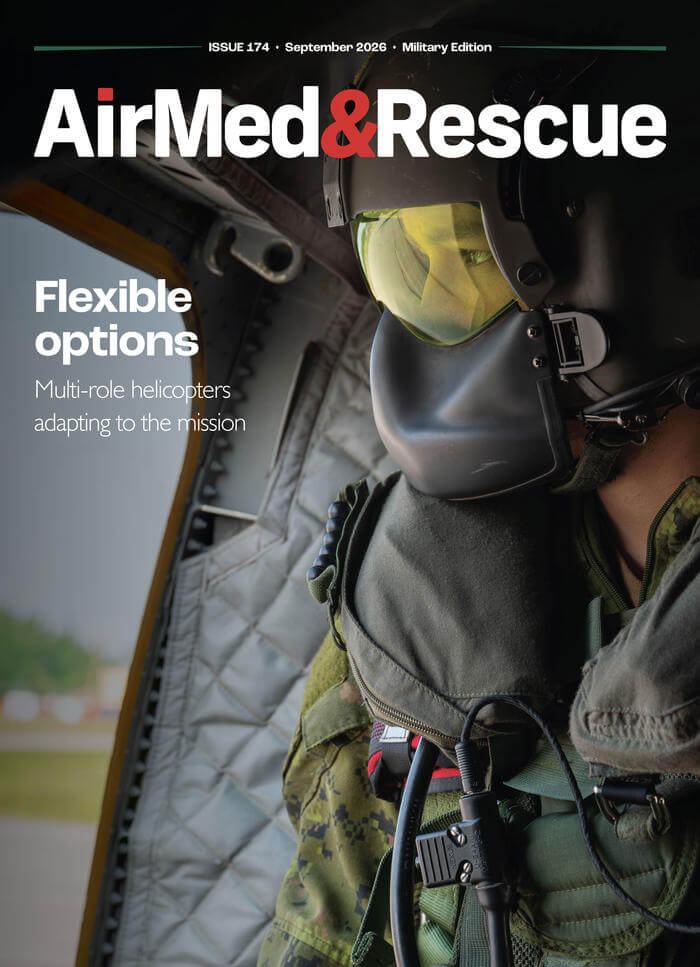
September 2026
Issue
As we reach the equinox, I’m happy that we have an interesting military edition of AirMed&Rescue for you to read on those longer nights. We have features on the benefits of governmental institutions having a multipurpose helicopter; why military operators are at the forefront of exploring optionally piloted aircraft; how uncrewed aerial vehicles are serving as platforms for sensors that can operate in extreme situations; and on the equipment that is essential to carry on board an emergency medical services aircraft.
Jon Adams
Jon is the Editor of AirMed&Rescue. He was previously Editor for Clinical Medicine and Future Healthcare Journal at the Royal College of Physicians before coming to AirMed&Rescue in November 2022. His favorite helicopter is the Army Air Corps Lynx that he saw his father fly while growing up on Army bases.