
Fire support: coordination of ground and air assets

Attacking a fire from the air requires careful coordination with those on the ground as well as other aerial assets. Chris Croot provides a look at the world of aerial firefighting fleets, and how they communicate and operate to ensure maximum effectiveness and safety
Wildfires are an intrinsic part of the natural world’s symbiosis, vital for stimulating new growth. However, as our presence on Earth has grown, so has the risk posed to our wellbeing by fire. As the climate warms, fire seasons start earlier and finish later, and their ferocity is set to increase.
To counter wildfires, firefighters utilize the best tools available. Perhaps the tool that comes to mind first when thinking of wildfires is the ‘waterbomber’ – aircraft of fixed- and rotary-wing varieties spraying varying volumes of water or retardant from internal tanks or underslung buckets. Responsibility for providing this aerial capability varies globally. It may fall to military, federal or civilian authorities; in any such scenario, these organizations may be supported by private contractors.
Fleets
Fixed- and rotary-wing aircraft make effective aerial firefighting platforms. Helicopters deliver water or retardant precisely and can resupply from various water sources using either a bucket or snorkel. They are limited by volume carried, and their endurance can be restrictive – though with careful planning of refill locations, this can be negated.
Fixed-wing aircraft can be categorized into scoopers and tankers. The former are amphibious aircraft, designed to land on or skim across the water’s surface, scooping water into internal tanks. The latter are typically larger, based on cargo aircraft or even converted airliners, and are refilled at land bases.
The Hellenic Air Force operates both Canadair CL-215 and the modernized Bombardier CL-415 amphibious waterbombers (featuring two Pratt & Whitney Canada PW100 turboprop engines, upgraded cockpit, redesigned water release system and aerodynamic improvements), as well as the single-engine PZL Mielec M-18B Dromader. The M-18B is used to respond to wildfires and start the initial attack, with the CL-215 and CL-415 bringing volume to extinguish the fire.
Lieutenant Colonel Christos Lytras, Commander of 338 Squadron, Hellenic Air Force, identified the key strengths of these aircraft: “All three are designed for firefighting missions. They provide the most suitable platforms and characteristics to perform these tasks efficiently. The CL-415 and CL-215 are amphibious aircraft and can pick up water from the sea, lakes or rivers close to the fire area, providing the ability to drop large amounts of water per hour.” All three types are utilized in search and rescue (SAR) operations, while the CL-215 and CL-415 have a personnel transportation capability as well.
CAL FIRE’s Aviation Management Unit (AMU) provides aerial firefighting for much of California. Using the world’s largest civil aerial firefighting fleet, CAL FIRE can reach the remotest of fires in its State Responsibility Area (SRA) in 20 minutes and aims to keep 95% of fires under 10 acres or less.
Using the world’s largest civil aerial firefighting fleet, CAL FIRE can reach the remotest of fires in its State Responsibility Area (SRA) in 20 minutes and aims to keep 95% of fires under 10 acres or less
CAL FIRE’s fleet is a mix of fixed-wing and rotary aircraft, all except for the Beechcraft King Air B200 turboprop, originally intended for military employment. A limited number of Bell UH-1H Super Hueys remain in service, though their age is catching up with them, as Stu Sprung, CAL FIRE’s former AMU Chief of Flight Operations, explained: “The Hueys did a phenomenal job for many, many years for us. But they’re single engine and with the fact we realized there is an advantage to be had with firefighting at night, we had a mandate to do that safely. For that, we need to have a multi-engine helicopter.”
The Sikorsky S-70i Firehawk is the organization’s primary fire attack helicopter (helitack). Base Black Hawk airframes manufactured by PZL Mielec in Poland were procured through United Rotorcraft, Colorado, which conducted extensive modifications to suit CAL FIRE’s needs. A 1,000gal tank is fitted under the fuselage, allowing the single pilot (supported by a front seat captain trained to monitor the helicopter’s primary systems, including autopilot and navigation) to drop water/foam in varying quantities. Cockpit avionics have been upgraded to better suit CAL FIRE’s needs and are night vision goggles (NVG) compatible, and a starboard-mounted hoist allows for SAR missions.
Firehawks are day/night multi-mission platforms tasked with delivering firefighters to the scene of a fire and then supporting them with precision water drops. Sprung explained fleet plans and basing: “We’ll have up to 16, with three still on their way in. Those will be spread throughout 10 bases statewide and are ‘all-risk’ aircraft. So, they will [perform] firefighting, rescue, fire reconnaissance, vegetation management, and move crews.”

The mainstay of the fixed-wing fleet is the Grumman Aerospace S-2T airtanker, with 23 in service. The S-2T is a modified S-2 Tracker, a carrier-based anti-submarine aircraft formerly operated by the US Navy. Upgraded by Marsh Aviation with removal of military equipment and fitting of Garrett TPE331-14GR 1,650shp turboprop engines, the aircraft can carry up to 1,200gal of fire retardant.
S-2s make a very adaptable platform, as Sprung explained: “They were all built for short takeoffs and landings with very stout landing gear and torpedo bays in the middle, which made a very handy spot for a [retardant] tank.” Airtankers are dispersed to smaller airports with shorter runways around California, allowing them to respond quickly to fires. “When used by the Navy, they were dual-pilot aircraft; we were able to transition to single pilot. That allows us to minimize the hazard to life in the aircraft but still make it as effective,” said Sprung.
In August 2024, CAL FIRE introduced the first of seven former US Coast Guard Lockheed Martin C-130H Hercules to its fleet. Inside the aircraft’s cargo hold are tanks capable of holding 4,000gal of retardant, released through the belly by the Coulson RADS-XXL Retardant Aerial Delivery System. The C-130 offers an increase in capacity and provides fleet future-proofing, as Sprung explained: “The S-2T is no longer in production, and we have to manufacture a lot of parts for it ourselves. When I came to CAL FIRE, one of the questions we were asking was: ‘What is going to be our next-generation attack aircraft?’ And, realizing there wasn’t a great replacement for it, the best thing to do was to augment it.” C-130s will be used to support the S-2T rather than replace it.
Coulson Aviation is an industry leader in contracted aerial firefighting with a fleet of large rotary- and fixed-wing aircraft. The family-owned business started in the 1960s as Coulson Forest Products, using helicopters to transport felled timber. “We would get shut down in the summertime because of fires, and then we started getting calls in the late ’80s to start aerial firefighting,” explained President and COO Britton Coulson. “It was a pretty good gig, preventing the devastation of the forests and regeneratively logging.” The company sold off the last of its timber businesses in 2016 and shifted to firefighting.
Unlike CAL FIRE, Coulson Aviation only employs large bombers, such as the C-130 Hercules. Not having access to smaller aircraft isn’t a limiting factor: “The C-130 may carry the same volume as three and a half S-2s, but delivering that volume in one drop is exponentially different,” said Coulson. When dispensing retardant, pilots must aim to overlap 30% of previous drops in order to avoid gaps through which flames may escape. Multiple small drops can therefore be less efficient than larger, continuous sprays by larger aircraft.
The C-130 may carry the same volume as three and a half S-2s, but delivering that volume in one drop is exponentially different
Alongside its fleet of six C-130s, Coulson Aviation operates three Boeing 737 Fireliners, an in-house conversion of the short-haul airliner. The bulk of the fleet are -300 ‘classics’, but the company is modifying its first -700 ‘Next Generation’ series aircraft. But why a converted airliner? “C-130s are ultra desirable, especially H models, to militaries around the world, and so when we looked at continuing to grow the fleet, we challenged ourselves to find the best platform to complement the C-130,” explained Coulson. “The 737 is the perfect physical size, its low stance doesn’t require additional ground support equipment at tanker bases, and it doesn’t have the challenges fly-by-wire airplanes experience in the low-level environment.” The Fireliner gives Coulson Aviation the flexibility to drop retardant (thanks to the same 4,000gal tank as the C-130) and transport firefighters to areas quickly.
The core of Coulson Aviation’s rotary fleet is its Sikorsky S-61s, of which type it is the longest commercial operator anywhere globally. “We’ve got 38 years under our belt with that fleet and hundreds of thousands of hours,” said Coulson. S-61s can be configured to firefight with an external 1,057gal tank or Bambi Bucket, or carry 18 firefighters who rappel/hoist to the ground. It can also be used to rescue civilians trapped by fire or flooding. The aircraft have satellite connection to the Iridium network, allowing precise tracking of drop locations and volumes.
Helitack operations are flown by Boeing CH-47 Chinook and UH-60 Black Hawk helitankers – note the UH-60s are being upgraded with a similar large-volume tank to CAL FIRE’s Firehawks. Coulson Aviation’s CH-47s utilize an industry-leading 3,000gal internal tank, similar in design to that fitted to the C-130s and Fireliners. One of the Chinook’s key advantages is its speed, cruising at 160kts. To preserve this, the aircraft is fitted with the only retractable snorkel of its type in the industry: “The Chinook is a very fast helicopter,” said Coulson. “If you put a fixed snorkel on it, you’re now limited to 110kts, and you just lost its speed advantage. Other legacy helicopters fly that slow.” Coulson Aviation’s Chinooks can be converted to transport personnel and equipment and are night ops capable.
One of the Chinook’s key advantages is its speed, cruising at 160kts. To preserve this, the aircraft is fitted with the only retractable snorkel of its type in the industry
Hynaero’s Fregate-F100 will primarily target historical Canadair operators and be capable of scooping and dropping 10 tonnes of water per hour as opposed to six, and fly 40% faster. According to Hynaero this makes the Fregate twice as efficient as its competitors.
As an amphibious aircraft, the Fregate features a high wing and fixed outrigger floats. Pratt & Whitney 150 engines, which are sustainable aviation fuel (SAF) compatible, will sit atop the wings. Flight controls will be fly-by-wire to improve safety during demanding flight profiles.
Two prototypes are planned for production by 2029, with entry to service with launch customers by summer 2031. So far, €1.2 million has been raised to conduct the feasibility concept phase against a target of €1 billion, with letters of interest from operators in Indonesia, France, Turkey and Australia. Partnerships with major assembly and systems manufacturers have been signed (ONERA, Bt2i Group, Aresia, Altitude Aerospace and Thales), though some remain confidential.
“Our initial objective is to build 150 Fregates, but we have already been approached by some countries and companies for potential passenger, freight, search and rescue, and maritime surveillance variants,” said Pincet. Hynaero will need to sell 35–40 aircraft to break even but believes there may be a market for more than 300 by 2050.
Training
Hellenic Air Force pilots follow a typical training pathway, progressing through the Air Force Academy before being assigned to a firefighting type. Personnel are trained by their squadrons in the specific roles and requirements of that unit and participate in exercises of varying complexity. Scooper crews train for sea and lake operations and practice increasingly harder drops as they progress.
Hynaero intends to establish a dedicated training facility alongside its final production line, likely in Bordeaux, where technicians and crews will receive their type certifications. How much training will be conducted in France is to be determined by customers, but crews will be trained in scooping and dropping.
In January 2024, Coulson Aviation received Transport Canada Approved Training Organization (ATO) status for its training academy. This trains high-school students and funds their Aircraft Maintenance Engineer – Structures (AME-S) license, ensuring a capable flow of engineers into the company. The ATO does not cover pilot training; instead, Coulson recruits experienced crews from both the military and airline industry: “We have one path where we take experienced aircraft commanders that are non-fire pilots and grow them into fire pilots. We then have another path where we take experienced fire pilots that come to us from other competitors in the industry and pair them with the experienced commanders,” explained Coulson.
This, combined with Coulson Aviation maintaining contracts in North and South America and Australia, ensures that effective year-round training is available. The company rotates its crews around the world to experience the contrast in fire conditions: “The US is great to train people in, but the fires in South America and Australia are very different when it comes to vegetation and weather,” Coulson said. He went on to explain how crews then take lessons learned in one geographical area and adapt tactics in another.
The US is great to train people in, but the fires in South America and Australia are very different when it comes to vegetation and weather
CAL FIRE also recruits seasoned pilots, who are put through an incremental upgrade training program. Pilots first start flying the North American Rockwell OV-10A Bronco with an experienced aerial attack supervisor in the rear seat. Sprung explained how this “gives them a chance to listen to the radios, understand how incidents start, operate and wind down, and to put the pieces of the puzzle together.” Crews will do this until they have built sufficient seniority to then apply for an airtanker trainee position, typically on the S-2. The pathway to the C-130 is still being determined; presently, experienced pilots and flight engineers are being utilized through direct entry.
S-2T training takes 18–24 months and qualifies pilots to independently act on fires, fly low-level and coordinate airspace if needed. “I am the one that does the check right at the very end and qualifies them. It’s got to be one of the most humbling experiences a pilot can go through. We’ll have very experienced fighter pilots come from the military and say it was the most grueling thing in their career,” said Sprung.

Ground monitoring and coordination
Attacking a fire from the air requires careful coordination with those on the ground and deconfliction with bombers in the air. Both CAL FIRE and Coulson employ dedicated observation and control aircraft during their firefighting operations.
CAL FIRE’s platform of choice is the OV-10A, a two-seat light attack/observation aircraft. CAL FIRE’s fleet of 15 Broncos now provides an aerial supervision capability. Sprung discussed how the aircraft was modified for this role: “We’ve demilitarized them by around 4,000lbs. We have taken all of the armor out, the ejection seats, munitions hardware, and fitted turboprop engines. They have six radios inside, monitored by the air attack officer, and an auxiliary fuel tank to increase their ability to stay on station for up to five hours.”
To deconflict with aircraft and ground parties, CAL FIRE uses a combination of tried and tested methods and technology. “We require some sort of traffic avoidance systems in all of the aircraft, not just our own but in our contracted aircraft, as well as Automatic Dependent Surveillance-Broadcast (ADS-B) In. They’re all supposed to have ADS-B Out, but we also require they have In,” explained Sprung. Pilots maintain ‘see and avoid’ tactics, while firefighters on the ground use ‘hear and avoid’ as another safety net.
Once aircraft have been cleared into the area and directed onto the fire by the aerial supervisor, a ground supervisor ‘clears the line’, visually ensuring the drop will not impact firefighters
Once aircraft have been cleared into the area and directed onto the fire by the aerial supervisor, a ground supervisor ‘clears the line’, visually ensuring the drop will not impact firefighters. However, the final responsibility for a drop lies with the pilot. Before releasing water/retardant, pilots will conduct a dry run to look for any obvious signs of ground activity. If they cannot confirm a clear area, they go around and recontact the aerial supervisor. Sprung said that although most firefighters will have been accidentally dropped on by helicopters, a drop from an airtanker can be more serious: “36,000lbs is coming out of the C-130s!”
The organization is working to implement technology that allows aircrews to monitor ground-based personnel in real time. The major issues to overcome are ensuring that both parties have a reliable connection to the network – no easy feat in California’s hills and valleys – and ensuring the right level of data makes it to the aircraft: “Right now, there is a fire in Ventura County with 3,000 people on the ground,” said Sprung. “That might get a little noisy on a map, so how do you get just the right amount of information?” The problem will likely be solved utilizing satellite communications and software not dissimilar to the blue force tracking used by the US military to track troops.
To monitor fire progress CAL FIRE uses Beechcraft King Air B200s outfitted with sensors to gather visual and infrared (IR) imagery and data. One aircraft is owned by CAL FIRE, and two are operated in partnership with the California Governor’s Office of Emergency Services (Cal OES). This information can be fed into the University of California WIFIRE supercomputer to provide real-time fire modeling and predictions.
Coulson Aviation instead utilizes Cessna 550 Citation II corporate jets to react quickly to reports of wildfire. Although at first glance it may seem costly to operate jet aircraft in this role, Coulson explained the rationale: “One of the fire chiefs in southern California said it best: ‘There’s no amount of money too great you can spend in the first hour.’” The four Citations are fitted with a line-scan system or a Teledyne FLIR Star SAFIRE 380-HD gimbal camera and satellite uplink. This allows the mission crew to gather wind and temperature data readings, building a picture of what the fire is likely to do and determining which additional support may be required.
On-scene control is provided by a Sikorsky S-76 helicopter coordinator (HELCO), which, in addition to guiding tankers, is equipped with IR cameras and sensors. Mission operators in the rear of the cabin process and downlink data in real time, looking for shifts in the fire or spot fires with the potential to start a new blaze. As with CAL FIRE, data collected by the Citation and S-76 can be sent to the WIFIRE supercomputer.
Hellenic Air Force aircraft transmit their location and flight parameters to fire supervisors at a base of operations (BoO), which coordinates assets moving to and from the scene. Traffic avoidance is provided by air traffic controllers while aircraft are close to the airport and by the on-scene commanders (OSC) and coordination officers in the field of operations.
The OSC, usually a fire department officer, has operational authority around the fire. They provide aircraft with a drop location and attack direction based on weather, visibility, turbulence, terrain and planned attacks by other bombers.
Communication between aircraft and firefighters is via two-way radio: “The functionality of this equipment is of the utmost importance, as many firefighting aircraft and helicopters may operate in the same area, and even slight confusion or misunderstanding can prove fatal,” said Lytras. No special tracking equipment is in use at the moment.
The functionality of this equipment is of the utmost importance, as many firefighting aircraft and helicopters may operate in the same area, and even slight confusion or misunderstanding can prove fatal
Hynaero aims to introduce an integrated mission system based on an air-land situational awareness network to provide deconfliction to all assets operating in and around the fire. “We will bring on board artificial intelligence which will analyze and map the fire, weather and vegetation, and will propose to the pilots potentially more efficient angles of attack for drops,” added Pincet. Like CAL FIRE, Hynaero wants a system comparable to blue force tracking. The Traffic Collision and Avoidance System (TCAS) and ADS-B In/Out will form part of the traffic deconfliction software.
The Fregate is being developed to integrate into existing fire management systems, such as CS Group’s Crimson in France: “We want to make sure the Fregate-F100 can plug into the crisis system that exists already and know how that is going to evolve because we want the aircraft to be competitive and relevant for the next 10–15 years,” said Pincet.
To enhance flight safety further, Hynaero is in discussion with industry to introduce microwave radars on board the aircraft for obstacle detection. This system will spot trees and power lines, and provide ridge crest clearance warnings. Pilots will also have heads-up displays, maximizing time spent ‘eyes out’ rather than monitoring instruments.
April 2025
Issue
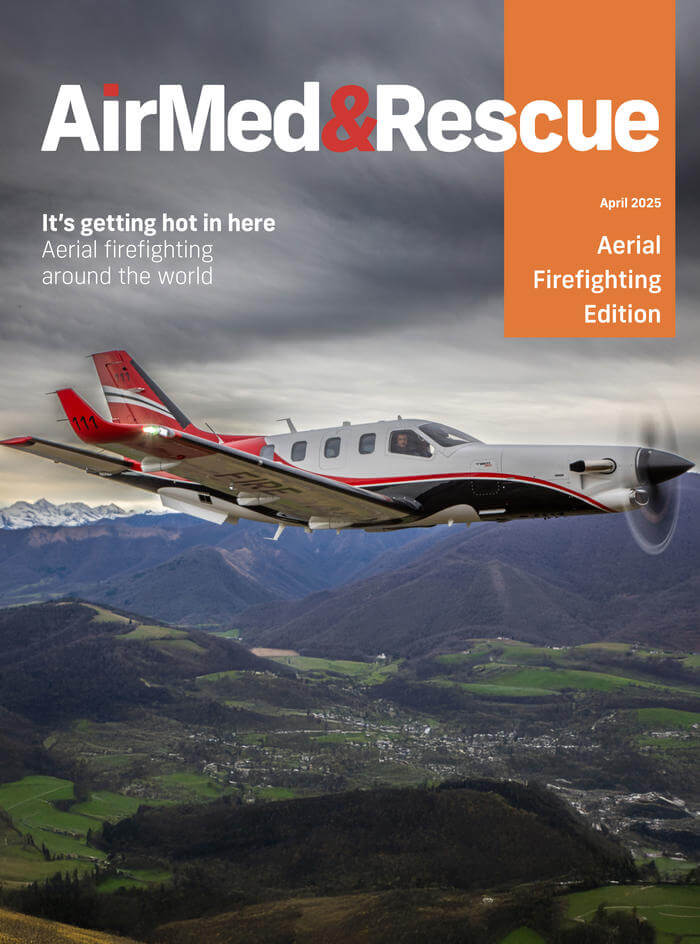
Our April edition has a special focus on aerial firefighting, with features that include rescues during wildfire situations; the coordination process and tools used between aircraft and firefighters; the distinct job of the smokejumper; the different use cases for buckets and tanks, and what needs to be considered for your airframe; the continued appeal of the Firehawk platform; and the importance of proper expertise when treating traumatic brain injuries; plus more of our regular content.