
Forces of nature versus air forces

Natural disasters and emergencies can swamp the resources of civilian organizations. Ian Harbison looks at some examples where air forces can provide invaluable help
Military aircraft can provide fast and effective assistance to the civil powers in the event of natural disasters. Tactical transport aircraft can deliver specialist equipment and personnel close to the scene as their airfield performance allows them to use even unprepared landing strips, while helicopters can operate anywhere. An important aspect is the immediate treatment of casualties and their transfer to hospitals further away from the epicenter to avoid overloading local medical facilities.
The Royal Air Force
In the case of the UK’s Royal Air Force (RAF), assistance is from a combination of the Airbus Atlas C.1 A400M and Boeing C-17 Globemaster III transports, as well as the Airbus Voyager tanker transport (based on the A330-200), supplemented by the Boeing CH-47D Chinook and Westland Puma HC2 helicopters, as well as the AgustaWestland AW101 Merlin operated by the Royal Navy.
Operational medical planning for the RAF is conducted by the Medical Operations team, often in conjunction with the Permanent Joint Headquarters. The mounting and delivery of RAF Medical Force capabilities is then delivered by the Tactical Medical Wing (TMW) based at RAF Brize Norton. Through the Medical Reserves Wing, Medical Force capabilities, exercises, training, and deployments are routinely augmented by Medical Reservists.
TMW’s roles include the training of RAF medical personnel, as well as some tri-service personnel. TMW also equips medical personnel and capabilities ranging from RAF medics, paramedics and doctors to flying and ground-based medical treatment facilities. The Wing also holds the RAF Medical Services’ highest-readiness clinicians and delivers worldwide strategic air medical evacuation, 365 days a year.
TMW coordinates around 1,700 strategic air medical evacuations each year; the most complex patients are evacuated strategically by the RAF’s Critical Care Air Support Team, (CCAST), a capability that is on continuous standby to transfer the most critically ill or injured patients by air. The team includes a consultant, two flight nurses, a medic and a Medical and Dental Servicing Section (MDSS) engineer.
TMW coordinates around 1,700 strategic air medical evacuations each year; the most complex patients are evacuated strategically by the RAF’s Critical Care Air Support Team,
There are no dedicated RAF air medical aircraft or helicopters, so the teams are platform agnostic and aircraft will be determined by operational and medical requirements. CCAST is self-contained, and team members meet their allocated aircraft bringing all the necessary medical equipment and supplies, typically enough for 24 hours. Standard intensive care unit (ICU) equipment, such as monitors, ventilators and oxygen, can be installed around the stretcher, which is fitted with a vacuum mat to keep the patient immobile. A five-point harness is also used where possible.
Communication between the medical professionals and aircrew is paramount to understand the complexities of looking after a patient in-flight, with issues such as turbulence and variations in cabin pressure that can have adverse effects.
Although TMW primarily delivers medical evacuation to UK military personnel, it can cover a wider group of entitled personnel, including support to British Overseas Territories, partner nations, contractors, and civilians. This is determined by direction from the Ministry of Defence (MOD) and through the Medical Rules of Eligibility (MROE). Much of the latter work involves close cooperation with the Foreign, Commonwealth & Development Office (FDCO) – for example, hurricane relief in the Caribbean or repatriation of Ebola victims from Sierra Leone using a mobile Air Transportable Isolator in a C-17 – but an outstanding example was the UK response to the devastating earthquake in Turkey in February 2023, called Operation Greenlighter.
The FCDO launched its Emergency Medical Team, which provides rapid, coordinated and appropriate medical assistance in the immediate aftermath of humanitarian disasters. Its partner is UK-Med, a medical non-governmental organization (NGO).
TMW deployed alongside Tactical Aeromedical Evacuation (Tac AE), responsible for patient movements by air, CCAST, and Role 1 (AIR) Lead – a primary healthcare capability to support deployed personnel, augmented on this occasion with a 10-bed ward. TMW deployed its capabilities at eight and 48 hours’ notice, including one reservist who, after consultation with their civilian employer, deployed in less than 24 hours.
All were flown by Lockheed Martin C-130J Hercules to Türkoğlu, around 30km from the earthquake epicenter in Nurdağı. Ironically, the Hercules was retired from the RAF just four months later, having been at the forefront of relief operations like these for 56 years, including Operation Khana Cascade 50 years earlier, in which some 2,000 tons of grain, maize and rice were dropped to Himalayan villagers in Nepal in the biggest airlift since Berlin.
In Türkoğlu, Role 1 (AIR) Lead was co-located alongside a Turkish medical facility, a field hospital run by 16 Medical Regiment of the Royal Army Medical Corps, and a UK-Med facility. During the deployment, the combined medical facility treated 6,394 patients, of which 1,872 were directly treated by MOD personnel.
On this assignment, the RAF supported the movement of 151 patients across nine missions. This included two moves collaborating with the Royal Norwegian Air Force, also operating Hercules, as was the Royal Netherlands Air Force. The cooperation allowed more patients to be transferred more quickly, up to 27 patients on one flight.
Nearly all of the patients were earthquake victims, and many had suffered significant injuries because of days under rubble, including an 89-year-old Turkish national who had been trapped for five days and a five-year-old child who needed lifesaving treatment by the team that was not available locally.
On one occasion, CCAST, with a team comprising a consultant anesthetist, five nurses, three medics, a paramedic and a medical equipment technician, flew to Adiyaman Airport in Turkey, close to one of the regions worst affected by the earthquake
On one occasion, CCAST, with a team comprising a consultant anesthetist, five nurses, three medics, a paramedic and a medical equipment technician, flew to Adiyaman Airport in Turkey, close to one of the regions worst affected by the earthquake. Patients injured in the earthquake, close family members and Turkish medical staff then flew 550km to Etimesgut, where treatment was available.
The Canadian Armed Forces
On the other side of the Atlantic, the Canadian Armed Forces (CAF) have a major role to play in search and rescue (SAR), having the primary responsibility of providing aeronautical SAR services, while the Canadian Coast Guard is responsible for maritime SAR services. The CAF is also responsible for the effective operation of this coordinated aeronautical and maritime SAR system.
Royal Canadian Air Force (RCAF) wings, located across Canada, provide military air resources in response to approximately 700 SAR taskings annually.
The CC-130 Hercules and Airbus CC-295 Kingfisher are fixed-wing aircraft that can respond quickly over great distances and dispatch specialized equipment, such as air-droppable survival kits, including life rafts and shelters, along with SAR personnel.
The AgustaWestland CH-149 Cormorant and Bell CH-146 Griffon helicopters are the primary rotary-wing aircraft used to respond to SAR. They offer precision response with hoist capabilities, along with highly trained SAR personnel to assist and recover people from very remote situations.
Most other CAF aircraft, such as the Lockheed Martin CP-140 Aurora anti-submarine aircraft, have the ability to provide some SAR service as a secondary role.
The CAF has approximately 140 SAR technicians, or techs. They are highly trained specialists who provide advanced pre-hospital medical care and rescue for aviators, mariners and others in distress in remote or hard-to-reach areas. These individuals are trained to a primary-care paramedic national standard with additional advanced skills. SAR techs are land and sea survival experts who specialize in rescue techniques, including Arctic rescue, parachuting, diving, mountain climbing and helicopter rescue.
The CAF has approximately 140 SAR technicians, or techs. They are highly trained specialists who provide advanced pre-hospital medical care and rescue for aviators, mariners and others in distress in remote or hard-to-reach areas
As an example, in May, a CC-295 Kingfisher from 19 Wing Comox, based on Vancouver Island, deployed RCAF SAR techs during its first operational parachute deployment to rescue a downed pilot near Mount Kinney, British Columbia. The rescue involved coordination with the Royal Canadian Mounted Police (RCMP) and BC Emergency Health Services. This successful mission occurred just 21 days after the Kingfisher assumed SAR duties in British Columbia.
The RCAF supports the efforts of the Civil Air Search and Rescue Association (CASARA), which is a volunteer organization that contributes directly to SAR outcomes by providing additional search resources for SAR efforts. CASARA assets include privately owned aircraft equipped with trained crews and spotters, as well as electronic homing equipment and, most recently, drones operated by volunteers to search high-probability areas.
Canada’s vast and diverse geography presents logistical hurdles, making timely responses to remote or hard-to-access areas complex. Extreme weather conditions, including Arctic cold, mountainous terrain, and turbulent seas, further complicate operations and increase risk.
The CAF response to natural disasters is called Operation LENTUS. If provincial and territorial authorities are unable to cope, they can call on the federal government for additional resources, which can include CAF personnel, equipment and facilities. Operation LENTUS follows an established plan of action to support communities in crisis, which can be adapted for forest fires, floods, ice storms, or hurricanes.
There has been an increasing demand on the CAF, especially associated with evacuations ahead of out-of-control wildfires.
In August 2024, the Minister of Emergency Preparedness approved a request for assistance from the Province of Manitoba for the Department of National Defence (DND) and the CAF to provide support to the province to manage the evacuation of approximately 2,700 members of the remote fly-in community of Bunibonibee Cree Nation. The first flight evacuated 54 passengers, including elderly, mobility impaired, and vulnerable persons, to Winnipeg. The operation was complete three days later with evacuations to Winnipeg, Brandon and Thompson.
The first flight evacuated 54 passengers, including elderly, mobility impaired, and vulnerable persons, to Winnipeg
In June 2025, another operation involving 170 CAF members saw the evacuation of more than 3,800 people from Norway House, Cross Lake, and Pukatawagan in northern Manitoba. This involved CC-130 Hercules and De Havilland Canada CC-138 Twin Otter aircraft, and Bell CH-146 Griffin and CH-147 Chinook helicopters. It also involved KF Aerospace, which, as Allied Wings, operates a Contracted Flying Training and Support (CFTS) program at Southport, Manitoba. Several of its Bell 412CF helicopters were drafted in to safely move more than 250 people, despite heavy smoke, poor weather, congested airspace, and equipment challenges.

The US Air Force
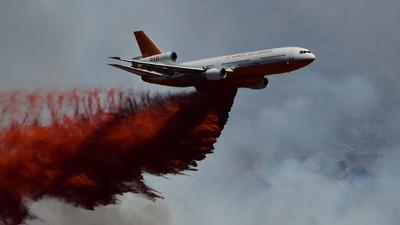
In the USA, the military also gets involved with wildfires, although it is rather more hands-on. The US Forest Service (USFS) has a well-established network of contracted civilian firefighting operators with a range of airtankers. There is a non-compete clause between these and the military but, if they are out of retardant, or if there are technical problems, or if surge capacity is needed to fight larger outbreaks, additional support is provided by the Air Expeditionary Group.
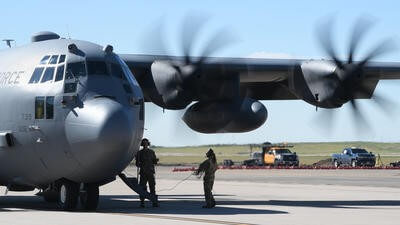
This consists of one Air Force Reserve unit and Air National Guard units in California, Nevada and Wyoming. These are the 302nd Airlift Wing from Colorado Springs, Colorado; the 146th Airlift Wing from Port Hueneme, California; the 152nd Airlift Wing from Reno, Nevada; and the 153rd Airlift Wing from Cheyenne, Wyoming. All fly the C-130 Hercules.
The units use the Modular Airborne Fire Fighting System (MAFFS), which is provided by the USFS along with the retardant. It has eight MAFFS II systems. The equipment is loaded into the cargo compartment and can drop up to 3,000gal of water (or a mix of water and fire retardant) weighing 28,000lb in six seconds through an S-duct installed in the paratroop door on the rear left side of the aircraft. This has a footprint measuring a quarter of a mile long by 100ft wide. The drop is carried out at an altitude of 150ft. After that, it returns to base to be replenished and can be back in the air again in less than 20 minutes.
The equipment is loaded into the cargo compartment and can drop up to 3,000gal of water (or a mix of water and fire retardant) weighing 28,000lb in six seconds through an S-duct installed in the paratroop door on the rear left side of the aircraft
Activation normally starts with a request issued by the USFS to the US Secretary of Defense, although they can also be activated by the Department of Agriculture through the USFS, the Department of Defense or the governor of the states where the Air National Guard military units are located.
In the past 10 years or so, military C-130s equipped with MAFFS have delivered about 8 million gallons of fire retardant on wildfires around the USA. And, of course, climate change is ensuring that the risk of wildfires is increasing.
September 2025
Issue
Our September edition is the special military issue, bringing together news, features and other articles that showcase military contributions to special missions. We have themed features on air forces helping with disaster response, the stretchers and baskets that make combat search and rescue possible, and the varied duties of military coast guards, and we have an extra non-themed feature on the medical equipment used in air ambulances.
Ian Harbison
Ian has had a long career in the defense and aerospace industry, including journalism, PR and market intelligence.
Between 1990–2000, he was at Shephard Press as Editor of Commuter World, later Regional Airline World, and launch Editor of Air Ambulance and Inflight magazines.
From 2004–2020, he was at Air Transport Publications, as Editor of MRO Management, as well as launch Editor of Low Cost & Regional Airline Business, GreenSky - Aviation and the Environment and Aircraft Cabin Management and MRO News Focus newsletter.
From 2000–2004, he variously handled PR for Bombardier Regional Aircraft, was Editor of Offshore Patrol magazine and Airline News Weekly, and freelanced. He is currently freelancing for several publications in the UK and the USA.