

Gallery: Aerial firefighting in northwest Italy

The Vigili del Fuoco were on hand when a warehouse fire in northwest Italy demanded the intervention of a helicopter firefighting team to complement the work of the firefighters on the ground. Words and images by Dino Marcellino
A huge fire that destroyed a warehouse of a chipboard manufacturer, a factory located in the town of Frossasco in northwest Italy, was an unusual operating environment for the firefighting helicopters. The fire started at 04:30 hrs, and was to last for a number of days.
The scenario was dramatic: an enormous pile of wooden waste, estimated to be around 30,000 tons, was stored inside the industrial factory area.
It was clear that it would be very difficult to extinguish the flames, so the priority was to prevent the fire from spreading to the buildings surrounding the plant, as well as to other neighboring industrial sites and nearby residential buildings.
The Italian fire brigade, the Vigili del Fuoco (VVF), mobilized 10 teams from various stations and a wide range of fire trucks, water tankers, a coordination unit, and a unit for recharging breathing apparatus. The firefighting inside the plant was performed exclusively by the fire brigade because the situation required breathing equipment and specialist clothing to be worn by the teams.
Outside, the local farmers offered their water irrigation pumps, which sprayed water onto the piles of timber that had not been affected.
As the fire raged the columns of smoke rose into the air, requiring some nearby houses to be evacuated under the instructions of the town’s Mayor. Homes in proximity to the north and west sides were evacuated.
The extremely high temperatures, estimated to have reached around 800°C, did not allow the firefighters to work between the piles of wood, meaning their vehicles could not get close enough to the source of the flames. The first day therefore also required helicopters to fight the fire from the air.
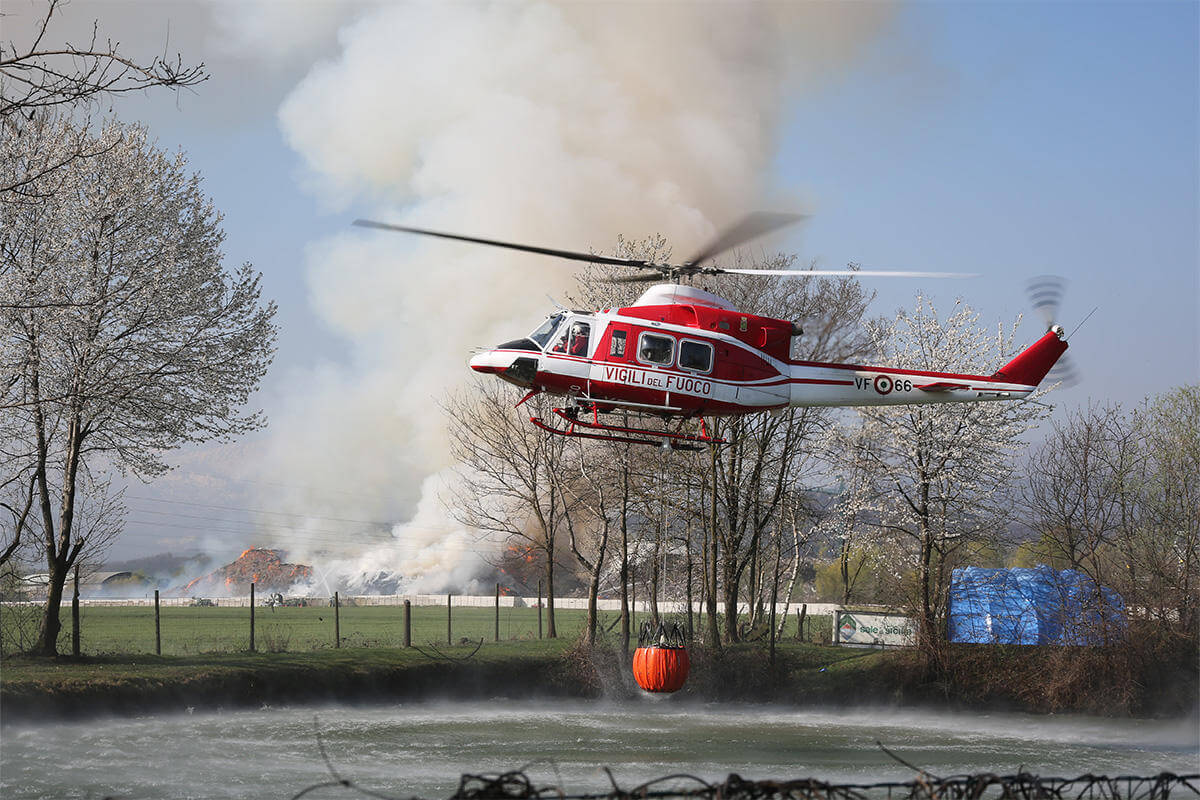
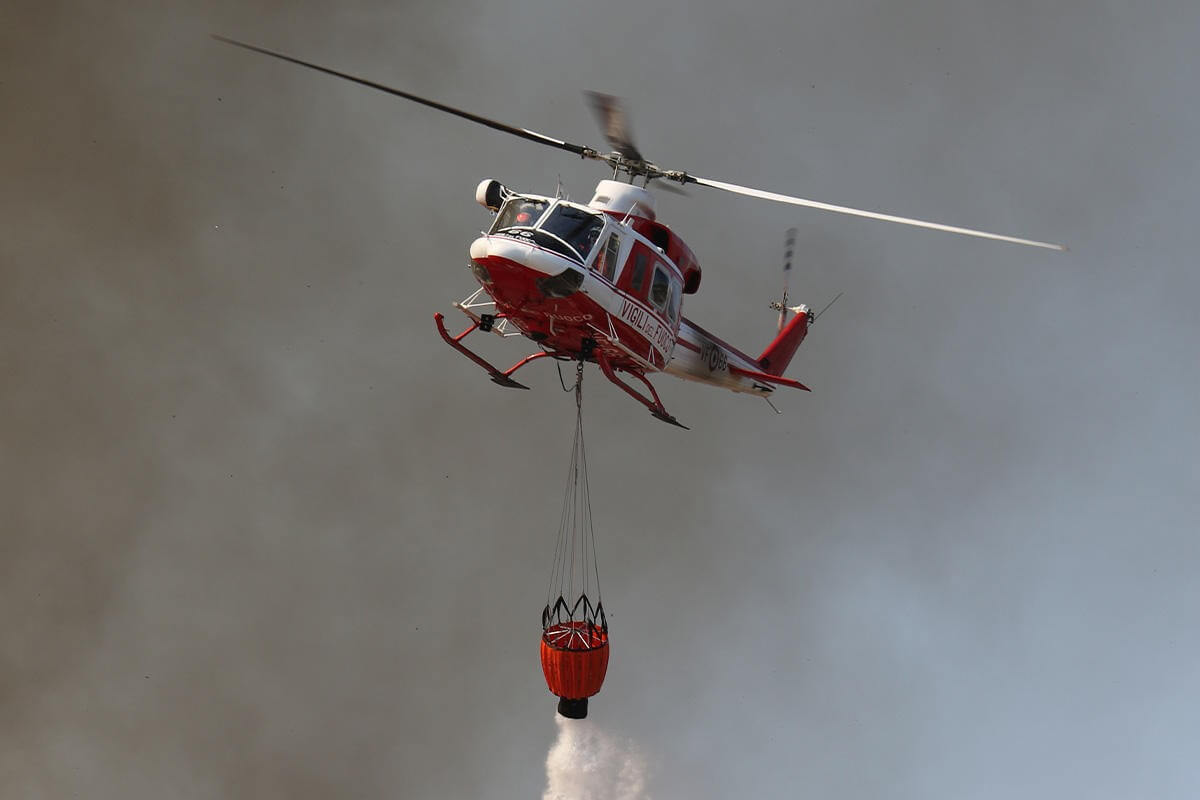
An AB-412 arrived on site from the VVF Piedmont Helicopter Unit, based in Turin Caselle Airport; the crew carried out a reconnaissance flight, and then started attacking the flames in an area where the ground teams could not reach. A nearby private water basin, used for irrigating fields, allowed the AB-412 crew to fill the 1,000L Bambi Bucket every four minutes. The fire was bombarded from different directions, depending on the smoke and wind. The only pause was to stop for fuel, which was supplied by an on-site mobile VVF unit, which brought 900L of fuel.
The crew gave an honest appraisal of the situation: “A fire of this type is difficult to extinguish. We are aware that our intervention is not decisive, but it is a contribution to containment and control of the situation.”
In addition, a more powerful Erickson S-64F attended the scene and had a significant impact on the fire, thanks to its performance in dropping 9,000L at a time. The S-64F crew give ample proof of the capabilities of the helicopter, using different techniques in their approaches and in dropping water: single releases, multiple drops, swipe and bomb on a single point in a turn; of course, all maneuvers being accomplished at low level.
For both helicopters, the attack phase was complicated: the high structures within the plant and the heavy smoke, along with the close proximity of houses, made the flight in the confined area extremely hazardous. For the crews, it could not have been easy to fly with the acrid air that burns in your throat, and high external temperature.
The aerial activities were coordinated by an Operations Manager on the ground, which allowed them to maintain control of the situation and ensure the safety of the people on the ground and in the air.



April 2025
Issue
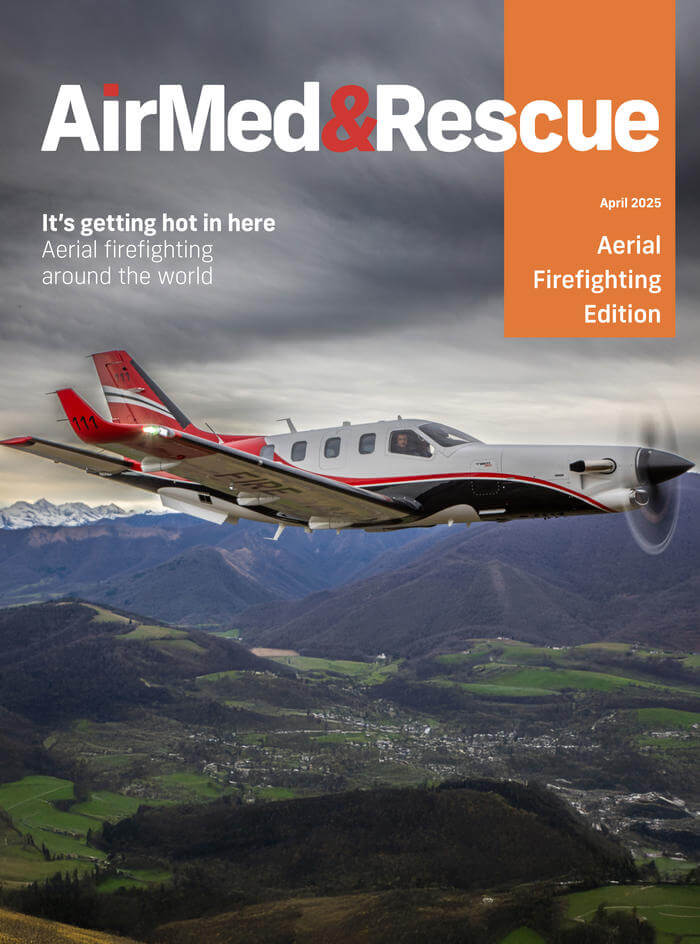
Our April edition has a special focus on aerial firefighting, with features that include rescues during wildfire situations; the coordination process and tools used between aircraft and firefighters; the distinct job of the smokejumper; the different use cases for buckets and tanks, and what needs to be considered for your airframe; the continued appeal of the Firehawk platform; and the importance of proper expertise when treating traumatic brain injuries; plus more of our regular content.
Dino Marcellino
Known around the world for his aviation photography and reports, Dino Marcellino has been fascinated by aircraft since his childhood, and has spent his life combining his passion for aircraft with that of photography. Flying on more than 25 different types of helicopters, he has worked with the Italian Navy, Army and Air Force, as well as police and rescue organisations.