

Gallery: Falcon Spring 2025

Peter ten Berg describes a Dutch military exercise encompassing a range of battle scenarios, including deployment of a complete medical unit into theatre, transport to a tactical field care unit, and medical evacuation
In the light of growing training needs, troops of the Dutch 11th Air Mobile Brigade (11 AMB) conducted a new mobility exercise, Falcon Spring (FS). Major Mark Bakker, Deputy Commander of 11 AMB and exercise director, explained the need to train regularly with the helicopters in realistic scenarios. Due to the larger size of the exercise, the Dutch Chinook and Apache helicopters were joined by US Army Chinooks and Black Hawks, totaling 20 aerial assets.
FS included developing battle scenarios for which temporary forward operating bases (FOBs) were set up. Another element to maximize flexibility for helicopter operations was the use of forward arming and refueling points (FARPs) at various locations to remain in the vicinity of the battlefield.
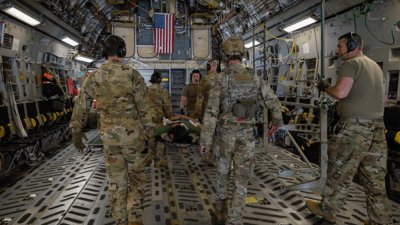
Tactical combat casualty care
When the troops were airlifted to a new area, the helicopters conducted follow-up logistics flights to provide them with sufficient support means, vehicles, and supplies.
Next was a deployment of a complete medical unit into theatre. Chinooks carried Mercedes-Benz 290GD terrain trucks with a small trailer attached, underneath the helicopter, while the medical crews were on board the CH-47s.
Shortly after being airlifted, the medical units set up a medical facility on site to become operational within an hour and fully equipped to operate for 48 hours independently.
The military define the medical routing in the field as tactical combat casualty care (TCCC), which knows three specific areas, namely care under fire (CUF), tactical field care (TFC), and tactical evacuation care (tacevac). The medical unit at FS was the TFC unit, to which casualties from the front line were transported. At this facility, they were assessed according to the MARCH protocol to prioritize casualties for further treatment. This protocol follows a standardized way to assess casualties for massive bleeding, airway, respiration, circulation, and hypothermia (MARCH).
Medevac
The TFC unit assessed one of the incoming casualties, played by an actor, for urgent follow-on hospital treatment and applied tacevac, appropriate medical care during transport from the field to the hospital.
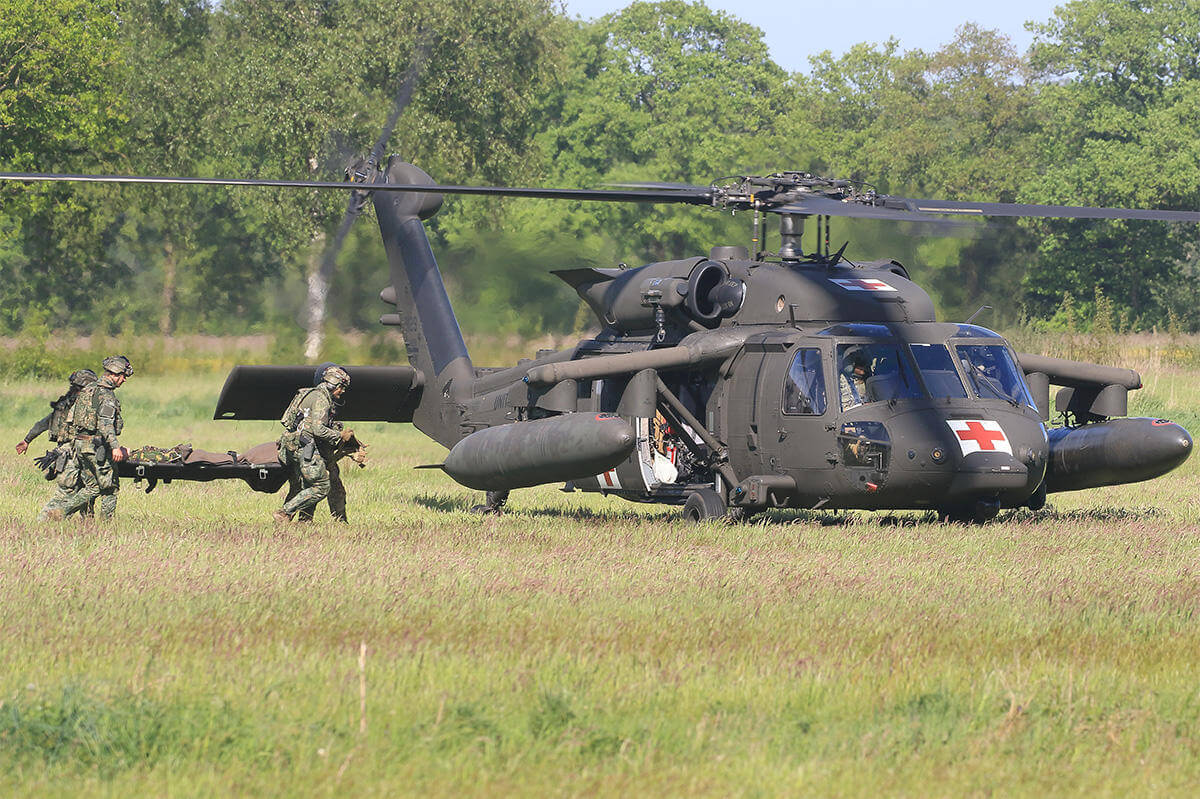
Meanwhile, a US Army HH-60M Black Hawk was called upon from its FOB by the TFC unit in the field to execute a medical evacuation (medevac). In less than 10 minutes, the HH-60 approached the TFC while flying tactically at low treetop level. Within minutes the casualty was on board and the Black Hawk departed the provisional landing zone (LZ) and disappeared quickly out of sight.


November 2025
Issue
Our November edition is packed with content relating to special missions from around the world. We have features that explore the design and engineering that go into modern rotorcraft; the interactions between ground and air teams on helitack operations; the tools and attire needed for successful water rescues; and the new onboard technology that is revolutionizing special missions by detecting and communicating with cell phones.
Peter Ten Berg
Inspired by the dynamics of aviation and a passion for photography, Peter accompanies aircraft and helicopter crews to capture them at work and hear their story for his exclusive reports. His focus is on military aviation as well as governmental subjects including HEMS, SAR, UAV and rescue.