

Gallery: The Olympic Yellow Flames: The Guardia di Finanza at Milano Cortina 2026

The Winter Olympic Games 2026 took place across multiple sites across Lombardy and northeast Italy. Called to support the riskier sports were the air sections of the Guardia di Finanza. Dino Marcellino was on hand to capture photos and record the operation
A fundamental requirement expressed by the Milano Cortina Organising Committee of the Winter Olympic Games 2026 was that two helicopters dedicated to Games activities had to be available and operationally ready at the competition venues where the most risky sports were taking place. These helicopters were to remain on site throughout the competitions, during both the trials and the actual competition, and in any case for as long as the operations room deemed appropriate.
The primary helicopter was configured for helicopter emergency medical services (HEMS) operations and was provided and operated by civilian operators active in the specific sector, ready to intervene within minutes to assist athletes, staff, volunteers, and anyone involved in the Olympics.
The secondary helicopter, provided by state agencies, was designed to ensure the continuity of rescue operations in the event that the primary helicopter was already engaged in a rescue.
The Guardia di Finanza (Financial Guard) mobilized its two Alpine-based Air Sections in Varese and Bolzano, both equipped with Leonardo UH/MH169A helicopters. It deployed one helicopter to Bormio and one to Cortina, with a helicopter on standby in Bolzano, and a fourth helicopter for territorial surveillance equipped with forward-looking infrared (FLIR) sensor, Airborne Tactical Observation and Surveillance (ATOS) mission console, and an international mobile subscriber identity (IMSI) catcher.
The Guardia di Finanza, a police force also known in Italy as the ‘Yellow Flames’ (Fiamme Gialle), also mobilized 850 ground troops to contribute to security; and 30 athletes from its sports group took part in the Olympic Games.
Following an athlete’s fall/incident, a coordinator manages the activation of rescue operations, both on the slopes and by helicopter, and codifies the operations.
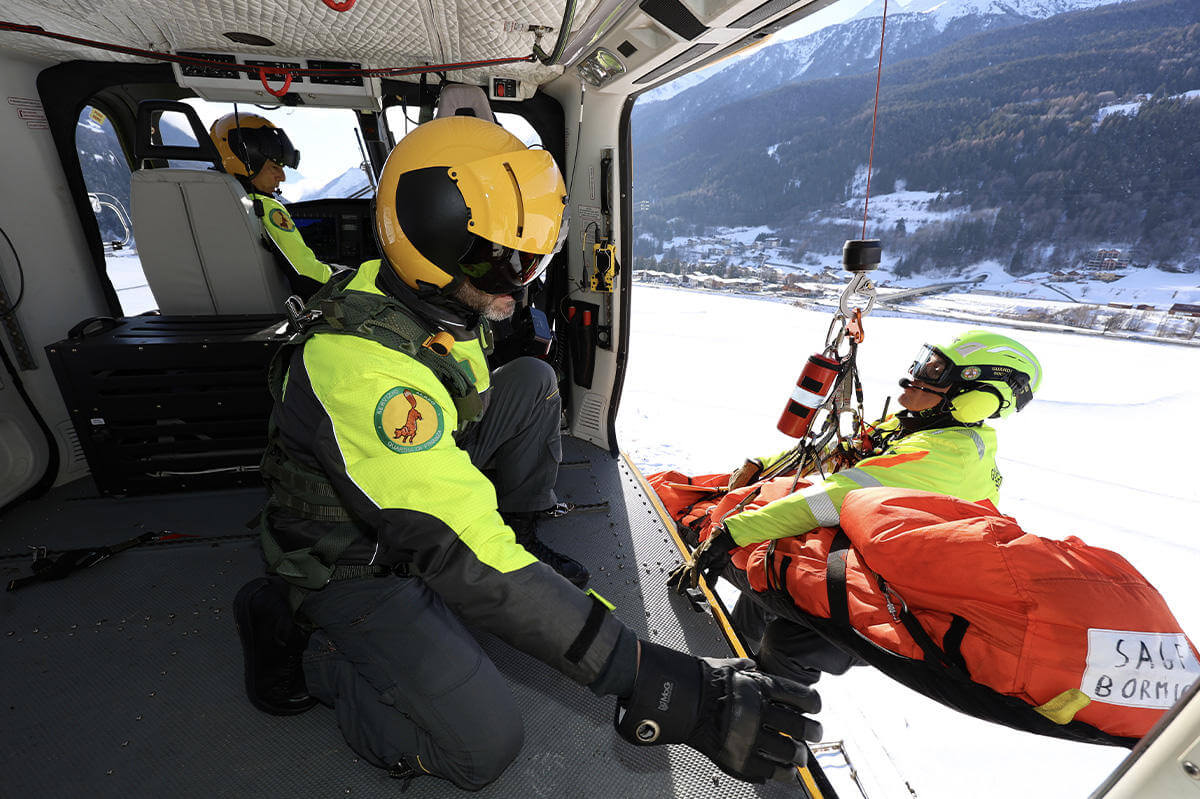
If the helicopter is alerted, its crew get on board and start the rotors, awaiting confirmation for takeoff. If, in the meantime, the patient is found to be independently mobile, the mission is aborted, and the crew stop the rotor and return to standby. If the patient is placed in a stretcher, takeoff is carried out for recovery via winch.
At this point, several scenarios arise: if the athlete’s condition is very serious, the primary helicopter transports them directly to the most suitable hospital, with the secondary helicopter subsequently taking over operational readiness for rescue. If an athlete’s condition is deemed not to require direct transport to the hospital, the athlete is taken to the helipad, where they are picked up by the secondary helicopter’s crew and taken to the hospital, while the primary helicopter repositions itself for any further emergency.
Winching operations on the slopes are carried out using the maximum cable extension, with pulls of 80/90 meters, to ensure the safety of everyone on the slope, as well as the integrity of the slope itself and all safety and competition equipment: safety nets, poles, advertising banners, and so on.
The regional health services provided the secondary (Guardia di Finanza) helicopter with medical equipment, and a doctor and nurse remained on call for as long as the operations room deemed necessary.
For standard transport, the crew consisted of two pilots, a hoist technician, a doctor, a nurse, the injured athlete, and the doctor from his team; a rescuer technician was also always present at the helipads.
The helicopters performed several medical missions, regarding which the Guardia di Finanza crews said: “Contributing to rescue operations, in support of the HEMS helicopters assigned to the initial deployment, was a significant and formative experience, allowing us to operate in a real medical emergency context, with helicopters equipped for medical transport – an unusual experience for us, being a police force: although we often support search and rescue operations, it’s always with non-medicalized helicopters.
“Interacting with the medical personnel also allowed us to better understand their needs and operational timelines.”


April 2026
Issue
Launching into spring, we have another great edition covering the world of airborne special missions. We have features on the European approach to aerial firefighting; how maintenance, repair, and overhaul companies are still managing the complex supply chain environment; neonatal transfers in regions that are not conducive to easy ground transport; and how helicopter emergency medical services deal with attending to traumatic accidents and injuries.
Dino Marcellino
Known around the world for his aviation photography and reports, Dino Marcellino has been fascinated by aircraft since his childhood, and has spent his life combining his passion for aircraft with that of photography. Flying on more than 25 different types of helicopters, he has worked with the Italian Navy, Army and Air Force, as well as police and rescue organisations.