
Gallery: Wildfire fighting on Gran Canaria island

Peter Ten Berg visited the Spanish Forest Fire Operations Unit on Gran Canaria to find out about its mission to combat wildfires across the Canary Islands
Off the western coast of Africa, you can find the Spanish Canary Islands, including Tenerife and Gran Canaria. These Atlantic islands are very popular with tourists thanks to their pleasant yearround warm climate, which also favors the spread of large wildfires mainly generated in summer by hot and dry Saharan winds. Large wildfires occurred in 2007, affecting 19,200 hectares on Gran Canaria and 18,400 on Tenerife, but also more recently in 2023, when 15,000 hectares burned in Tenerife. With an increasing number of wildfires affecting populated areas, the existence of a modern civil protection agency remains essential.
Spanish civil protection is the responsibility of all levels of government, while emergency management falls under the jurisdiction of the autonomous communities, which are responsible for various public services like healthcare and firefighting. The autonomous Canary Islands government has transferred the responsibility for fighting forest fires to the island governments, such as the Cabildo de Gran Canaria (Gran Canaria Island Council).
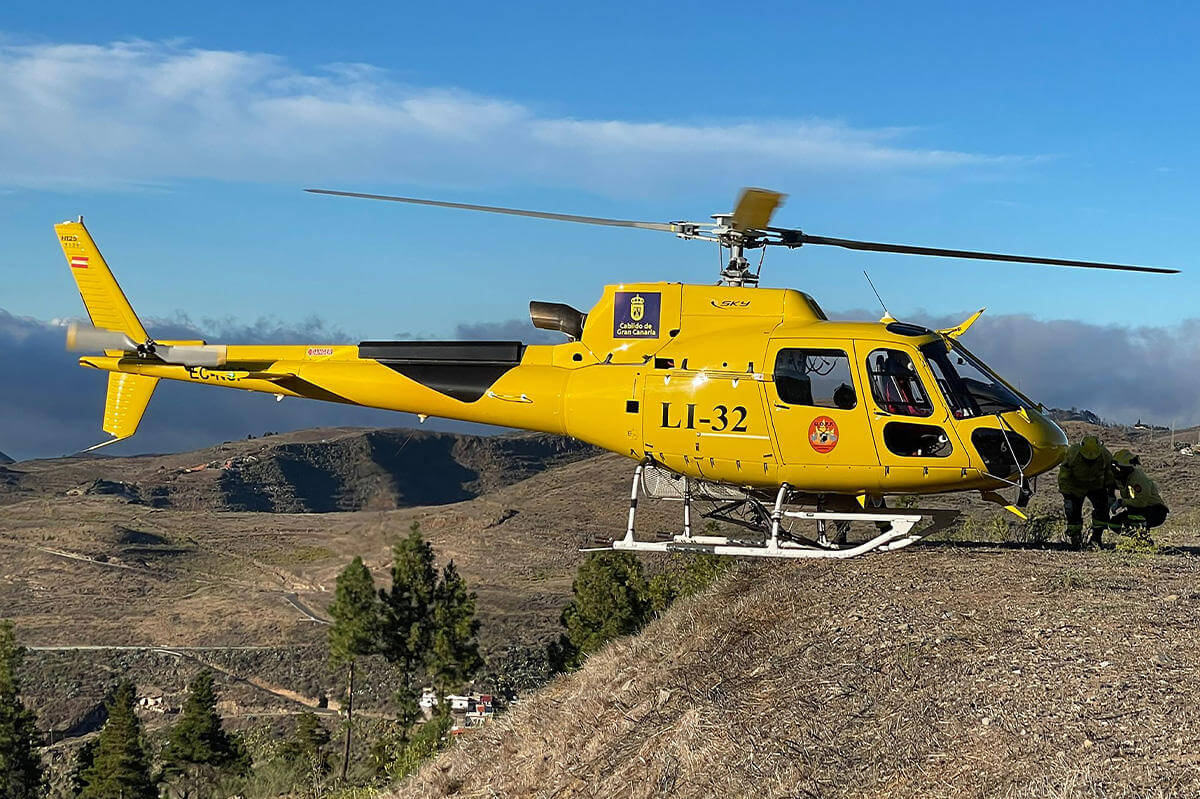
The main base, Artenara helicopter station, is strategically located on a hilltop 1,250m above sea level where forests predominate. This station houses the PRESA Teams, an elite unit of the Forest Fire Operations Unit (UOFF), which operates from here with two helicopters and a significant fleet of off-road vehicles.
The two Airbus AS350 B3 ‘Ecureuil’ helicopters based in Artenara are contracted from Sky Helicópteros. Ecureuil pilot Román explained that a helicopter is available within 10 minutes for daytime firefighting operations year-round, and that during peak season (June to December) two helicopters are on duty.
In the event of a fire, the pilot is assisted by a chief firefighting engineer in the cockpit and carries four firefighters in the rear. A second helicopter carries another five firefighters. At the fire site, the AS350 requires a 20x20m landing area, where the forestry engineer coordinates the teams from the ground and directs the pilot on where to drop the water. The helicopters are equipped with a side basket for transporting equipment and a 910L Bambi Bucket mounted underneath the AS350. Water storage tanks have been installed at strategic points throughout the island, and crews are also free to collect water anywhere, except for saltwater.


June 2026
Issue
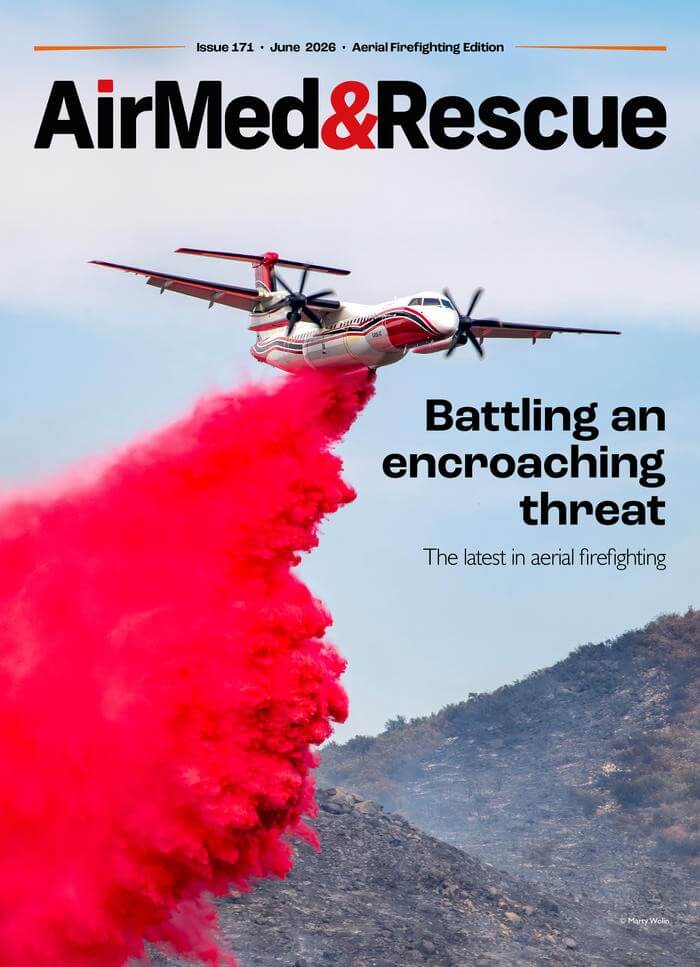
As the northern hemisphere heats up for another hot summer, I’m pleased to bring you the aerial firefighting edition of AirMed&Rescue. We have features on how climate change is accelerating firefighting technology; the improvements in Australian firefighting capacity; and getting ahead of wildfires before they become unmanageable.
Peter Ten Berg
Inspired by the dynamics of aviation and a passion for photography, Peter accompanies aircraft and helicopter crews to capture them at work and hear their story for his exclusive reports. His focus is on military aviation as well as governmental subjects including HEMS, SAR, UAV and rescue.