
Got a head, get a helmet

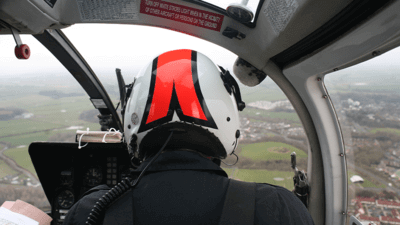
Helmets save lives. Period. And beyond the fundamental head protection capabilities, they support communications, protect hearing and eyesight, allow for attachments and enhancements, not to mention they can be stylish and aid visibility. Jon Adams looks at the benefits of helmets and how they can save your life too
Fashion is a close interplay of form and function, and this also applies to safety gear such as helmets. Designers work to understand how to make a head covering that manages to protect the head, but is not so bulky or heavy that it is unwieldy and taxing to wear in the confines of a helicopter for long periods of time. The materials have to be light, but strong, and the helmet has to integrate communications equipment and hearing protection, visors, and attachments for night vision goggles (NVG) and other mounted equipment.
The human element
Flying has been applied to many areas of our lives, but in the history books, the stories that are told, the romance of aviation often stems from casting off the shackles of gravity and soaring like a bird, high above the ground. The desire to fly is for transcendence. Many aviators get this bug from an early age and then pursue it doggedly so that the dream becomes a career. This was the pathway of Davide Spatola, who is currently a helicopter emergency medical services (HEMS) pilot for Heli Austria, a helicopter company in Austria providing various services that include HEMS, firefighting (worldwide), utility sling operations and a flight school. His journey into aviation began in a small village not far from Turin, Italy, where he said he fell in love: “The village is close to the mountains: helicopters at work there were quite common, and this machine fascinated me since the beginning. As a big power line was constructed on the mountain in front of my home, I used to spend hours spotting, with my binoculars, the [Aérospatiale SA 315B] Lama operating on the slope. I guess there is where it all started from.”
Spatola’s introduction to aviation, and subsequent passion, is a familiar one. For those of us who were the children of aviators, the pull is sometimes even stronger, and access is more available. This was the case for Dave Callen, Owner and Flight Instructor at SR3 Rescue Concepts: “My father is a retired rescue/patrol pilot from LA County Sheriff’s Office, and this had a huge influence on me wanting to be a police officer and pilot.” Before SR3 Rescue Concepts, Callen “began receiving training for special missions after building enough time as a patrol pilot with Metro Police in Las Vegas. I flew patrol, surveillance, day and night SAR – hoist, short-haul and one-skid rescues in the mountains.” Callen’s experience is across a broad range of special missions, as he explained: “I am one of six flight instructors at SR3. I am fortunate in that I fly a variety of helicopters on a regular basis, while conducting our training courses. The majority of our mission training is for hoist rescue (day, night/NVG, mountainous, open water, swiftwater, vessel, high angles and many others). We also train rappel, short haul, long line, NVG, aerial firefighting, tactical missions (fast rope, aerial use of force) and more.”

Getting airborne
Most initial training is done on smaller, lighter aircraft, in good conditions, in safe environments. As well as the expense of training, the associated gear and equipment also comes with a price tag. As such, training, general aviation, and many commercial or tourist flights are performed without a helmet. There is a calculated cost–benefit analysis for this, as crashes are rare, and the value added of wearing a helmet for short flights along well-defined and scheduled routes on calm, sunny days is low. However, incidents do happen, such as the fatal Australian Gold Coast crash near the Sea World theme park in early 2023, or the recent New York Helicopter Tours crash into the Hudson River.
Accidents
Spatola’s story is one of a shuttle flight that ended in tragedy while he was working for a commercial charter operator in Nepal. Spatola explained what happened: “On the morning [of the accident], my company had planned a shuttle service from Simikot to Hilsa. I landed at Simikot in the early morning and I started shuttle flights from Simikot to Hilsa. The flight program was Simikot-Hilsa-Simikot to pick up passengers and load and then Simikot to Tumkot and shuttle flights between Tumkot, Hilsa and Simikot. On the third flight from Hilsa, I had to carry the bodies of a woman and two children who had sadly died during the flooding in Hilsa in the previous few days. I carried out a few flights to Hilsa through a direct pass, which requires climbing to 15,000ft to cross the pass, and I was using supplementary oxygen during the flight. To be on the safer side, I was regularly checking my oxygen in blood using a pulse oximeter while on ground at Hilsa.
“On the 10th flight from Hilsa, on my way to Tumkot, I followed the Humla Karnali River, though it is a longer route, because the direct pass was covered by clouds. The flight had been conducted at about 13,500ft. On arriving near Tumkot, I started a descending turn to the left. The wind was easterly light with fair weather at Tumkot. As Tumkot helipad had high ground towards the west of the helipad, I decided to make the approach from the east following the river through the middle of the valley. A passenger (a fixed-wing pilot of a local company) noticed that the helicopter was in a steep bank with a high forward speed and had a higher rate of descent than the previous flights.
On impact, the right sliding door and passengers sitting next to it were thrown out of the helicopter
“On the downwind heading, the helicopter continued the bank without rolling out to check the top of final for approach and landing. I actually don’t remember anything after descending through 1,000ft above ground level (AGL). The turn was steep with a high speed and positive g-load maneuver. Just before the impact, the helicopter rolled to the right with a slight nose-up attitude and hit the ground very hard with the right skid; as a result, the right skid collapsed, the tail boom got detached from the main structure, the main rotors hit the ground and shattered to pieces. The helicopter bounced up and swung to the left, rolling over right and settled to a final resting position facing northeast direction. On impact, the right sliding door and passengers sitting next to it were thrown out of the helicopter. The front-seated passenger and the passenger sitting behind him evacuated me. Villagers informed Simikot tower by cell phone and a rescue helicopter from Nepalgunj landed two hours later.”
This accident is an example of multiple factors converging on a single point that results in tragedy. And a clear illustration of the ways that safety can be improved to save lives from being lost, and harm from being caused, even in the case of humanitarian aid missions.
Spatola described what were the leading causes that contributed to the accident in addition to the emotional trauma experienced: “One of the investigation commission conclusions was that my emotional state after seeing the bodies had been a contributing factor for my loss of consciousness. The other probable factors of this accident mostly relate to physiological and psychological aspects, including deficiency of oxygen – the system providing oxygen was not a properly certified one. Beside this, I was flying without any rest all day, beyond the flight duty time limitation, because of induced and self-induced pressure (to evacuate the people of the village that had suffered the flooding the night before), and I had not eaten anything and had too little hydration.” He continued: “I learned a lot from this accident. Pressure is a big risk in this industry. No matter if it is perceived or self-induced, the result is often fatal. And a lot of ‘small’ factors all together play a big role in building a perfect accident chain; it is not only what you learn during the periodic courses or training: it is for real!”
Callen’s story is possibly less exotic, but just as horrifying. Flying over an urban environment comes with its own dangers and hazards to avoid, and it was while working on a routine callout with the Metropolitan Police in Las Vegas that Callen had his incident. Callen explained what happened: “[My] accident occurred right after departure on a patrol flight, on New Year’s Eve in Las Vegas in 2014. I was the Pilot in Command and my co-pilot was also a highly experienced Chief Flying Instructor and Tactical Flight Officer (TFO). We received a call in the Downtown area of Las Vegas involving an adult male chasing a female with a knife. While in the first orbit over the scene, there was a slight degradation in rotor revolutions per minute (RPM), which I attempted to adjust manually. When the RPM did not respond, I notified my TFO that I had an issue and was going to return to our hangar. At that point, the engine flamed out and we had to perform an autorotation to a small residential street that had several wires and parked vehicles on either side.
The engine flamed out and we had to perform an autorotation to a small residential street that had several wires and parked vehicles on either side
“Due to some maneuvering that was required to avoid wires and land in the street, we impacted hard. The tail boom was severed, both skids collapsed and one main rotor blade separated from the rotor hub. Both my TFO and I sustained moderate injuries.”
Vanderbilt LifeFlight is the critical care air medical transport service of Vanderbilt University Medical Center and the Monroe Carell Jr Children’s Hospital at Vanderbilt in Nashville, Tennessee. Air Methods operates Vanderbilt LifeFlight’s air operations. Andrew Sikes, Flight Paramedic for Vanderbilt LifeFlight, explained that his organization has had its own share of incidents: “Though we are fortunate as a program to have never experienced a catastrophic event in our program’s 40-plus-year history, we have suffered a number of incidents that had potential to be much worse. Most of these are bird strikes; more than a few of them involved broken windscreens with intrusion into the patient compartment.”
He elaborated on one such occurrence: “[One of our] aircraft (EC145) collided with a Canada goose during a night flight. The animal entered the cockpit on the unoccupied co-pilot’s side (we fly single-pilot in the right seat), then continued past the (fortunately empty) seat, around and through the privacy curtain and into the rear patient care compartment, which was occupied by the two medical crewmembers and a patient. One crewmember was sitting in the rearward-facing seat immediately behind the co-pilot’s seat and was hit on the back of the helmet by bird remains. The second crewmember was in a forward-facing seat on the right side of the compartment; the patient was secured to the stretcher along the left side. Fortunately, the patient was wearing a mask and had been shielded from significant impact by the first crewmember; the second crewmember had her visor down, which prevented eye and facial injuries. Remains of the animal were found as far back as the rear clamshell doors. The pilot was able to maintain control of the aircraft, made an emergency landing, and all personnel were cared for appropriately with no lasting injuries.”
One crewmember was sitting in the rearward-facing seat immediately behind the co-pilot’s seat and was hit on the back of the helmet by bird remains, leaving him briefly stunned
Lifesaving
Where does a helmet come into Spatola’s story? While he was performing shuttle flights, Spatola wasn’t required to wear a helmet under regulations or company standard operating procedures. He didn’t have his own helmet and wasn’t supplied one by the company. But, he is alive to tell his story because, on this occasion, he was serendipitously wearing a helmet. Spatola explained how this came about: “I was actually planning to buy [a helmet] but I wasn’t sure because I couldn’t afford the cost of this important device. My salary working in that company was not the most brilliant one, and I was struggling a bit about how to get one. I asked some advice from a colleague of mine that was working in Nepal too. He suggested that I should to try his helmet, he was going sell it eventually anyway. That was my ‘salvation’: I had only wanted to use it for one day, to test it and give it back immediately. He denied that, and ‘forced’ me to keep it until I could afford to buy one of my own. That is actually the only reason why I am alive. After my accident, I spoke to the manufacturer, and gave them the helmet for an investigation: they found an invisible (to the human eye) crack on the rear part of the carbon fiber shell that could only have been generated by a strong impact. They calculated that the impact had been of a much higher intensity than what a human head can bear; almost double.”
The helmet was a Northwall LMT pilot helmet, and as well as saving his life, Spatola credits the professionalism of the company (coincidentally an Italian company) to his advocacy of helmet usage: “My curiosity after my accident brought me to investigate more accurately the world of helmets. Northwall was really open to answer all my questions and explain what happened to my helmet, why certain design and production choices are made, and why helmet protection is so important.”
I do believe our helmets protected us well, as a lot of the items inside the aircraft were tossed around violently and neither of us had any major injuries to our heads
Callen also credited his MSA Gallet helmet with saving him (and his colleague) from more serious harm: “I do believe our helmets protected us well, as a lot of the items inside the aircraft were tossed around violently and neither of us had any major injuries to our heads. The cause [of the accident] was a suspected interruption in fuel flow, and after six months we were both back to work and flying.”
Sikes’ example indicated not only the importance of helmets for pilots, but that the safety of flight medical crew is also enhanced by wearing head protection. Sikes said: “Our standard-issue medical crewmember helmet is the Gentex SPH-5 or Gentex ALPHA Eagle,” whereas “pilots’ helmets are varied but their Air Methods-issued helmet is the Paraclete Aspida”.
Special helmets for special missions
Spatola now flies HEMS operations, and, suffice to say, he wears a helmet for his work. Similarly, Callen, now retired from the police, wears a helmet for his current role: “I did first start wearing a helmet in Vegas with Metro, as it was a requirement. All the helmets were supplied by the department. I never wore a personal helmet prior to 2018, when SR3 was founded and I had a need for my own. I was wearing a MSA Gallet in Vegas and liked the fit and familiarity, so I purchased my own [from Merit Apparel] that I have worn ever since.”

Function and form
Other than protecting the head from skull-crushing impacts, the helmet permits pilots to attach NVG: even if night flights aren’t standard, some operations necessarily take flights beyond sunset. “We do not fly at night as a normal scheduled operation,” said Spatola. “It sometimes happens that we get a call close to the end of our duty, and then we may have to fly after sunset. Those flights are then performed with the help of NVG, a device nowadays more and more required to safely operate at night.”
The physical comfort of a helmet is not to be overlooked, nor is the functionality provided, explained Callen: “I like the comfort of the helmet, as well as the setup for my NVG mount and battery pack. I also like the dual visors (I have dark tint and the yellow). I would definitely recommend to anyone that is flying special missions of any kind to wear a helmet.”
These extra protections were elaborated upon by Spatola: “Wearing the helmet allows me to be more isolated from the noisy environment; the perceived protection, beside the mechanical protection itself, is also a nice feeling. It is really practical to be able to swap from a clear visor to a dark or a yellow one – the first offers good sun protection, the latter is really helpful for landing in flat light conditions: there’s no need to grab your sunglasses in the critical phases of flight.” Spatola was keen to express that modern helmets are much better and lighter than they used to be: “Modern technology allows us to reach excellent safety standards with a really modest weight; moreover this specific manufacturer (Northwall) designed the center of gravity of the whole helmet in such a smart way that the weight of the gear does not burden the pilot’s shoulders and neck.”
Modern technology allows us to reach excellent safety standards with a really modest weight
What’s more, a helmet can be customized to be personalized. It can be highly visible to help stand out, and it can also add a level of emotional comfort to the wearer: “It is nice to play with the design of your own helmet. Some have nice aphorisms painted on the back – personally, I’ve got a painting of my (at that time) little daughter. It is nice to always bring her with me!”
The ability for helmets to protect crew from minor injuries as well as major injuries should also be stated, as Sikes indicated: “Even simple, minor injuries, such as head strikes on the ceiling or internal structures (cabinets / medical equipment) of the aircraft, or being struck by a combative or altered patient, have been avoided simply by wearing a properly fitted and secured helmet.”
Whether you are flying straightforward flights, or tackling more challenging special missions, a helmet can provide safety and security for your wellbeing should the worst happen.
June 2025
Issue
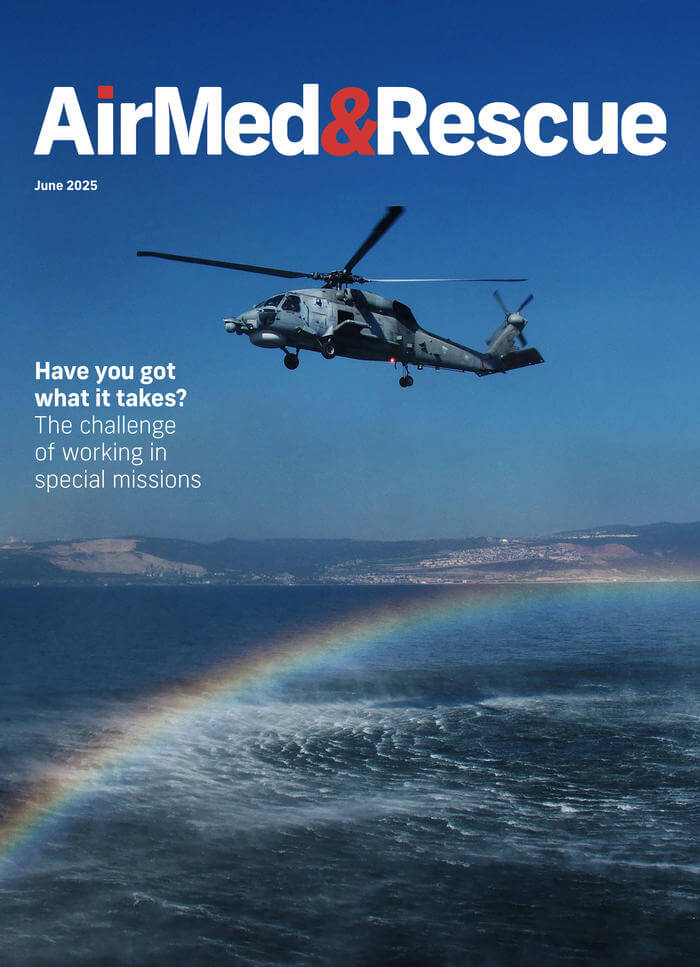
Our June edition covers a range of articles with a wealth of experiential information in the features, such as search and rescue as a career route, the latest night vision technology, the increasing popularity of drones for firefighting, the importance of helmets in special missions, why diversity matters in aviation, and why switching to special missions as a job is more fulfilling; plus we have more of our regular content.
Jon Adams
Jon is the Editor of AirMed&Rescue. He was previously Editor for Clinical Medicine and Future Healthcare Journal at the Royal College of Physicians before coming to AirMed&Rescue in November 2022. His favorite helicopter is the Army Air Corps Lynx that he saw his father fly while growing up on Army bases.