
Hampshire and the Isle of Wight air ambulance celebrates 15 years of saving lives

AirMed&Rescue visited the team to mark this special benchmark, catching up with both the charity’s CEO, Richard Corbett, and patient Clare Danson
Since the first flight back in 2007, the charity’s critical care team has responded to over 15,500 emergencies across the region and beyond, providing life-saving care usually reserved for inside a hospital emergency department. In the first six months of 2022 alone, they have attended 791 emergency callouts, an increase on 2020 and 2021, with pre-pandemic levels predicted going forward.
One of those 15,500 patients to receive such care was 32-year-old Claire Danson. With her dream of becoming a professional triathlete in reach, Claire collided with a tractor during a routine cycle ride, leaving her paralyzed from the waist down. The air ambulance team attended and provided Claire with specialist treatment before flying her
to hospital.
Claire commented: “You effectively wake up one day and your body is completely different to how you’ve ever known it. That can make you feel quite differently about yourself.”
“I always say that when the team save somebody’s life, it’s the further impact that they have made on the other people’s lives connected to that patient. They have done something amazing for them as well, because their lives would be so different if I hadn’t come home.”
It costs the service, which receives no government funding, an average of £3,320 for every emergency mission.
Kate McLaughlin sat down with CEO Richard Corbett to find out more about his work with the charity, and his hopes for its future.
How long have you been involved with the team here at HIOWAA?
I joined the air ambulance last September, so I’ve been here about nine months. But you know, the organisation has now been going 15 years and it’s great to be here and be able to have the privilege of being the chief exec as it reaches its 15th birthday.
Have you found any major changes or developments in your time here that have really helped get it to the world class standard that it is today?
I was here a week ago with the previous chief executive, who was involved in the very early days, and he was talking about the changes and how the organization has developed since those first days when the first flight happened, and to be honest, it’s a total transformation. Not only were they operating from a porta-cabin, but also the helicopter and equipment the medical teams use is totally different to how was 15 years ago.
What helicopter do you use at the moment?
We have an Airbus H135. Around the country, different air ambulances have different helicopters, and that very much depends on their local geography. For us with cities being part of that geography, it’s a relatively small aircraft which means that we can land in many sites, which is important when you’ve got dense population areas.

What do you see ahead for HIOWAA over the next 15 years?
Well, it’s going to be fascinating what happens in the next 15 years, we’re a critical care service rather than just a helicopter service. So, you never know, with drone technology, and all these other things coming along, what we offer could be unrecognisable in 15 years’ time.
Climate change is also a consideration for us, and we recognize the issues we have around that in terms of running a helicopter. But clearly the service demands that, and we’re looking to create a balance of other vehicles. We also have cars which respond with our critical care teams, and we’re looking at how we can utilize electric capabilities with those and change the way we work. No doubt there will be a lot of changes, but some of them are yet to be known in terms of how technology will develop and enable us to deliver a better service.
September 2022
Issue
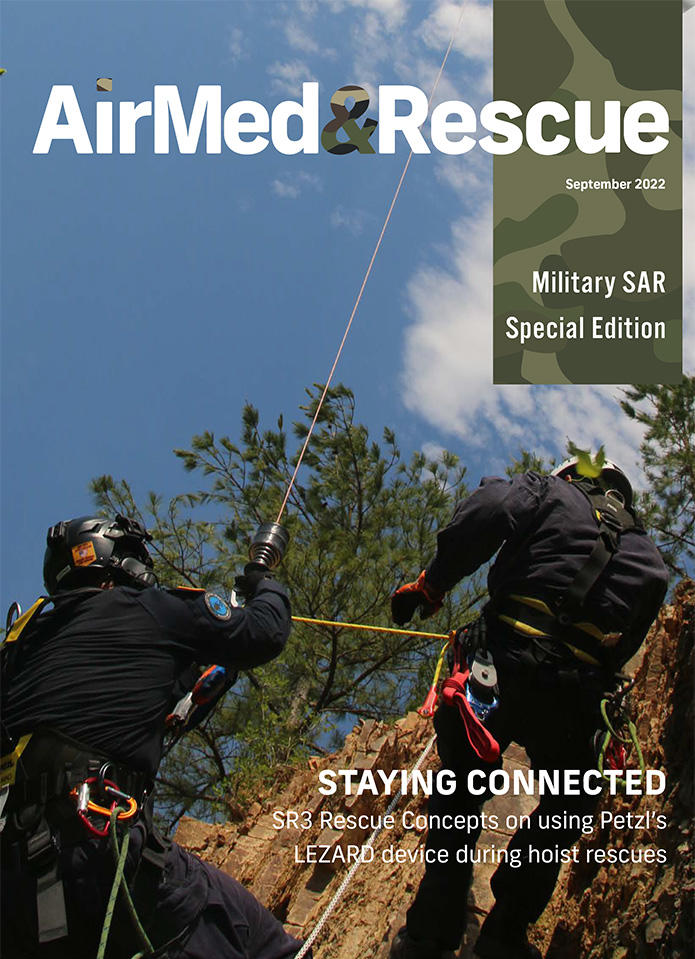
In our September Special Military edition, we consider challenges faced both on and off the battlefield, and how modernization is at the forefront in overcoming these. From the reality of search and rescue operations, aiding the care of injured servicemen and women, to how technology can transform battlefield medicine. We also talk to Leonardo about the capabilities of the AW149, and SR3 Rescue Concepts discuss the new innovation from Petzl designed to aid in mountain rescue.
Editorial Team
The AirMed&Rescue Editorial Team works on the website to ensure timely and relevant news is online every day. With extensive experience and in-depth knowledge of the air medical and air rescue industries, the team is ready to respond to breaking industry news and investigate topics of interest to our readers.