
Helicopter medevac fraud in Nepal

Unjustifiable medical evacuations cause concern
The Ministry of Culture, Tourism and Civil Aviation in Nepal has announced the launch of an official Special Investigation Unit that will be looking into the activities of more than 500 expedition, trekking and helicopter companies in the country who are accused of corruption and price-fixing through unnecessary and fictitious helicopter rescues to defraud the travel insurance industry out of millions of dollars. Jonathan Bancroft, Managing Director of Traveller Assist Ltd, which provides medical assistance and cost containment services in Nepal, said he was proud to support the efforts of the Ministry of Culture, Tourism and Civil Aviation.
The company’s campaign to end the issue of helicopter evacuation fraud in Nepal began in August 2017, when Traveller Assist – in a joint venture with an Australia-based insurer – sent Operations Manager Forest Williams to Kathmandu to assess the level of care being provided in hospitals, and to ascertain why the 2017 spring climbing season had been the most expensive on record for medical claims, particularly for helicopter rescues and evacuations. “We learned a lot from the 2017 high-season [Oct-Nov]. It was the busiest year on record since the 2015 Nepal earthquake. This gave us the opportunity to try and test different methods to facilitate and improve rescue and evacuation missions,” said Williams.

Last year, a record 940,000 visitors arrived in Nepal and within the last three months of 2017, Traveller Assist provided medical assistance for over 250 travellers from the UK, Australia, New Zealand, Canada, and the US – 37 of which involved a helicopter evacuation. After further investigation, it was found that 30 per cent of these evacuations were completely unnecessary.
Bancroft explained the situation to AirMed&Rescue Magazine: “A typical scenario that we have seen repeated again and again: a traveller on an expedition complains of a headache. The expedition leader calls for a helicopter. The helicopter arrives and provides an evac, with an agreement to pay the expedition company a commission. The helicopter company then flies the patient to a hospital, where in turn they are promised a commission by the hospital. The patient, who remember only complained of a headache, is then admitted for observation, and given blood tests, X-rays, and in some cases, even an MRI and EKG.” A helicopter rescue and inpatient medical bill is then presented to the travel insurance company, which at the time has no choice but to seek a medical opinion or direct care. In some cases, the bill for the helicopter evacuation and medical care can total more than $20,000. “It’s a racket that’s tantamount to fraud, and it’s happening on a large scale throughout Nepal,” said Bancroft.
Spearheaded by the company’s Head of Assistance, Danny Kaine, the first task for Traveller Assist was to create a chart of all helicopter companies registered in the country, and then ascertain which companies actually owned helicopters, and which ones just rented them. “Stands to reason,” noted Bancroft, “that the cost to charter a helicopter from the owners is less than renting it from a company who in-turn rented it from the owners.”

The second task was to visit the senior management of every hospital in Nepal that was suspected of over treating patients in their facilities, and of paying helicopter companies a commission to receive these patients in the first place. With a letter signed by four major insurance companies – which in turn manage 27 brands and collectively insure over three million travellers worldwide – Traveller Assist was authorised to deny a claim on their behalf if fraud was suspected.
Bancroft said: “With the intelligence we had gathered, and the support we received from our clients, I reached out to request a meeting with a representative at the Department of Tourism in Nepal, where I was authorised to disclose that a major underwriter was considering the option of no longer offering travel insurance in the region due to the sheer amount of fraudulent claims, which would have a major effect on the economy of Nepal.” In what the company says is an industry first in Nepal, Traveller Assist has created an agreement and established a line of communication with helicopter companies, whereby if the operator is called on to evacuate a traveller who is covered by an insurer on its list of clients, it calls the regional operations centre in Kathmandu, whereupon the in-house doctor or nurse assesses whether the patient requires an evacuation or not. Bancroft pointed out that this strategy is already having a positive effect: “So far in 2018, we have successfully managed to capture 65 per cent of helicopter evacuation cases insured by our clients, and 40 per cent of medical assistance cases, before a service was provided – meaning that we got to assess the patient, and direct care before a single helicopter charge or medical bill was created. While these numbers will never reach 100 per cent due to various factors, we do think we can get them closer to 80 per cent based on this season’s results.”
Fast forward to the end of the 2018 spring climbing season, and Traveller Assist has provided medical assistance for over 800 cases and stopped over 100 unnecessary helicopter evacuations from happening in Nepal.
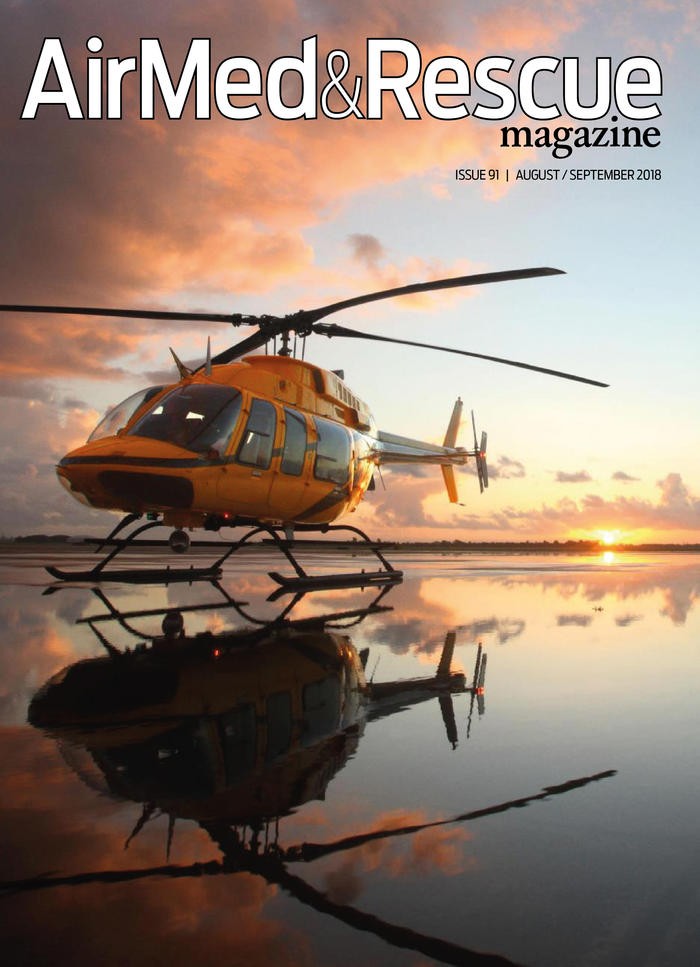
August 2018
Issue
In this issue:
Night riders - The ever-increasing availability of night vision imaging systems onboard helicopters and the regulations surrounding them
Electric avenue - Electronic flight bags are changing how pilots work
I, robot helicopter - The latest generation of helicopters are lighter, faster and better equipped
Costs of medical transport in Florida come under scrutiny
Aeromedical transport training in Bangkok
AirMed&Rescue Magazine attended the 2018 annual Air Centric Personnel Recovery Course (APROC) at Gilze-Rijen air base, The Netherlands
Focus on helicopter evacuations in Nepal
Working to the limit -Fatigue management in the world of international medical repatriations
Creating the right culture -Bruce Webb, Airbus pilot, offers his thoughts on leadership and the culture of safety for crewmembers
Profiles
Capital Air Ambulance
AIUT Alpin Dolomites
Airbus Helicopters
Jonathan Bancroft
Jonathan Bancroft has spent the past 32 years protecting and rescuing people. He has served as a kidnap response manager for Lloyd’s Insurance Group, a security manager for the UK Government’s Foreign and Commonwealth Office, and as a British Army intelligence officer. Now, he is the Managing Director of Traveller Assist, a medical and travel assistance company who travel insurers contract to assist travellers when they are sick, injured, lost or in trouble abroad.