
Helmet standards in the US

Astonishingly, the US Federal Aviation Administration does not mandate the use of helmets for crew in civilian air ambulances. However, thankfully most crewmembers do use them despite this – but are they choosing the right helmet?

The US Association of Air Medical Services (AAMS) notes in its Considerations for Selecting and Using Helmets that ‘crash investigators often hear from survivors that they are able to speak to us singularly because they were wearing their aviation life support equipment’. Although the Federal Aviation Administration does not mandate their use, nonetheless, helmets are considered by most involved in the industry to be essential, and thus their design and specification should be held to a high standard. For many years, however, this has not been the case in the civilian helicopter air ambulance sphere.
Standards, what standards?
crash investigators often hear from survivors that they are able to speak to us singularly because they were wearing their aviation life support equipment
The US Office of Aviation Safety (OAS) developed a modern, cost-effective civilian aviation helmet performance standard that was published in April of 2018. Prior to the OAS standard, though, there were no rules and regulations governing the quality of helmets being manufactured and distributed. In the 1970s, following the conclusion of the Vietnam War, the US military had a surplus of Gentex helmets and spare parts, and so sold them to surplus dealers. As helmet designs have been updated, older parts have again been sold to dealers. However, the situation now is that some surplus dealers would appear to be running out of said parts, and are instead making their own, which may not be made to a military specification. (Further analysis of this in the next issue of AirMed&Rescue).
The Department of Interior and US Forest Service (DOI/USFS) Aviation Helmet Standard Specification, and Interagency Aviation Life Support Equipment Guide/Handbook provide an avenue to allow non-military helmets to be considered for acquisition within agencies. Manufacturers and distributors can test their helmets using an ISO certified laboratory to the DOI/USFS Aviation Helmet Standard.
The Aviation Helmet Standard, according to Dudley Crosson (Aeromedical Safety Officer and Principal of Delta P, an organisation focused on increasing operational efficiency and safety and aircrew), establishes aviation helmet design and performance standards, requires helmets to be tested at a certified laboratory, requires that manufacturers certify and label each helmet, and establishes a list of approved helmets.
Those meeting or exceeding these standards can be issued a certificate of compliance by the laboratory. These helmets will be identified by the manufacturer and model type on the OAS website within 30 days of receiving the certificate.
When the website was checked in January 2019, there were no non-military certifications of compliance. Military helmets that have been approved by the ALSE (Interagency Aviation Life Support Equipment) handbook are:
Helicopters: HGU-56/P; HGU-84/P; SPH-4B; SPH-5.
Fixed Wing: HGU-55/P and HGU-68/P.

Making a choice
When it comes to the choice of which helmet to choose, Crosson stated in the AAMS Considerations paper: “I do not believe there is a ‘best’, but there are several options based on your specific needs. There are a number of acceptable helmets to select from, the key being a reputable product based on articulated supporting test data to see how the helmet performs when compared to others. Certainly, the HGU-56/P (current US Army helmet) goes through the most rigorous testing.” (www.ihst.org/portals/54/Helmets.pdf)
Another key characteristic of helmets that must he considered, he added, is the nape strap. “It is imperative that the helmet has a device that can be secured below the occipital lobe (the bump on the back of your head). This prevents the helmet from sliding/rotating forward and possibly coming off in a crash,” explained Crosson.
His three top tips after helmet choice has been made are:
- Ensure the vendor is recognised by the manufacturer
- Ensure the vendor can accurately explain the data on the safety features of their products
- Examine the specifications.
Post purchase, it is then vital that crewmembers ensure their helmet fits correctly. If it doesn’t, they risk short-term damage and discomfort, and then there are the longer-term considerations. The two most common pilot complaints are hearing loss and neck/back pain, both of which are often the result of poorly fitted helmets. Some helmets feature active noise reduction, which claims to work by a 180-degree out of phase signal at the same frequency and amplitude to cancel the target ambient noise, according to Crosson’s AAMS paper. “At the recent Aerospace Medical Association annual meeting,” noted Crosson, “it was presented that ANRs do not mitigate hearing loss like originally thought. So, at this time, there is no scientific evidence that supports this claim.”
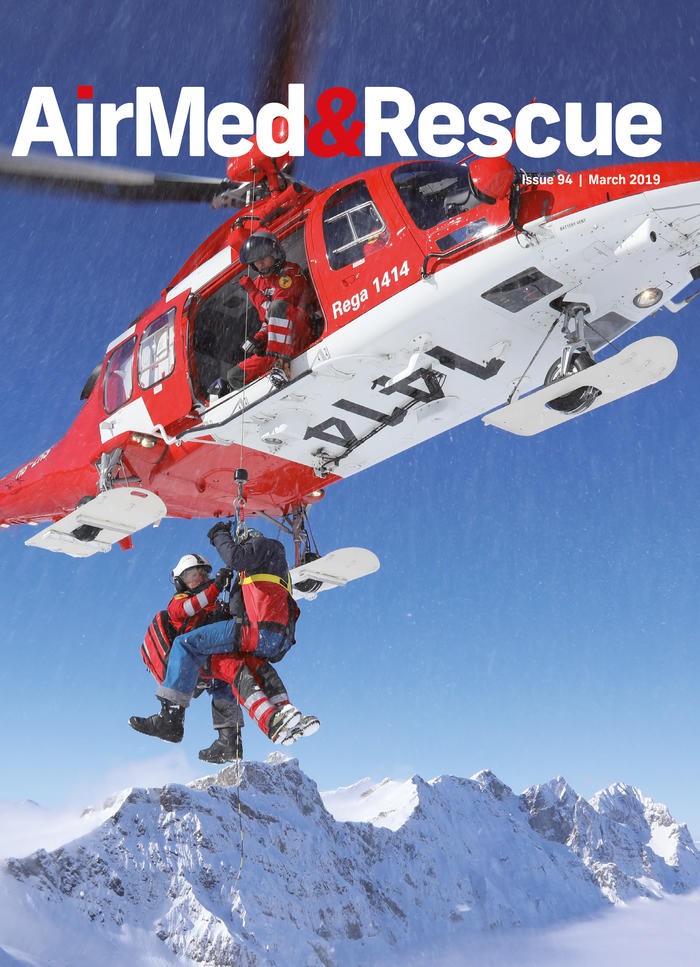
March 2019
Issue
In this issue:
Traumatic brain injury transports - best practice
Survival of the fittest - ALSE - Staying alive after a helicopter crash
Surf's up - Surf-based rescue techniques
Never forget - the lone survivor of a helicopter accident
Patient safety is the number 1 priority for ER24
Interview: Mikko Dahlman, Coptersafety
Provider Profile: LifeFlight Network
Company Profile: Sikorsky / Lockheed Martin
Case Study: AirLec Ambulance describes the challenges of an evacuation from a warzone
Mandy Langfield
Mandy Langfield is a Director of Palladium Media Partners and former Publishing Director at Voyageur Group. She has written extensively on international travel and health insurance, medical assistance provision, and air medical transportation. She was Editor of AirMed&Rescue from December 2017 until April 2021. Her favourite helicopter is the Chinook, having grown up near an RAF training ground.