
Help from a distance: UAVs for SAR

Drones’ growing capabilities mean emergency services are viewing these remotely piloted aircraft as increasingly useful. Rob Coppinger speaks to experts about how drones are changing the way missions are being performed
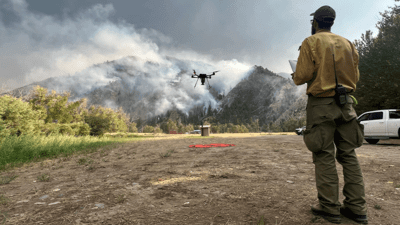
From their high vantage points, drones can search large areas relatively quickly with cameras that are becoming more and more capable, including thermal imaging, but is regulation delaying their deployment?
Suitable for search and rescue (SAR) operations in the day or night, in urban or rural areas, there is a tension between these products’ development and rules around their use, which undergo a slow political process. Police forces and other emergency services use drones to support their operations, but, for some jurisdictions, they are still not standard equipment. In 2020, the UK’s Maritime and Coastguard Agency (MCA) started trialing the use of drones. In 2021, HM Coastguard’s (part of the MCA) first operational flight of a remotely piloted rotorcraft took place as part of training exercises. A Bristow Helicopters-owned Schiebel S-100 remotely piloted aircraft system (RPAS) flew alongside HM Coastguard piloted aircraft: a Bristow-operated Sikorsky S-92 helicopter based at Caernarfon, and a King Air surveillance aircraft operated by 2Excel Aviation.
“The MCA is constantly researching a wide range of technology to enhance the effectiveness and efficiency of its SAR and maritime counter-pollution work,” an MCA spokesperson said. “Drones have been an important part of this, with the first major steps in 2018 involving a collaboration with the Royal National Lifeboat Institution (RNLI) to explore drones’ safe and appropriate deployment in specific SAR scenarios, as well as engagement with the SAR community and drone industry.”
For the MCA, the longer loiter times afforded by today’s drones, and the increase in autonomous operations, such as navigation, response and detection capability from cameras and sensors, have had the potential to benefit SAR. In particular, the development of technology for high-quality imagery and the rapid dissemination of that data is viewed as a way of improving the response to time-critical incidents, which could save lives. As drones’ loiter times, range and endurance increase, the MCA spokesperson said, “this could lead to the safe integration of drones into UK airspace … and enable SAR operations beyond visual line of sight (BVLOS), where safe and appropriate operations [are conducted] without the need for special permission.” The MCA intends to continue to research drones in partnership with the industry.
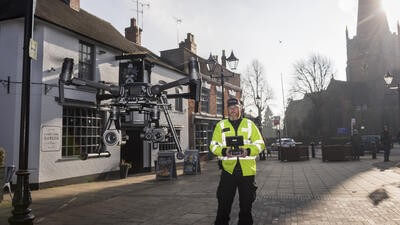
Also in the UK, Bedfordshire Fire and Rescue Service uses drones in partnership with the police. “Initially [from 2019], that was for building fires and missing person searches in collaboration with the police. A lot of our work comes from the police,” said Bedfordshire Fire and Rescue Service Crew Commander Liam Common of Leighton Buzzard Fire Station. “It was a DJI Matrice 210 [drone] that we started with, which had one of the best thermal cameras on the market at the time.” Before 2019, firefighters had handheld thermal cameras they could use atop a fire engine’s ladder, or hydraulic arm platform to use the technical term.
Common recalls what led to the service obtaining drones. “We had the budget, we had the justification of using it for the building fires, for the missing person, in collaboration with the police.” Initially there was DJI Matrice 210 training for the firefighters to be awarded a license. “We did a license and there were some emergency service exemptions that the UK Civil Aviation Authority (CAA) agreed to,” Common explained. “But that has changed and, as of a few years ago, we now fly under a commercial license, which gives us no exemptions at all.”
Regulation
A CAA spokesperson said: “In the UK, we have a number of levels for drone approval. Some of these are relatively easy to obtain: for example, a short online course that then enables you to fly larger drones closer to people and built-up areas. The regulations for search and rescue drone use depends on the level or type of SAR.” One example the CAA gave was volunteer groups for uses such as mountain rescue. But the rules for the police are not covered by the regulation for civil users.
The police, and other emergency service users, have to apply for an operational authorization using an Operating Safety Case
Despite this, the CAA has to ensure that police RPAS operations “take due regard of the safety objectives” of the law that governs civil use, “and that they are separated safely from other aircraft,” according to the CAA’s website. However, the police, and other emergency service users, have to apply for an operational authorization using an Operating Safety Case (OSC). A UK CAA spokesperson said: “Then we have the use of drones by official emergency services, e.g. police and the fire department. In many cases, these are in-house teams that have the higher-level OSC approval.” Examples the CAA gives for operations requiring an OSC-based operational authorization include dropping items from a drone, flying beyond the visual line of sight (BVLOS) and flying close to crowds.

Common is aware of a trial taking place in Norfolk to send a drone from a police station to the scene of a reported incident a long distance away. This may lead to a change in standard regulations as a visual line of sight has to be maintained with a drone, according to UK rules. “We can’t go further than 500m,” Common explained. The Norfolk trial was inspired by a trial in the USA, where police dispatched drones to get a quick overview of an incident. Common expects that this capability would begin with the police and could be developed for the fire service later.
Another area where fire and police overlap is car accidents. Common explained that traffic accidents can lead to missing persons searches to rescue them. “Often, we spread out if there’s signs that people have been in the car but there’s no one there. Then we do an area search around it, just to check that no one’s sort of crawled away with any injuries,” he added. Thermal cameras are good for finding the accident victims, who may be in shock. Sadly, though, their injuries are sometimes fatal, “depending on how long that person has been there,” said Common. “It’s very difficult to see a deceased person on a thermal imaging drone. [You’re] more likely to see them during the daytime using the normal camera.”
Thermal cameras are good for finding the accident victims, who may be in shock
A key technology that has helped with the utilization of drones is streaming the videos to a website other first responders can access. “It can be streamed so anyone can see it. We use GoodSAM, the live streaming platform,” Common said. “So, straight away when we put the drone up and click ‘Start stream’, our control room can see it and they can send the link to anyone in any organization that needs it.”
Special equipment
Despite the proven utility of drones since Bedfordshire Fire and Rescue Service started using one in 2019, the aerial platforms are still not considered standard equipment. “I wouldn’t [say it’s standard equipment]. I think in people’s minds as well, it’s still early stages. We need to get the benefits across,” Common said. Bedfordshire Fire and Rescue Service has two stations: the one in Leighton Buzzard, which is in the south of the county, and one in Harrold, in the north of the county. “There’s around five pilots, as they’re called, at each station with a drone capability north and south of the county,” Common explained. The Service replaced the DJI Matrice 210 with a DJI Matrice 300 for its thermal camera and normal camera zoom capability, and now the firefighters use DJI Mavic 3Ts and one DJI Mini 2.
The CAA’s rules regarding amateur users and their potential involvement in SAR has a parallel thousands of kilometers away in Canada. “The Saskatchewan Royal Canadian Mounted Police (RCMP) in Canada have actually been using drones or RPAS since 2010,” said Saskatchewan RCMP Superintendent Devin Pugh. “It started on a search and rescue mission for a young boy that was lost in a rural location, and one of our volunteer search and rescue individuals had a drone with them, and we saw the capability and the usage of that and immediately adopted drones for our operations in search and rescue.”
Since then, we’re seeing huge benefit with the advantage of thermal imagery. We have thermal cameras that have the ability to provide that high-quality thermal video capability back to the pilot
The volunteer just had a small helicopter drone with a normal daytime video camera on it, but the RCMP was sufficiently impressed. “Since then, we’re seeing huge benefit [with] the advantage of thermal imagery. We have thermal cameras that have the ability to provide that high-quality thermal video capability back to the pilot,” Pugh explained, “and the high-definition regular viewing camera system on it as well, plus the GPS locating. We can laser pinpoint areas on the ground and feed the coordinates back to ground searchers.”

Limitations and further potential
Like the UK emergency services, Canada’s civil aviation authority, Transport Canada, has set out rules for piloting RPAS and a pilot’s license. “Every one of our police officer pilots have to obtain their advanced RPAS license through Transport Canada to be able to operate the drone,” Pugh said. Canada also has laws on privacy for those on private property. “We have special regulations and policies that we have to adhere to,” he added. “Every person has an expectation of privacy on private property.”
Another limit for the RCMP is altitude: “We limit [the drone] to 400ft,” Pugh said. “We also are required to have a spotter present with an aviation radio available. We operate primarily in unrestricted airspace, but we do have the occasion to operate in restricted airspace, which we would then require clearance [for] from the local airport.”
Since 2010, the RCMP has worked closely with Transport Canada in the development of these rules. The police can be issued with a special flight operation certificate that allows flight through restricted airspace where they are searching for an individual, perhaps an active shooter, or for other police operations during a critical incident.
Emergency service providers are working with the RPAS manufacturers and universities to deliver the capabilities needed to search for, find, communicate with and supply water and food to people in distress
The special flight operation certificates are a response, in part, to the technology improvements that drones have seen, and the new procedures Transport Canada has developed because of them. Drones are now capable of dropping phones or other supplies to someone in distress. South of Saskatchewan in the US state of Colorado, artificial intelligence is being given to drones to help search for people. Announced in June this year, the University of Colorado Boulder’s aerospace engineering department is working with the Boulder Emergency Squad on the project. An early phase of the project saw drone operators given software tools to better control the aerial platforms. The commercial popularity of drones drove that early technological development and demonstrated their utility. Today, emergency service providers are working with the RPAS manufacturers and universities to deliver the capabilities needed to search for, find, communicate with and supply water and food to people in distress. While still constrained by regulation and considered a novel capability, the drone is becoming an indispensable tool.
December 2024
Issue
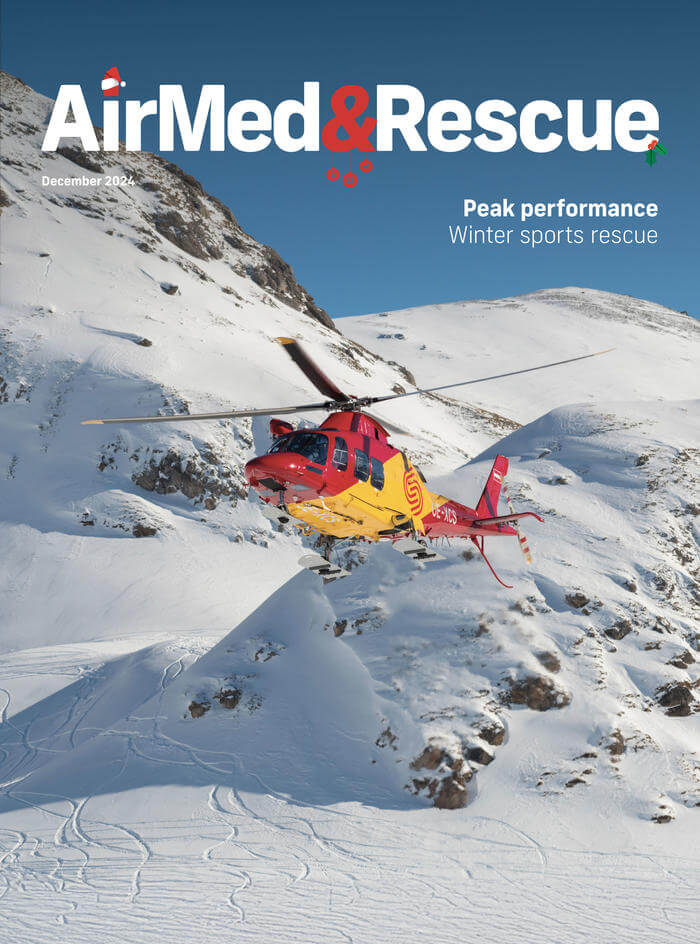
In the December edition, discover what goes into saving people that get into trouble on the ski slopes; find out about drones that are being used for search and rescue; learn about the treatment options for people with fractures; and see what has been happening this year in the realm of avionics development; plus more of our regular content.
Rob Coppinger
Rob Coppinger is a veteran aerospace writer whose work has appeared in Flight International, on the BBC, in The Engineer, Live Science, the Aviation Week Network and other publications. He has covered a wide range of subjects from aviation and aerospace technology to space exploration, information technology and engineering. In September 2021, Rob became the editor of SpaceFlight Magazine, a publication by the British Interplanetary Society. He is based in France.