
Hoist and winch training for rescue missions

Hoist and winch operators are continuously trained, with virtual reality, risk management and adherence to industry standards representing key elements. Experts share with Lauren Haigh insights on what’s required
In air medical and rescue missions, each crewmember plays a crucial role, representing one part of a well-oiled engine. The rear crew is paramount for safety, efficiency and, ultimately, success. An essential responsibility is managing hoists and winches which, beyond proficiency with hoist controls, necessitates exact timing and seamless communication with the rest of the crew. Through comprehensive hoist and winch training, these crewmembers are equipped to use these tools effectively and safely, in any environment, night or day.
Vital skills
Indeed, safety and efficiency are absolutely paramount, as Flight Lieutenant Byron Hodge of No. 3 Squadron, Royal New Zealand Air Force, underlined: “We focus on the technical skill set of safe, efficient winch techniques, coupled with a strong emphasis on crew resource management (CRM) and non-technical skills (NTS) during hoist operations.” FLTLT Hodge pointed out the need for a focus on proficiency. “Although the flying skill of using the hoist can be very demanding due to a wide range of factors, including environmental, the fundamental skill not often understood is the teaching of the individual’s cognizant ability,” he stated. “Maintaining situational awareness and effective communication during the more challenging evolutions can often challenge an individual’s capacity. Therefore our winch training is completed after the more rudimentary flying skills, such as general handling and underslung loads.”
These skills are critical because the hoist operator is required to direct the pilots on where to safely position the aircraft while identifying threats and communicating the status of the operation and at the same time, they are physically operating the hoist
AirMed&Rescue also spoke with Master Sergeant John T Grady, a member of the US Air Force’s (USAF) Air Education and Training Command (AETC), 344th Training Squadron (TRS), Center of Excellence (COE), who agreed that situational awareness is a priority, in combination with a checklist of other vital skills. “The ability to multitask, communicate and have high situational awareness while operating the hoist are key skills and competencies that we teach in our hoist training program for the USAF HH-60G/W,” he said. “These skills are critical because the hoist operator is required to direct the pilots on where to safely position the aircraft while identifying threats and communicating the status of the operation [and] at the same time, they are physically operating the hoist.”

Ready for anything
Operating in challenging environments is not out of the ordinary for crews, and operating hoists and winches in unpredictable or extreme conditions can push equipment and crewmembers to the limit. Training therefore equips rear-crew members to tackle rescue missions in hazardous environments and extreme weather conditions. Ascent Flight Training’s rotary wing team at the UK Royal Air Force’s RAF Valley commented: “During their time with us, trainee aircrew will learn the necessary skills to effect hoist recovery of personnel from a variety of environments, including boats, rigid inflatable boats (RIBs), cliffs and inaccessible terrain, as well as the necessary skills to extract downed aircrew from the water, either free-floating or from a survival dinghy.”
Alvin Fyhn, rescue swimmer, rescue crewmember and Instructor at CHC Helicopter, reported that training is provided across a wide range of scenarios to ensure readiness for any situation: “With offshore training, some example programs include calm and rough seas, life rafts and small and large vessels. On land, we train for mountain rescues, avalanche responses, terrain landings in summer and winter, shoreline and river rescues, glacier operations, and more. Whether land or offshore, all of our training covers both day and nighttime operations.”
Tailored tools
Winch and hoist training is continuous, with permanent room for improvement, and there is a variety of tools on hand to assist. Stig Ove Saure, pilot and Search and Rescue (SAR) Instructor at CHC Helicopter, said that helmet cameras are an important tool in the arsenal. “They allow valuable video playback to analyze performance, highlighting strengths and areas for improvement,” he pointed out. “We also have wireless communication between everyone in the crew, which is essential for seamless coordination and safety during training and real operations. Rope rescue techniques are practiced extensively on the ground, supplemented by indoor climbing walls and outdoor exercises in realistic environments.”
We also have wireless communication between everyone in the crew, which is essential for seamless coordination and safety during training and real operations
MSgt Grady said that various devices on the hoist that are tailored to the situation and the condition of the survivor are utilized: “These include a rescue strop, forest penetrator, Stokes litter, Skedco, and rescue basket. We train with these devices and utilize them in real-world operations as well.”
Risk management: a cornerstone
Risk management is a crucial part of training, with the goal of ensuring safety. “One of the most obvious methods of implementing relevant risk controls is to incorporate synthetic training devices to control risk and exposures for the aircrews,” asserted Brad Matheson, President of Priority 1 Air Rescue (P1AR). “This includes practicing specific techniques and training tasks which cannot be practiced safely in the aircraft or in hazardous environmental conditions.”
Training must also be up to date, as FLTLT Hodge highlighted: “All New Zealand Defence Force (NZDF) aircrew are required to conduct aviation risk management training every year. This ensures aircrew are trained to assess risk and mitigate that risk so far as reasonably practicable. This risk management is carried out from organizational levels right through to the airborne environment in real time.”
All New Zealand Defence Force (NZDF) aircrew are required to conduct aviation risk management training every year. This ensures aircrew are trained to assess risk and mitigate that risk so far as reasonably practicable
Another element of risk management is the use of a ‘crawl, walk, run’ approach, explained MSgt Grady: “This means that, initially, we will train students at a lower hover height with no live personnel, in a training area that provides no risk of snagging the hoist hook or cable. As student proficiency progresses, we can perform more challenging hoist training with risk mitigated through increased skill of the operator. In all cases, students and instructors brief all contingencies and emergencies we may face during hoist training and how we will address them if they arise. Risk is continuously monitored and addressed throughout all phases of training.”
A further consideration when it comes to effective risk management is ensuring the adherence to standards and regulations. Fyhn told AirMed&Rescue: “Risk management is a cornerstone of our training programs, ensuring safety and preparedness at every stage. All training adheres to strict regulations and standardized methods to maintain consistency and safety.”
Review and elevate
Beyond playing an important part in risk management, adherence to regulations and standards helps ensure quality. “Training is comprehensive yet highly standardized, aligning with industry regulations and internal protocols. This ensures consistent quality and effectiveness and is designed to instill confidence and competence in every participant,” Fyhn explained.
Matheson highlighted that P1AR training programs have been audited and are compliant with the US Federal Aviation Administration (FAA), Transport Canada, Australia’s Civil Aviation Safety Authority (CASA), and the European Union Aviation Safety Agency (EASA) in multiple jurisdictions. “This includes the recent approval of our entire hoist operator/specialist training program with our incorporated synthetic training devices,” he asserted. “The P1AR mission training programs incorporate not only these requirements but also other relevant international and domestic standards. While there are best practices, there is no international or national set standard in how to conduct helicopter hoist SAR. There are many organizations providing highly capable and effective SAR service, however adopting very different methods and best practices.”
While there are best practices, there is no international or national set standard in how to conduct helicopter hoist SAR. There are many organizations providing highly capable and effective SAR service, however adopting very different methods and best practices
Continuous analyses of processes and tools is important, as a spokesperson from the Australian Department of Defence stated: “Navy continuously reviews procedures and equipment in consultation with industry to ensure any growth and development of winch technology is considered and, if deemed suitable, acquired.”

Optimal simulation
Indeed, winch technology is evolving, ensuring teams are equipped with the tools required to enhance safety and efficiency in a range of environments. A key development in the industry is virtual reality (VR), which can be used in winch and hoist training to enable trainees to experience simulated environments. Leonardo Helicopters utilizes a cutting-edge training device called the Modular Interactive Trainer for Helicopter Operators (MITHOS), which allows crews to recreate real-life missions in a fully immersive and safe environment.
“MITHOS is specifically designed to recreate hoist operations and brings together two complementary simulation technologies – the use of virtual reality and a 1:1 size mock-up cabin equipped with a rescue hoist system,” a spokesperson said. “Through MITHOS, we can offer operators a complete training program that spans ab initio training for hoist operators and rescuers through to advanced scenario-based training. For example, students can practice basic operations such as ‘voice marshalling’, which is essential to effective communication between pilots and cabin crew. This would previously have taken place on a real aircraft.
“MITHOS can also simulate highly demanding scenarios such as confined area operations. There are clear benefits in terms of safety and also training efficiency – we are able to reduce live flying hours by around 40% and this figure could increase further in future.”
The spokesperson from the Australian Department of Defence said that the Navy delivers winch training on the EC135 T2+ training helicopter and the MH-60R maritime helicopter, with basic training delivered at 723 Squadron, using the EC135 T2+: “Winch training commences using a synthetic (simulated) training environment via a virtual reality trainer (VRT) and aviation rescue trainer (ART), where initial procedures and drills are conducted, allowing initial learning to be isolated from real-world hazards.”
Despite the usefulness of VR, there are limitations and it cannot be used in isolation, as FLTLT Hodge highlighted: “The experience of airborne winch operator training for operations can never be fully replaced with simulation. The aircraft allows students to see, hear and feel the helicopter in a foreign environment and, more importantly, work in a dynamic, multi-crewed environment. The military adage of ‘train as you fight’ is something we really focus on in the aircraft. Immersing a student into an airborne environment with real-time weather conditions and crew interactions is invaluable. The key is to ensure we do things efficiently and get the optimal result in the optimal amount of time. To put it simply, we create a progression training environment, building on foundational techniques with more advanced methods and efficiencies.”
The key is to ensure we do things efficiently and get the optimal result in the optimal amount of time. To put it simply, we create a progression training environment, building on foundational techniques with more advanced methods and efficiencies
Matheson agreed: “Virtual simulation training needs to be integrated into a larger training system that is relevant and achievable by all types of adult learners and cultures. This is achieved through multiple phases of training with detailed academics, part-task demonstrations and practice, methods of assessment for both the student’s cognitive realm and the physical technical parts required for rear crews performing SAR missions.”

Ahead of the curve
In addition to developing technical proficiency and the ability to adapt to myriad challenging environments while maintaining safety standards, rear-crew members must be prepared for the unpredictable. “The biggest challenge faced by trainees in hoisting operations is in carrying out three or four tasks at once, while always trying to remain one step ahead,” stated Ascent. “The hoist operator must provide verbal direction to the pilot to deliver the winchman to the target area. It’s like a more dynamic, three-dimensional version of the old ‘hook a duck’ game at a fairground! We have a formatted, strict voice procedure for this which we call ‘voice marshalling’, which involves the hoist operator passing the pilot directions in terms of left/right/forwards/backwards/up/down, at the same time as operating the hoist to deliver the winchman, and keeping a lookout around the aircraft to ensure there is no interaction between the airframe and a boat or cliff, for example. The use of synthetics is a valuable tool here, allowing us to teach and consolidate these skills without any risk to life.”
FLTLT Hodge said that a shortage of instructors and time availability of those instructors presents a significant challenge. “No. 3 Squadron is one of two helicopter squadrons in the NZDF, the other being No. 6 Squadron, which is a naval helicopter unit. Due to being the sole utility helicopter unit, we are used by a large array of agencies for an even larger variety of roles, along with all the NZDF aircrew helicopter training,” he commented. “Because of this we are challenged to balance training with outputs and ensuring we do not over-train. For winch operations it is considered a core skill for all NZDF helicopter loadmasters (HLMs), and on initial HLM training a heavy focus is put on the basics of this skill. When HLMs are posted to their next helicopter, winching is then further refined as required for whatever role is of a priority to that unit.”
Complex challenges require complex solutions, and as hoist and winch training continues to uphold the highest standards of safety and efficiency, VR will continue to play an important role. “Based on our 25 years in the SAR industry and over a decade of experience providing synthetic hoist SAR training in our European Union (EU) and US Search and Rescue – Tactical Training Academy (SART/TAC) facilities, we believe one of the most important developments in the market will be focused on greater incorporation of virtual simulators with comprehensive training programs,” Matheson stated. “The simulation will be updated to keep up with industry best practices, and it will be just as important as the actual reliability and implementation of synthetic devices into rear-crew SAR training programs.”
We believe one of the most important developments in the market will be focused on greater incorporation of virtual simulators with comprehensive training programs
While simulation will never entirely replace in-air or on-the-ground training, it will continue to assist the hoist and winch training industry. “Technology is highly unlikely to ever fully replace the need to have trainees in the aircraft; it will, however, continue to optimize the time spent airborne,” FLTLT Hodge concluded.
May 2025
Issue
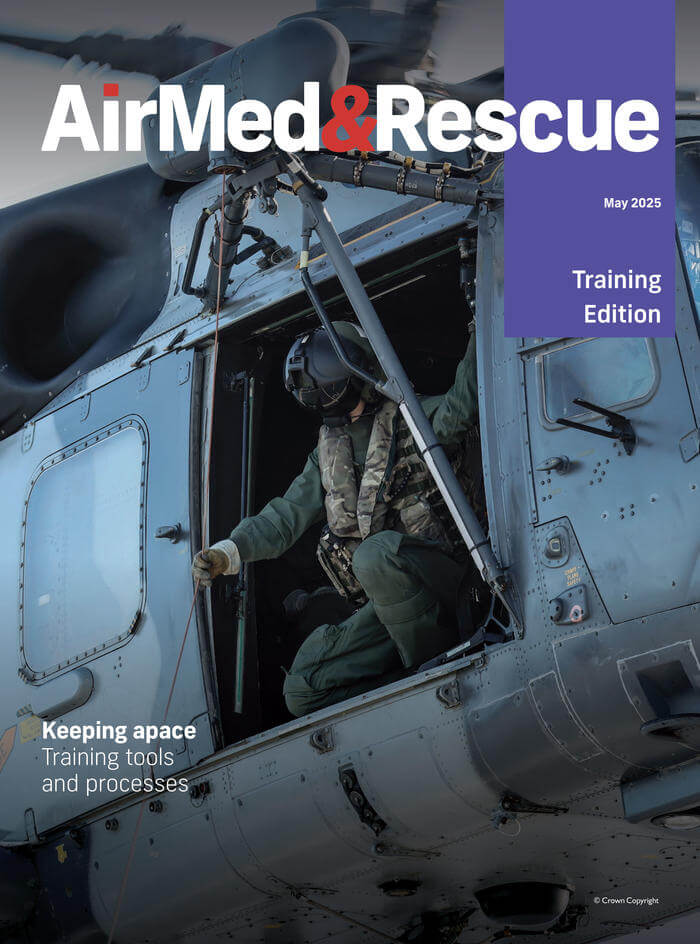
Our May edition is full of articles centered around training, with features covering pilot training, winch and rear-crew training, and air medical training; as well as a feature in the trend towards longer-range air ambulance transfers; plus we have more of our regular content, with lots of articles highlighting different aspects of training, from startle and surprise management to simulation centers and everything in between.
Lauren Haigh
Lauren has worked in the publishing industry for eight years and reads and writes about healthcare, science and travel insurance on a daily basis. Her favourite aircraft is the plane from the title sequence of British educational children’s TV series Come Outside.