Holistic treatment of patients with severe hemorrhage and hemorrhagic shock

Dr Daniel Werner, Regional Medical Director, South, and Head of Clinical Research at ADAC Luftrettungsstation München, details that an effective approach to hemorrhage and hemorrhagic shock requires a comprehensive strategy to control bleeding and maintain physiological functions until definitive hemostasis can be achieved in the pre-hospital phase
How long have you been working on the helicopters with ADAC Luftrettung? And what attracted you to helicopter emergency medical services (HEMS)?
I have been working in HEMS with ADAC Luftrettung for 10 years. What attracted me to HEMS was the combination of emergency medicine, highly specialized teamwork, and the opportunity to bring advanced medical care directly to critically ill or injured patients.
In HEMS, we often encounter patients where time really matters. Being able to deliver high-level critical care at the scene and then rapidly transport the patient to the most appropriate hospital is extremely rewarding.
The pilot project by ADAC Luftrettung to carry blood on board occurred about five years ago. What were the findings and how quickly were whole blood and blood products rolled out to all aircraft?
At the present time, we are carrying red blood cell concentrates with us. The project demonstrated that carrying blood products on a helicopter is feasible and allows us to start transfusion much earlier, directly at the scene, or during transport, rather than waiting until the patient reaches hospital. This is particularly relevant in patients with severe hemorrhage and hemorrhagic shock.
The important point is that pre-hospital transfusion is not simply about putting blood on board. You need the entire system around it: appropriate storage, temperature monitoring, logistics, clear indications, training, documentation, and, importantly, the ability to warm the blood during administration.
The number of transfusions performed at the participating helicopter bases currently amounts to one to two per month.
What proportion of your work required the intervention of blood transfusion?
Blood transfusion represents a relatively small proportion of our overall HEMS missions. However, these are among the most critically ill patients we treat. They typically include patients with major trauma and severe hemorrhage, but potentially also patients with non-traumatic bleeding.
So although transfusion is not something we perform on every shift, when it is required, it can be a key component of the patient's resuscitation.
Is there a trend in injuries and accidents that are resulting in a greater need for emergency blood interventions?
In my view, the most significant development is not necessarily that we are encountering a substantially higher number of patients suffering from hemorrhage, but rather that new scientific evidence indicates that hemorrhagic shock should be addressed as early as the pre-hospital phase.
Modern trauma care focuses on early hemorrhage control, the prevention of hypothermia and coagulopathy, and targeted resuscitation. The pre-hospital administration of blood products is one component of this approach. At the same time, we now have access to improved methods for achieving hemostasis, including tourniquets, pelvic binders, and other hemostatic interventions.
Therefore, a blood transfusion should never be viewed in isolation. It is part of a comprehensive strategy designed to control bleeding and maintain physiological functions until definitive hemostasis can be achieved.
As you’ve already mentioned, administering blood requires not only carrying the blood, but also appropriate cold storage and using fluid warmers at the point of administration. What is needed from a blood warmer (like the °MEQU °M Warmer System) on an aircraft and how is this different from those found in a hospital?
A blood warmer used in HEMS has very different requirements from a conventional hospital device. In hospital, you normally have mains power, a controlled environment, plenty of space, and an established infrastructure. In a helicopter or at an accident scene, none of those things can be taken for granted.
We need a device that is small, lightweight, robust, and easy to use. It needs to work reliably in challenging environmental conditions and, ideally, be independent of mains electricity. It also needs to deliver effective warming even when we need relatively rapid fluid or blood administration.
Another important aspect is speed. In an emergency, a device has to be ready quickly and should add as little complexity as possible to an already demanding resuscitation.
What blood warmers do you use and why these?
We use °MEQU °M Warmer System. For HEMS, the key reasons for selecting a warming system are reliability, portability, low weight, rapid deployment, and the ability to provide effective warming under prehospital conditions.
The device also has to integrate easily into our existing equipment and workflows. In my view, simplicity is very important. When you are treating a critically bleeding patient, often in a confined or difficult environment, medical equipment has to support the team rather than create additional complexity.
What other benefits does the °M Warmer System have besides the ability to warm blood?
The major advantage is that the device can also be used to warm other intravenous fluids. This supports active temperature management during resuscitation.
Hypothermia is particularly important in major trauma. A severely injured patient can lose body heat very quickly, and administering cold fluids can further contribute to that problem. Hypothermia can adversely affect coagulation, so avoiding additional heat loss is an important part of hemorrhage management.
I therefore see fluid warming not simply as a technical requirement for blood transfusion, but as part of the broader strategy of maintaining the patients physiology during resuscitation.
Ultimately, pre-hospital blood transfusion is about bringing a vital component of clinical resuscitation directly to the patient. However, blood alone is not the solution. Early hemorrhage control, appropriate transfusion, the prevention of hypothermia, and rapid transport to a facility capable of providing definitive care – all these measures must work in concert. To establish an evidence-based scientific understanding of the benefits of blood products in pre-hospital emergency medicine, a multi-agency registry for documenting transfusions – known as BiNAR ([Blut im Notarztdienst-Register]; Blood in Emergency Medical Services Registry) – has been established.
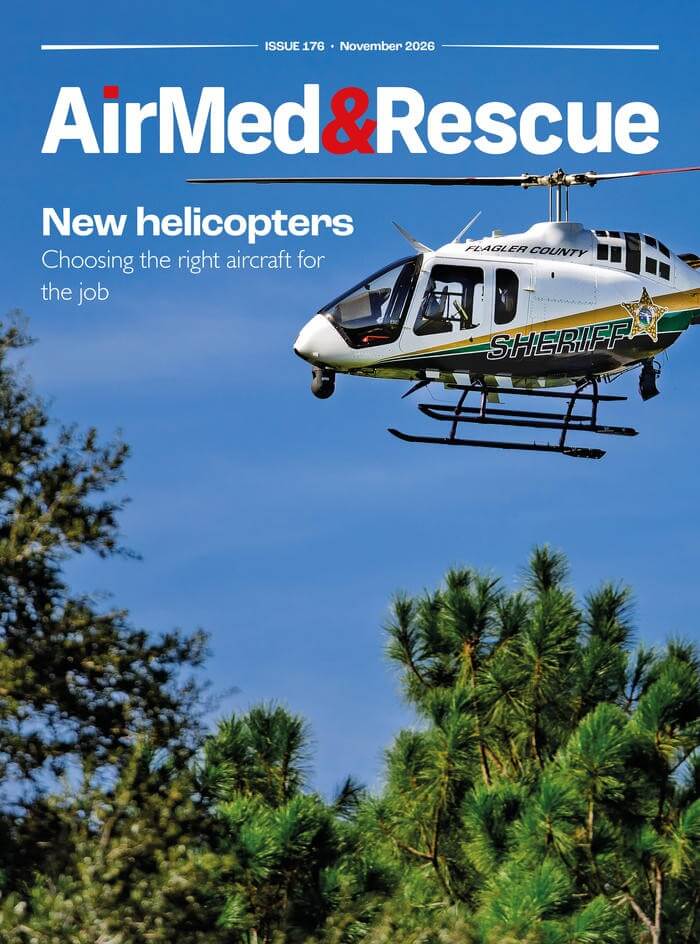
November 2026
Issue
The November edition of AirMed&Rescue has a wealth of articles to keep you informed and engaged. We have features that explore the challenges associated with cable snag and entanglement; determine how and why special missions operators choose a new helicopter; look at the risks, regulation, and requirements of temporary helicopter landing sites; and examine the inroads that are being made by the drone industry into the medical sector.
Editorial Team
The AirMed&Rescue Editorial Team works on the website to ensure timely and relevant news is online every day. With extensive experience and in-depth knowledge of the air medical and air rescue industries, the team is ready to respond to breaking industry news and investigate topics of interest to our readers.