
How to be a Canadian search and rescue technician

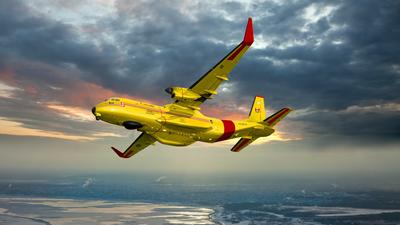
What does it take to be a Canadian SAR Tech? AirMed&Rescue reached out to the Royal Canadian Air Force (RCAF) to find out more about the unique role of a SAR Technician
Where does the opportunity to be a SAR Tech start?
SAR Technicians must have served a minimum of four years in the Regular Forces or in the Reserve Force prior to applying for a Voluntary Occupational Transfer (VOT) to attend the SAR Tech selection and Land Survival Course. Military background and training will vary from individual to individual. Both male and female Canadian Armed Forces (CAF) members apply for VOT and those with the strongest personnel files will be offered the opportunity to attend selection. The file review is the first phase of selection conducted at the BPSO level.
CAF members apply from the Army, Navy and Air Force and are generally top performers in their respective branch / occupation. Highest levels of physical fitness are an expectation of all candidates that volunteer. SAR Technician candidate occupations range from Infantry, Medic, Combat Engineer, ACS Technician, Boatswain to Construction Engineers and Special Operations.
Further file review for selection is conducted by D Air Pers and the SAR Tech CWOs. This is the second phase of the selection process. Stronger personnel files will include specific skill sets that mirror SAR Tech prerequisites of training such as parachuting, mountaineering, diving and medical.
The CAF has about 140 SAR Techs; why only 140?
Occupation total numbers are set by the RCAF in support of the National SAR Mandate. A limiting factor to the total number of SAR Techs in the occupation is the specialised training that they must receive. The Canadian Forces School of Search and Rescue (CFSSAR) trains SAR Techs, specifically the Restricted Team Member (RTM), Restricted Team Leader (RTL) and Team Leader courses. Due to the specialised training requirements, a maximum course load of 16 is recommended, thus limiting increased outputs.
How long does the initial training phase last?
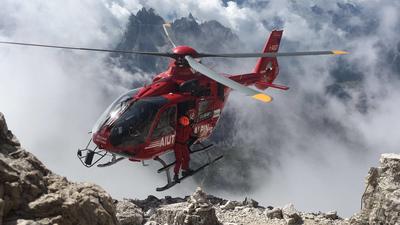
The selection and land survival course totals 17 days. Those deemed suitable and successful during selection will be course-loaded on the SAR Tech RTM course. The RTM course is 11 months long.
What does initial training involve?
Initial training on the RTM course consists of:
- In clearance – four administrative days
- Aeromedical training – four days
- Ground Search Operations Phase – five days
- Paramedic pre-studies – 10 days
- R2MR – two days
- Paramedic Phase – 80 days
- RUET – five days
- HPMA – two days
- Dive Phase – 29 days (includes CSRD)
- Arctic Survival Operations Phase – 12 days
- Winter Mountain Rescue Operations Phase – nine days
- Sea Survival / Rotary Wing Operations Phase – eight days
- Parachute / Fixed Wing Operations Phase – 35 days
- Summer Mountain Rescue Operations Phase – 10 days
- Final Operations Phase – 10 days+
- Graduation week – 10 administrative day

SAR Techs are trained to a primary care paramedic national standard – what exactly does this mean in terms of the care they are able to provide and drugs they can administer?
SAR Techs are trained to treat trauma injuries at the Primary Care Paramedic Level – performing triage in multiple casualty situations; assessing the medical condition of casualties; maintaining adequate airways; initiating and maintaining oxygen therapy; ventilating a patient; performing cardiopulmonary resuscitation; providing emergency treatment; treating hypovolemia utilising IV therapy; stabilising and extricating casualties from wreckages; evacuating personnel by loading and unloading patients from the evacuation platform; recognising and treating trauma injuries on an ambulance and in an ER setting over a five-day period; and initiating, maintaining and transferring patient medical documentation.
They are also trained to treat medical emergencies, providing treatment for respiratory conditions; cardiac conditions; chest pain; unconscious patient not yet diagnosed (NYD); cerebral vascular accidents (CVA); seizures; diabetic conditions; acute abdomen; allergic reactions; anaphylaxis; alcohol and narcotic overdose; neurological disorders; psychological emergencies including critical incident stress; obstetrical emergencies; paediatric emergencies; environmental emergencies; high-altitude emergencies; and diving emergencies.


SAR Techs are land and sea survival experts – what training do they undergo in order to achieve the right level of expertise in these disciplines?
SAR Techs will survive in a land environment by applying survival pattern; operating survival / personal equipment; performing first line maintenance on survival / personal equipment; constructing international / improvised ground signals; navigating on land using orienteering techniques; navigating on land using a GPS; performing first-line maintenance on SAR tents; erecting SAR tents / improvised shelters; and utilising field craft tools and woodsman skills.
For Arctic survival, SAR Techs survive by operating survival stoves and / or improvised heat sources to provide heat, food and water; erecting survival tents and constructing snow walls to provide shelter for an indefinite period of occupancy; constructing a multi- and one-man snow cave and fighter trench to provide shelter for an indefinite period of occupancy; contributing to group survival ability and morale; constructing improvised signals particular to the arctic; operating signal devices; and navigating.
For sea survival, the SAR Tech will train by parachuting into the water, practising egress from an aircraft, and completing the RUET training course.

WO Rob Coates spoke to AirMed&Rescue about his experiences as a SAR Tech in the RCAF:
What made you want to become a SAR Tech?
I had wanted to become a SAR Tech for many years during my time in the Army, prior to doing SAR Tech selection. What the trade did, both in training and in operations, appealed to me because it was more what I wanted to do with my military career and was similar to what I enjoyed doing in my personal life. I liked the fact that the skill sets that were taught and maintained throughout your career as a SAR Tech were transferable to life after SAR.
What is the most challenging part of the role?
The most challenging part of the job is maintaining not just your currencies, but proficiency in all of the many skill sets that SAR Techs possess.
What is the most satisfying part of the job?
The most satisfying part of the job is being able to return to safety those victims of disaster entrusted to your care by the assignment of the mission to which you have consented!
Being able bring loved ones home to their families or provide closure to families in some cases.
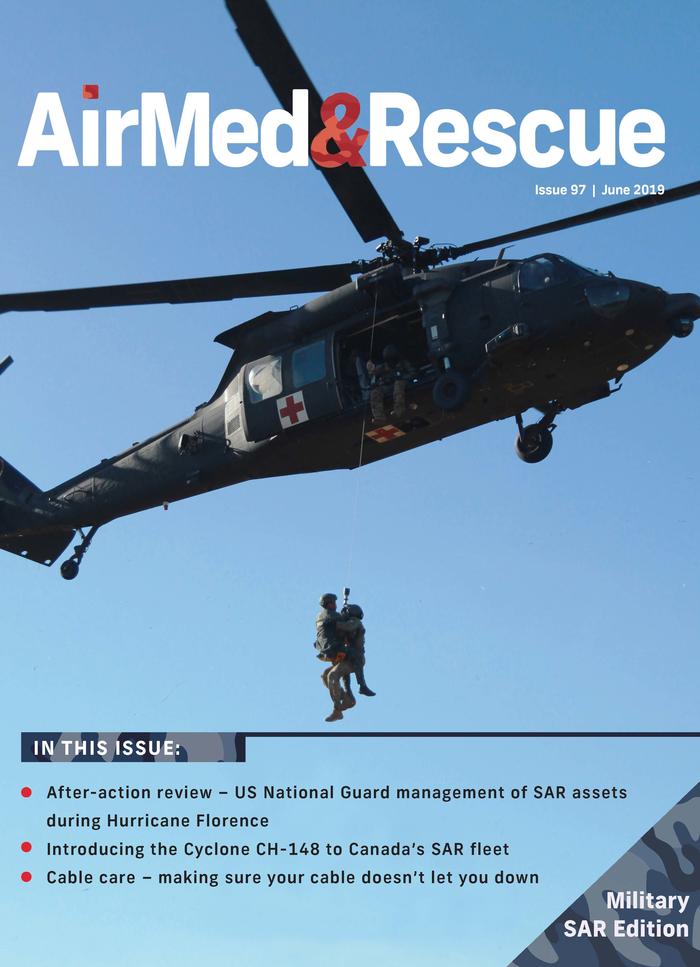
June 2019
Issue
In this issue:
Military SAR content:
Spotlight: Italian Air Force’s dedicated SAR unit, the 15th Wing,
Review of the operations that occurred during Hurricane Florence by a member of the US National Guard
Royal Canadian Air Force interview - what does it take to be a SAR Tech?
Medical Insight: The physiological effects of winching
The importance of cable care
Review of Rotorcraft Asia
Mandy Langfield
Mandy Langfield is a Director of Palladium Media Partners and former Publishing Director at Voyageur Group. She has written extensively on international travel and health insurance, medical assistance provision, and air medical transportation. She was Editor of AirMed&Rescue from December 2017 until April 2021. Her favourite helicopter is the Chinook, having grown up near an RAF training ground.
Keep on reading

HeliResQ 2019 - event report

Spinning Avoidance
A day in the life of a Canadian SAR pilot