

Impacts: strengthening assessment, accountability, and instructor support in hoist training

Trevor Abraham, Managing Director at Air Rescue UK, explains how the Integration of Mission Performance Analytics in Courseware, Training and Simulation (IMPACTS) module for the hoist trainer has a real impact on assessment decisions
In any specialist training environment, the moment of assessment carries enormous weight. For a student, it can determine progression, employment, or even their future within the industry. For the instructor, it represents a point of professional judgement, a decision that must be both fair and defensible. In the world of helicopter hoist training, where precision and human factors are inseparable, that decision has traditionally relied on experience, observation, recollection and instinct. Until now.
IMPACTS – a new data collection and assessment module developed by Bluedrop for the Hoist Mission Training System (HMTS) – is set to transform how instructors capture, analyze, and justify those critical moments of observation, evaluation and, ultimately, the decision to put their signature on the dotted line. IMPACTS can be adapted to any training simulator.
Built around the realities of modern hoist operations, Bluedrop’s IMPACTS provides a structured and evidence-based framework for recording student performance. Every decision, control input, error, and hoist cycle can be recorded, timestamped, and contextualized within the simulated mission. The result is a complete, auditable record of performance that allows instructors to move beyond anecdotal feedback and provide detailed, data-driven justification for each assessment decision.
For the instructor, this represents more than just technology, it’s protection, confidence, and credibility. When faced with a borderline pass or fail, IMPACTS ensures that the instructor’s judgement is supported by objective data. The system collates behavioral, technical, and procedural performance into a unified view, aligning with the instructional model and training objectives agreed before the sortie. This means instructors can clearly demonstrate why a student achieved a particular outcome, with traceable evidence that stands up to audit, client review, or moderation.
From a training management perspective, the benefits extend even further. IMPACTS allows training organizations to identify trends across multiple students, instructors, or scenarios. If several students are failing a specific phase, it becomes immediately visible, prompting a review of lesson design, scenario realism, or instructional delivery. In this way, IMPACTS doesn’t just record performance; it drives continuous improvement throughout the training system.
For the student, the transparency is equally valuable. Performance feedback is no longer subjective or reliant solely on recollection. They can review objective data points, matched against the instructor’s narrative, to better understand where and why they succeeded or fell short. It strengthens trust in the process and reinforces learning through factual reflection.
As an instructor and examiner who has spent years assessing operational technical crew in both real-world and simulated environments, I see IMPACTS as a vital evidence tool, one that is bridging the gap between instructor perception and measurable performance. It supports fairness, standardization, and defensibility in an industry where decisions have real-world consequences.
IMPACTS will soon be integrated into Bluedrop’s class-leading HMTS at Air Rescue UK’s training facility in Harwich, UK, extending the platform’s capability beyond immersive simulation and into the realm of data-supported assessment and assurance. It’s a natural evolution, ensuring that the same precision we demand in flight is reflected in how we teach, measure, and certify those entrusted to operate there.
November 2025
Issue
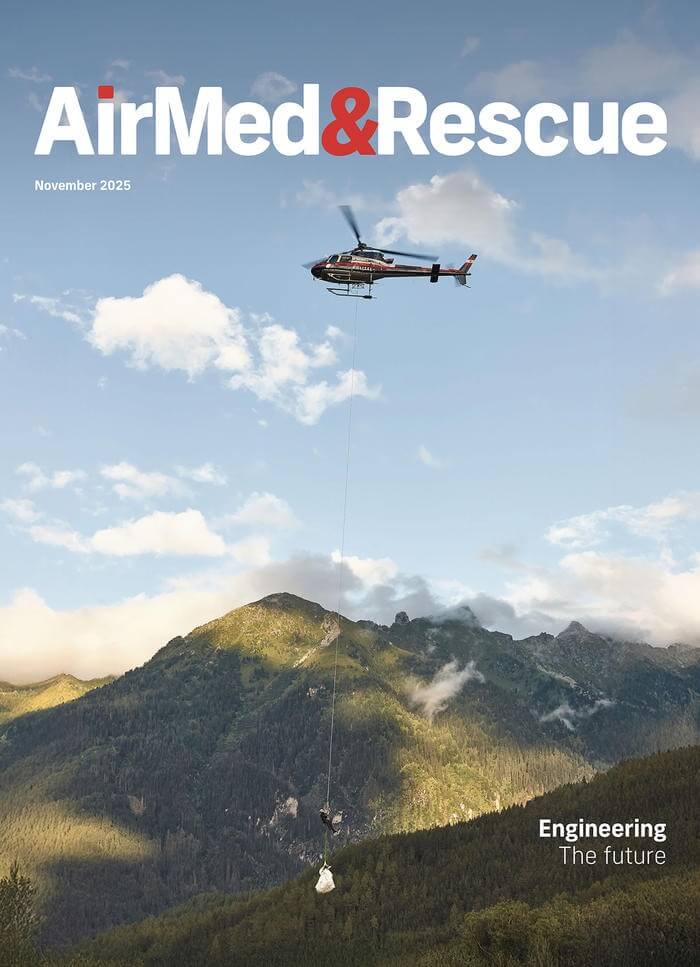
Our November edition is packed with content relating to special missions from around the world. We have features that explore the design and engineering that go into modern rotorcraft; the interactions between ground and air teams on helitack operations; the tools and attire needed for successful water rescues; and the new onboard technology that is revolutionizing special missions by detecting and communicating with cell phones.
Editorial Team
The AirMed&Rescue Editorial Team works on the website to ensure timely and relevant news is online every day. With extensive experience and in-depth knowledge of the air medical and air rescue industries, the team is ready to respond to breaking industry news and investigate topics of interest to our readers.