
Industry voice: Command to control: using tactical aircraft over wildfire for better results

Revie Lieskovsky, Technical Consultant at Conair Aerial Firefighting, explains the role of tactical aircraft and how important they are to managing, coordinating, and supporting aerial firefighting missions
Effective emergency response is dependent on the quality of situational awareness, or how well those responding know what’s going on.
Wildfire management teams use real-time data gathered from a variety of sources, coupled with internal experience, to coordinate fire containment strategies. Environmental science, climatology, and sophisticated imagery are used to predict the path wildfire will take and its intensity. Maintaining an accurate inventory of all available firefighting assets, their individual capabilities, and location, determines what response to deploy. When all elements are brought together, the bundle plays a vital role in determining effective firefighting response tactics.
Situational awareness gaps
Although technology is advancing, real-time data collection is still in its infancy. A continuous stream of high-resolution imagery over wildfire is difficult to achieve and is incomplete, leaving physical observation to fill in the gaps.
On the ground, information is relayed from teams on the fire line, who can only see the section of fire directly in front of them. Pilots in aircraft overhead can see more but are typically on site for short stints of time, focused on their own specific mission, and are unable to see changing fire behavior while away reloading or refueling. Often, wildfire management must piece together a dynamic response to changing conditions using disjointed, incomplete pieces of intel. Given that wildfires can spread over 20km per hour, that incomplete real-time picture means likely the response may not be the best it could be. In windy conditions, fire takes on a life of its own, burning dry vegetation and everything else in its path, throwing embers kilometers ahead, igniting new starts. Once the fire takes hold, it is hard to stop. Seconds, not minutes, count. A fast, powerful, initial attack is vital.
Prioritize safety, accuracy, speed
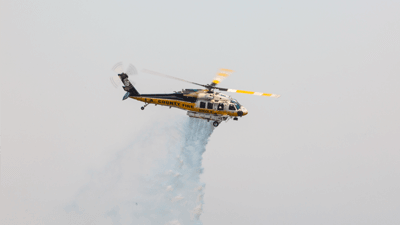
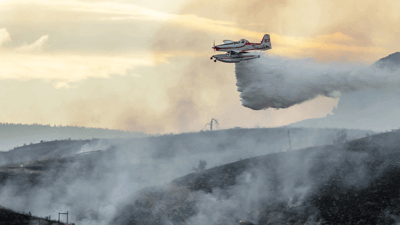
When seconds count, drops from aerial firefighting aircraft must be accurate in order to be effective. This means low and slow, with drops on flames threatening people or structures, or, if there is no immediate risk, drops around the perimeter of the fire to slow its progression. Effective drops also mean selecting correct coverage levels for the terrain, vegetation, and conditions, a long light release for grass fires or a heavier drop for dense forest, ensuring the drop reaches the ground and achieves maximum impact.
A quick assessment of the situation is critical, identifying the best drop location while evaluating fire behavior, coverage level, and best route, including safe exit points
Pilots arriving on scene are flying in smoke, wind, and, at times, airborne debris, making visibility challenging. They must decipher busy radio communications coming in from other aircraft, ground crews, and dispatch. Further, they must anticipate other aircraft, as the airspace becomes crowded with first responders. A quick assessment of the situation is critical, identifying the best drop location while evaluating fire behavior, coverage level, and best route, including safe exit points. They must also pinpoint a variety of risks, looking for crews on the ground in the potential drop location, and dangerous nearby obstacles such as rising ground, power lines, descending air, and tall trees standing out from the main canopy, as well as anticipating weather, including dangerous wind gusts.
Once they make their drop, sometimes in formation one after the other, they exit to reload, typically not returning to the fire for several minutes, if not closer to 30 minutes to an hour, a time period during which the fire situation can drastically change from the last time they laid eyes on it, burning kilometers away, consuming buildings and infrastructure, swept up by a change in the wind. When they arrive, the fire situation could be an entirely different fire from when they left.

Support from the sky
To overcome these situational awareness challenges, taking command over the fire, in coordination with teams on the ground, is key to effective response. Jurisdictions around the world that have faced escalating wildfire challenges for decades have adopted this essential ability, offering continuous airborne oversight to the changing situation with ‘eyes from the sky’ where technology is not yet able. These regions, across North America, parts of Europe and Australia, deploy air attack lead planes, sometimes called ‘bird dogs’.
These tactical aircraft fly over the wildfire on a constant basis, at a low level for improved visibility, with an Air Attack Officer onboard with the authority to manage the aerial response. The air attack team communicates with airtanker, rotary and skimmer pilots, as well as ground crews, to ensure a safe environment.
These small, fast, and agile aircraft are more maneuverable than larger airtankers and skimmers, scouting the fire area, observing fire behavior and changing weather, identifying critical values at risk. They develop and execute the aerial firefighting mission, tasking other aircraft to respond, communicating where to drop, how much to drop, and safe exit routes, avoiding hazards, taking into account airtanker performance capabilities. Often they will guide large airtankers into drop zones, indicating drop sites with a stream of smoke to ensure drops are effective. They observe the wildfire perpetually throughout the mission, reassessing tactics according to changing conditions so that return drops are placed effectively and efficiently. They further support the optimization of the aerial operations by minimizing time over the fire for the aerial firefighting aircraft so that a greater number of drops can be achieved. The operational efficiencies and flexibility gained through the use of the air attack cannot be overstated.
They observe the wildfire perpetually throughout the mission, reassessing tactics according to changing conditions so that return drops are placed effectively and efficiently
High-tech air attack aircraft
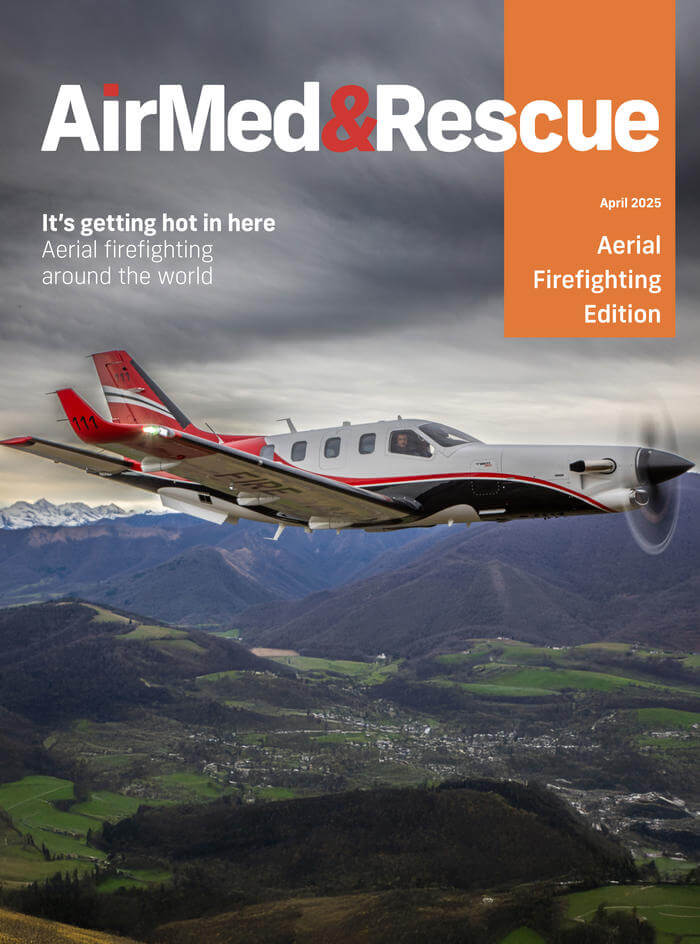
The most advanced tactical air attack platform in the world today is the Daher TBM 960, which Conair Aerial Firefighting has recently selected as the company looks to modernize its air attack fleet. The streamlined aircraft was selected for its superior performance, modern design standards, advanced safety features, and improved reliability. The TBM 960 air attack plane will be operating for decades to come, capable of adapting to advancing technologies that further improve situational awareness over wildfires.
“We are planning for our future with the selection of the TBM 960 aircraft, chosen after an in-depth analysis of more than 50 aircraft types,” shared Matt Bradley, President and CEO of Conair.
“Modernizing our bird dog fleet ensures our aircraft aren’t grounded by lack of parts supply, increasing maintenance, or obsolescence, when needed the most. Investing in modern aircraft gives our government agency customers the security of knowing the fleet is available to respond, offering lower operational risk at a time of crisis.”
Modernizing our bird dog fleet ensures our aircraft aren’t grounded by lack of parts supply, increasing maintenance, or obsolescence, when needed the most
Daher’s TBM 960 offers many advanced safety features advantageous for wildfire operations, including the HomeSafe emergency autoland system, and a single-button return-and-land function the Air Attack Officer can initiate in the event of pilot incapacitation. In addition, the aircraft offers an advanced Doppler radar system detecting lightning and turbulence, as well as electronic stability and under-speed protection, and emergency descent mode. The single-lever digital engine and propeller control affords more heads-up time to the pilot when flying low level.
The Daher TBM 960 aircraft is being retrofitted by Conair with specialized avionics and equipment specific to wildfire operations before deploying as air attack lead planes. Two TBM 960 air attack aircraft will operate in Canada for the 2025 fire season, with a government agency Air Attack Officer in the right seat and a Conair pilot in the left.
“Globally, the legacy fleet of bird dog aircraft are reaching the end of their lifespans given the demanding conditions they fly in, facing turbulence, heat, smoke, and fluctuating elevations on a continuous basis,” said Mike Benson, Director of Business Development at Conair. “These new aircraft offer key advantages for aerial firefighting response. They are fast, keeping pace with large airtankers, and are superior to jet-powered aircraft, with no lag time when accelerating and climbing, critical for low-level missions. They also can also keep pace with advancing technology, converting into multi-role platforms that incorporate intelligence, surveillance and reconnaissance equipment, used to map wildfires or provide search and rescue capability.”
New air attack lead planes, such as the Daher TBM 960, provide essential situational awareness in demanding operational environments, offering wildfire management teams access to the information they need to optimize their response, containing fires faster with less damage. A tactical, commanding aircraft to help control wildfires.
April 2025
Issue
Our April edition has a special focus on aerial firefighting, with features that include rescues during wildfire situations; the coordination process and tools used between aircraft and firefighters; the distinct job of the smokejumper; the different use cases for buckets and tanks, and what needs to be considered for your airframe; the continued appeal of the Firehawk platform; and the importance of proper expertise when treating traumatic brain injuries; plus more of our regular content.