

Industry voice: Considerations for HEMS and HEC programs operating in the vicinity of paragliders and BASE jumpers – part 2: Rescues of paragliders and BASE jumpers

Charley Shimanski, President of the Air Rescue Commission at the International Commission for Alpine Rescue (ICAR), looks at the challenges associated with rescuing paragliders and BASE jumpers who encounter a failed flight
The rescue of paragliders and BASE jumpers can be quite difficult depending on the place the jumper is found:
- The jumper will often still be connected by harness to their parachute, perhaps suspended from the parachute
- The jumper may be suspended from terrain (cliff, rock wall, etc) or from a tree or power line
- The position of the jumper may make critical medical care and spinal mobilization difficult.
Furthermore, the rotor wash from a hovering helicopter can be significant during the rescue of a paraglider or BASE jumper who has encountered a failed flight and is hanging by their parachute on a rock wall or from a tree.
Speed fliers/riders, on the other hand, are often found in sloping, rugged terrain. Such terrain may not suggest significant challenges to ground-based rescuers, but the risk of the canopy being re-inflated by rotor downwash is significant.
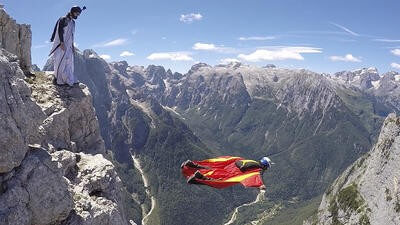
The situation with the parachute opening and catching rotor wash is very complex.
- There is a risk that the helicopter rotor wash will catch the wing of the parachute and cause it to become dislodged from the entanglement with the trees or rock that had originally suspended it, causing the parachute and pilot to fall further. Rescue teams must take this possibility into consideration when planning for a human external cargo (HEC) rescuer insertion
- Any reconnaissance flight should be at the subject altitude or below, to avoid any rotor wash issues. Helicopter rescue services should consider inserting rescuers to the ground to access the subject via traditional terrestrial techniques before performing HEC evacuation
Helicopter rescue services should consider inserting rescuers to the ground to access the subject via traditional terrestrial techniques before performing HEC evacuation
- The helicopter pilot should be careful to deploy rescuers out of downwash distance to the subject
- Some programs are careful not to fly close to, or above, the patient due to the possibility of rotor downwash disrupting the air around the parachute
- Generally, helicopter rescues should not be performed directly above the accident site using a hoist or a short-haul direct rescue with winch or longline. More often, the helicopter is used to bring mountain rescue personnel to the scene, who then carry out the rescue terrestrially. Afterwards, the personnel and patient are flown out of the site
- Whenever possible, helicopter rescue agencies should dispatch the aircraft with the smallest downwash profile.
Even without rotor wash hazards, entanglement of a helicopter HEC rescue system can become a very real hazard:
- Entanglement with trees/branches becomes possible as a rescuer is lowered or raised in HEC operations
- Entanglement with the multiple lines of the parachute becomes possible since rotor wash can cause those very lightweight lines to swing wildly during the rescue operation.
Rescues of paragliders and BASE jumpers whose parachutes are entangled in trees
The rescue of paragliders and BASE jumpers entangled in or suspended from trees presents a unique challenge to rescuers.
- As already mentioned, the jumper will often still be connected by harness to their parachute, perhaps suspended from the parachute
- In areas where paragliding and BASE jumping are popular, rescuers should train in climbing trees to determine a rescue system suitable to lower the jumper from his or her parachute
- There are many cords on a parachute. When entangled in trees, it takes time to cut them all, and they can be a hazard in themselves to the rescue team. Rescuers must be equipped with a hook knife to cut the parachute cords when necessary. The following must be considered when using a hook-knife:
- Only hook knives should be used by rescuers to cut rigging lines
Only hook knives should be used by rescuers to cut rigging lines
- A correct technique is essential, using a thumb or finger to shroud the opening before making the cut: using an open blade or unshrouded hook knife poses the risk of a weight shift (from a released line) pulling other loaded ropes (such as the rescuer’s working line) onto the blade. This may result in inadvertently severing the loaded line
- Rescuers must secure the parachute so that it does not become airborne under rotor wash or wind once it is free of its cords.
- Only hook knives should be used by rescuers to cut rigging lines
- There might be additional hazards to account for: loose rocks / dead branches (trees) at the site, and scene safety must be the first priority of HEC rescuers once on the ground
- Both ground and air rescue organizations must train in these types of rescue operations.

Rescues of paragliders and BASE jumpers stuck on rock walls
The rescue of paragliders and BASE jumpers suspended from rock walls presents its own unique challenge to rescuers.
- As with rescues of jumpers suspended from trees, the jumper will often still be connected by harness to their parachute, perhaps suspended from the parachute
- Rescuers must be certain to anchor themselves into the terrain to avoid falling from the accident site
- The risk of the hang glider pilot or BASE jumper falling from a rock wall is very real. The connection to the wall may be precarious, and even if the parachute is hanging by many of its cords from a stable rock ledge or horn, the fabric of the parachute may tear, potentially causing the person to fall. For this reason, rescuers must determine how to secure the jumper, who is likely only attached to the terrain by their suspended parachute
The risk of the hang glider pilot or BASE jumper falling from a rock wall is very real. The connection to the wall may be precarious, and even if the parachute is hanging by many of its cords from a stable rock ledge or horn, the fabric of the parachute may tear, potentially causing the person to fall
- The scene of the rescue may not be near an area popular for climbing, so routes to ascend or descend to the jumper by ground may be unknown to the rescuers
- If the area is not popular for climbing, it may be because the rock is unstable and/or unsuitable for climbing. This makes the hazard of rockfall very real while approaching the jumper from above. Still, construction of anchors and belay systems follows normal mountain rescue techniques in technical terrain
- Entanglement of a HEC rescue system with the multiple lines of the parachute is again a very real hazard, particularly since rotor wash can cause any loose lines to swing wildly during the rescue
- The situation with the parachute opening and catching rotor wash is very complex, and must be avoided
- Often these rescues can be in high-angle terrain. HEC rescue teams must be very mindful of helicopter clearance to the rock wall, as this may not be a typical rescue scenario for HEC programs
- The rescue of a suspended pilot could involve complex rigging. Both ground and air rescue organizations must train in these types of rescue operations, and have appropriate gear for the operation.
Risk management and decision-making in rescues of paragliders and BASE jumpers
Oftentimes, paragliders and BASE jumpers may suffer minor injuries or, at a minimum, be conscious and signaling rescuers after the accident, making it easier for helicopter crews to recognize that the jumper has survived the accident.
The survival probability of paragliders and BASE jumpers who encounter a failed flight and make contact with terrain is certainly lower than for individuals involved in ground-based recreational activities (hiking, climbing, mountain biking). The first scene assessment and patient assessment of a paraglider or BASE jumper may often be by helicopter, as the remote nature of the accident site might make access by ground rescue teams difficult and time-consuming.
In situations where the first assessment is by air, it may be difficult to determine whether a non-moving jumper is unconscious or deceased. Knowing whether the operation is a rescue or a recovery is a key factor in determining the risk management profile for the operation. Assessing this through a helicopter window is often difficult.
Wake turbulence
Another critical point concerning the impact of the helicopter on paragliders and BASE jumpers is the issue of ‘wake turbulence’. The French Bureau of Enquiry and Analysis for Civil Aviation Safety (BEA) recently published a detailed report on the impact of the rotor turbulences from helicopters on human flight. A video is available here:
https://youtu.be/iHqN7PQraMs.
The report was published following a fatal accident where a paraglider fell to the ground after crossing the wake turbulence of a nearby medical helicopter responding to an accident on the beach. A similar accident occurred in Switzerland, which was fortunately not fatal.
This BEA report should be shared with all helicopter crew and the paragliding community in order to draw attention to the risks of helicopters and human flight in the same airspace.
This BEA report should be shared with all helicopter crew and the paragliding community in order to draw attention to the risks of helicopters and human flight in the same airspace
Recent analysis of the effects of wake turbulence initiated by the helicopter main rotors shows that “the wake turbulence of a helicopter is greater than that of an aircraft having an equivalent weight”, according to BEA investigator Angelique Lefevre.

Education and communication
Communication with the paraglider and BASE jumping communities, clubs and schools is important, and must be well developed. HEMS and HEC programs must make helicopter operators and paragliders/BASE jumpers aware of each other, and organize meetings with the association and schools.
Conclusion
The rescue of injured or stranded paragliders or BASE jumping individuals is becoming more commonplace, and should be taken seriously by helicopter rescue agencies that operate in the vicinity of these outdoor enthusiasts.
Whenever possible, the theorical information provided above in relation to rescues in the vicinity of wing-suit, parachute/paraglider-equipped individuals should be part of helicopter rescue agencies’ educational and training programs.
May 2025
Issue
Our May edition is full of articles centered around training, with features covering pilot training, winch and rear-crew training, and air medical training; as well as a feature in the trend towards longer-range air ambulance transfers; plus we have more of our regular content, with lots of articles highlighting different aspects of training, from startle and surprise management to simulation centers and everything in between.
Charley Shimanski
Charley Shimanski is President of the Air Rescue Commission for the International Commission for Alpine Rescue. He is a 30-year member of Colorado’s Alpine Rescue Team, the Mountain Rescue Program Co-ordinator for Flight For Life Colorado, and Past President and Education Director of the Mountain Rescue Association.