

Industry voice: Sustainability in fuels and engine design

Nico Chabée, Vice President, Sales and Marketing, Helicopters, at Pratt & Whitney Canada, discusses how engine technologies are propelling a more sustainable future for rotorcraft and HEMS
At Pratt & Whitney Canada (P&WC), we are dedicated to pushing the boundaries of technology and delivering exceptional value to our customers across the globe. Our commitment is not just to meet their operational goals, but also to enhance the sustainability of their practices. We take immense pride in supporting the helicopter emergency medical services (HEMS) sector, which performs lifesaving missions globally, often under challenging conditions.
Our ongoing efforts to develop new technologies focus on enhancing engine performance and fuel efficiency and exploring the capabilities of sustainable aviation fuel (SAF). These advancements aim to provide significant benefits to HEMS operators by improving aircraft capabilities and reducing environmental impact.
Sustainability, electrification and disruptive platforms are key intertwined trends that are shaping the future of rotorcraft propulsion. As part of RTX, one of the world’s largest aerospace and defense companies, P&WC is well positioned to harness these trends and lead the rotorcraft industry into the future, with 11,200 of its propulsion systems powering helicopters globally.

Sustainable aviation fuel
Enhancing aircraft efficiency is crucial, and increasing the use of SAF is a key strategy in the industry's pursuit of reducing carbon emissions to achieve net-zero goals. SAFs are produced using alternative, non-fossil-fuel-derived feedstocks, allowing a reduction in life-cycle emissions compared with traditional fuels. All P&WC engines are compatible with SAF blends up to 50% with Jet A/A-1 kerosene, as per ASTM International specifications. As a ‘drop-in’ solution, SAFs require no modifications to aircraft or fuel infrastructure and maintain the same performance, reliability, and safety standards.
As a ‘drop-in’ solution, SAFs require no modifications to aircraft or fuel infrastructure and maintain the same performance, reliability, and safety standards
Helicopter operators, including those in the HEMS sector, are already exploring SAF as a means to reduce net emissions and support environmental objectives. For instance, in Germany, ADAC Luftrettung conducted a long-term trial using SAF in its routine operations of P&WC-powered Airbus H135 helicopters. Similarly, HeliService successfully implemented SAF during crew-change operations for an offshore wind energy project in the Baltic Sea. These initiatives are critical in demonstrating the demand for SAF and raising awareness of its benefits.
Looking forward, we remain actively involved in supporting industry efforts to test and qualify new types of SAF, including future specifications for 100% SAF. In 2023, we collaborated with Leonardo on a demonstration flight of a PT6C-67C-powered AW139 helicopter using 100% SAF, showcasing our commitment to sustainable aviation advancements.

Hybrid-electric technology innovations
In line with the trend towards aircraft electrification, particularly in hybrid-electric propulsion, we are advancing several demonstrator programs to develop this technology for a broad spectrum of future aircraft applications, including helicopters. As part of RTX, P&WC is strategically positioned to drive this technology forward through close collaboration with Collins Aerospace, a global leader in aircraft electrical systems, including motors and power controllers.
For instance, we are working with Airbus Helicopters on the PioneerLab demonstrator. This project is focused on developing a hybrid-electric propulsion system that combines a P&WC PW210 engine derivative with two Collins Aerospace 250kW motors and controllers. The initiative aims to demonstrate a 30% improvement in fuel efficiency and reduced emissions compared with a conventionally powered H145 helicopter, while also benefiting from aerodynamic enhancements.
The initiative aims to demonstrate a 30% improvement in fuel efficiency and reduced emissions compared with a conventionally powered H145 helicopter
Hybrid-electric propulsion is also facilitating more innovative aircraft concepts, including advanced air mobility applications that utilize distributed propulsion. We are exploring these new architectures through the RTX Scalable Turboelectric Powertrain Technology (STEP-Tech) demonstrator, which targets scalable propulsion systems reaching up to the 1MW power class and beyond.
While these technologies may eventually replace some roles served by conventional helicopters today, we are confident that many critical rotorcraft missions, such as HEMS, will continue to rely on the exceptional performance, reliability, and endurance of gas turbine engines, whether as part of conventional or hybrid-electric propulsion systems.
Furthermore, we continue to enhance the efficiency and performance of our gas turbine engines, particularly through the development of advanced materials that enable greater thermal efficiency. This is a focus of our recently announced Turbine Engine Advanced Materials for Efficiency (TEAME) project, supported by Canada’s Initiative for Sustainable Aviation Technology (INSAT), which explores advanced materials to improve engine durability and efficiency.

Collaboration is key
Collaboration with industry partners and customers remains a cornerstone of our strategy for advancing more sustainable aerospace technologies and solutions. This ensures our technology roadmaps are aligned with the evolving needs of the industry. Our collaborative approach is demonstrated through numerous initiatives, whether it’s supporting the use of SAFs or developing new technologies to enhance efficiency and reduce emissions.
Our collaborative approach is demonstrated through numerous initiatives, whether it’s supporting the use of SAFs or developing new technologies to enhance efficiency and reduce emissions
We stand ready to support our customers in achieving their business and environmental objectives and contributing to a more efficient and sustainable future for the rotorcraft industry. This includes the crucial missions performed by HEMS operators, ensuring they have the tools needed to continue their lifesaving work effectively and sustainably.
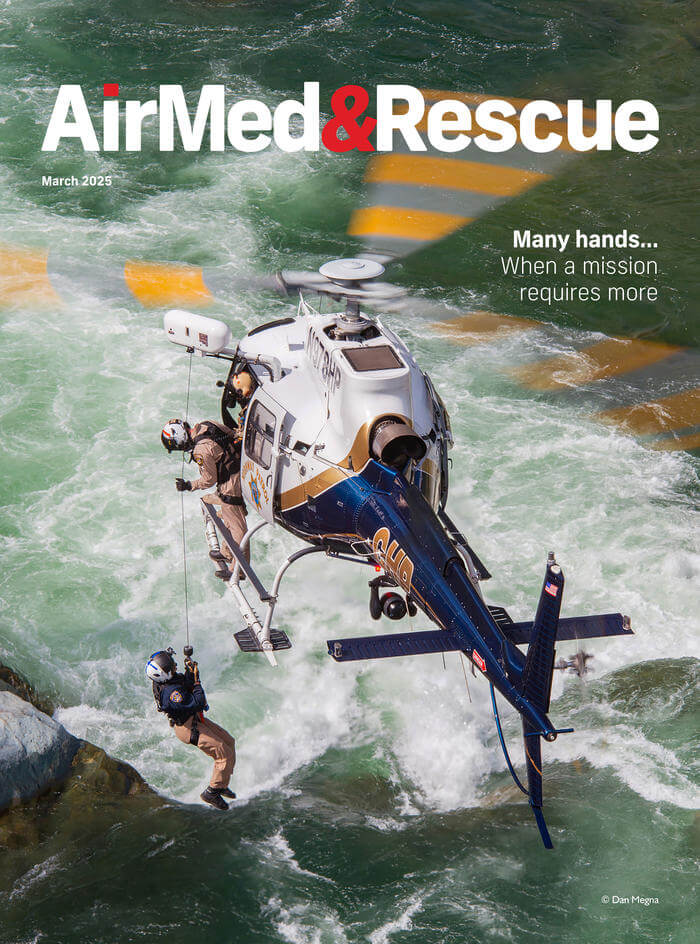
March 2025
Issue
Our March edition has features that let you discover the level of training provided by simulators; learn the ins and outs of medical interiors in aircraft; find out about how health and usage monitoring systems are changing special missions; and see how aerial firefighters communicate and coordinate their missions across multiple agencies and stakeholders; plus more of our regular content.
Nico Chabée
In his current role, Nico provides inclusive leadership and guides the development of aggressive strategies to expand P&WC’s helicopter market activities.
Nico acts as executive liaison with the global community of small, medium and large helicopter operators, defining and coordinating product concepts and establishing product design and development requirements. Nico also leads the product marketing and sales activities for the company’s helicopter segment and provides executive-level contact with helicopter original equipment manufacturers (OEMs).