
Industry voice: Swiftwater breathing apparatus: disrupting the drowning process and mitigating rescuer fatalities

Drowning is a leading cause of accidental death worldwide, with traditional drowning prevention strategies focused on buoyancy aids, and protective equipment proving insufficient in mitigating the immediate risks of cold-water shock and drowning. Steve Glassey explains how the Swiftwater Breathing Apparatus (SWBA) has emerged as a potential game-changer
Drowning is a major public health concern, with an estimated 295,000 deaths occurring worldwide each year.¹ Traditional drowning prevention strategies have focused on buoyancy aids like personal flotation devices (PFDs) and protective equipment such as helmets. However, these measures do little to mitigate the immediate risks of cold-water shock and the drowning process itself.2
Swiftwater Breathing Apparatus (SWBA) has emerged as a potential solution, offering respiratory protection at the water’s surface and a means of interrupting the drowning process.
Disruption of drowning
The drowning process involves a sequence of events, including struggle to keep the airway clear of water, initial submersion and breath-holding, aspiration of water, unconsciousness, and cardio-respiratory arrest.³ SWBA can interrupt this process at critical points:
Maintaining a clear airway: SWBA provides a means to maintain a clear airway even if submerged or engulfed by water, preventing the initial struggle to keep the airway clear²

Mitigating the gasp reflex: the gasp reflex, triggered by sudden skin cooling on immersion, can result in involuntary aspiration of water.³ With SWBA, the operator can quickly access the mouthpiece to provide breathable air, preventing water aspiration during the initial cold shock response
Preventing water aspiration: aspiration of water leads to worsening hypoxia, unconsciousness, and eventually cardio-respiratory arrest.³ By preventing water aspiration, SWBA can delay the onset of these later stages of the drowning process.
Aspiration of water leads to worsening hypoxia, unconsciousness, and eventually cardio-respiratory arrest
Benefits of SWBA compared with existing protective equipment
While PFDs and helmets provide important protection, they do not address the immediate risks of cold-water shock and the drowning process.² SWBA offers several key benefits:
Respiratory protection: SWBA provides a means to breathe while submerged, reducing the risk of water aspiration²
Increased rescue time: SWBA provides additional time for self-rescue or assisted rescue, increasing the chances of survival²
Compatibility with existing equipment: SWBA can be used in conjunction with PFDs and helmets, enhancing overall safety.2

Water rescuer fatalities and SWBA
Bystanders who attempt to rescue drowning victims often become victims themselves, a phenomenon known as aquatic victim-instead-of-rescuer (AVIR) syndrome.4 Studies have shown that a significant proportion of drowning incidents involve would-be rescuers.5,6
Studies have shown that a significant proportion of drowning incidents involve would-be rescuers
SWBA could potentially reduce the risk of rescuer fatalities by providing respiratory protection and increasing the chances of successful rescue. As awareness of SWBA grows, it is possible that future coronial inquests into rescuer fatalities may start to question why rescuers were not supplied with SWBA.
Implications for insurers
As the benefits of SWBA become more widely recognized, insurers, particularly in the US market, may start to exclude cover for incidents where SWBA was not used. This follows a pattern seen in other industries, where insurers have mandated the use of specific safety equipment or risk management practices as a condition of coverage.7
Conclusion
SWBA represents a significant advancement in swiftwater rescue, offering a means to interrupt the drowning process and potentially reduce the risk of rescuer fatalities. As awareness of SWBA grows, it is likely that its use will become more widespread, with potential implications for coronial inquests and insurance coverage. Further research is needed to quantify the effectiveness of SWBA in real-world scenarios and to develop best practices for its use in swiftwater rescue operations.
References:
- Franklin RC, Peden AE, Hamilton EB, et al. The burden of unintentional drowning: Global, regional and national estimates of mortality from the Global Burden of Disease 2017 Study. Inj Prev 2020;26(Supp 1):i83-i95.
- Glassey S. SWBA set to revolutionize swiftwater rescue. Public Safety Institute 2023.
- Tipton MJ, Montgomery H. The experience of drowning. Med Leg J 2022;90(1):17-26.
- Franklin RC, Pearn JH. Drowning for love: the aquatic victim-instead-of-rescuer syndrome: drowning fatalities involving those attempting to rescue a child. J PaediatrChild Health 2011;47(1-2):44-47.
- Turgut A, Turgut T. A study on rescuer drowning and multiple drowning incidents. J Safety Res 2012;43(2):129-32.
- Zhu Y, Jiang X, Li H, Li F, Chen J. Mortality among drowning rescuers in China, 2013: A review of 225 rescue incidents from the press. BMC Public Health 2015;15(1):631.
- Viscusi WK. The value of risks to life and
health. Journal of Economic Literature 1993;31(4):1912-1946.
December 2024
Issue
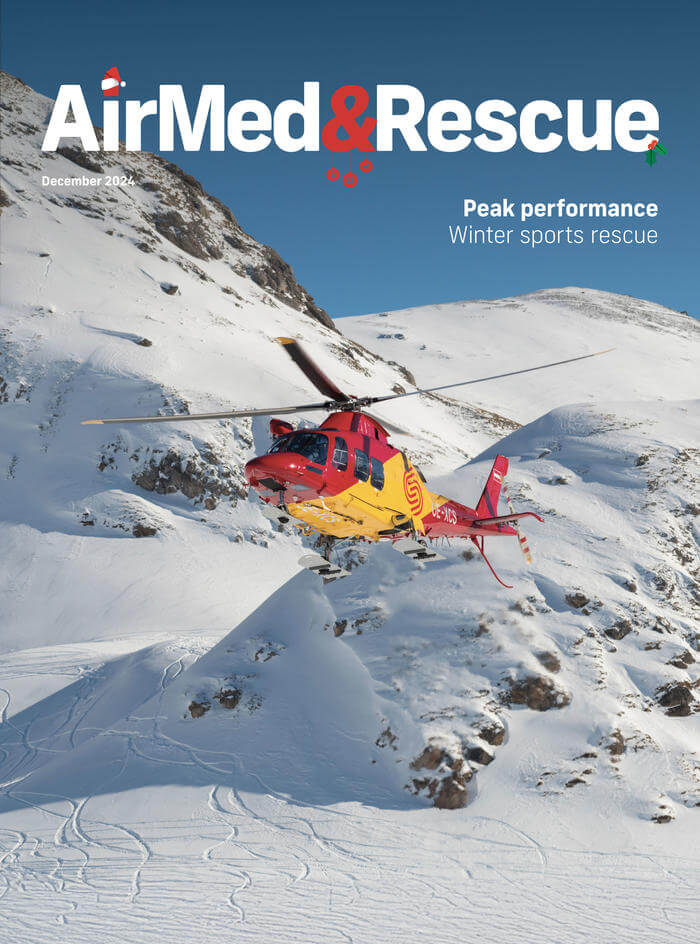
In the December edition, discover what goes into saving people that get into trouble on the ski slopes; find out about drones that are being used for search and rescue; learn about the treatment options for people with fractures; and see what has been happening this year in the realm of avionics development; plus more of our regular content.