
Industry voice: Transport of special pathogens: establishing new capabilities in complex systems

Anne-Marie Piche, Special Pathogens Transport Lead at Ornge and Special Operations Paramedic, and Patrick Auger, Special Operations Coordinator at Ornge, Incident Commander for Ontario's Emergency Medical Assistance Team (EMAT) and Special Operations Paramedic, explain the specialized equipment and protective measures required for the transport of patients with high-consequence infectious diseases
Imagine that, as a paramedic on shift, you are asked to transport a patient with Ebola, Marburg or smallpox from a community hospital to a large urban center. Upon receiving the request, you might wonder if you are adequately prepared to transport these types of patients. You might ask yourself how you can prepare your aircraft and what level of personal protective equipment (PPE) you need. As you are faced with the prospect of transporting a patient afflicted with a pathogen of high consequence, do you know your organization’s level of preparedness? Are there plans and engineering controls already in place? How could you move this patient with dignity while focusing on the safety of the crew?
What are special pathogens?
Special pathogens are highly contagious organisms that cause high-consequence, severe disease in humans and that are associated with a high mortality rate.1 From a biosafety perspective, special pathogens are organisms classified as Risk Group 4 (RG4) pathogens and require Containment Level 4 (CL4), the highest level of containment for pathogens and toxins.2 They include viral hemorrhagic fevers such as Ebola, Marburg, Lassa, smallpox, and new and emerging zoonotic diseases.
Transporting these patients outside the hospital, with limited resources and protective measures, is high risk
Transporting these patients outside the hospital, with limited resources and protective measures, is high risk. Cross-contamination in all phases of transport and the risk of clinician exposure is of significant concern. Preparedness for special pathogens transport is paramount to ensure the safety of the patient, the flight crew, and clinicians. As outbreaks of viral hemorrhagic fevers continue to occur around the world, land and air ambulance services must be adequately prepared to address these high-risk missions, without compromising systemic day-to-day operations.
The concept of operations
Ornge as an organization provides high-quality air ambulance service and medical transport to people who are critically ill or injured. It has established a special operations team consisting of experienced critical care paramedics to manage complex transport missions. The team has developed a special pathogens transport capability that will protect paramedics and the emergency medical transport environment and allow day-to-day operations to remain uninterrupted.

Specialized equipment and limitations
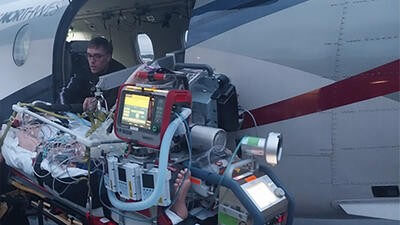
Ornge has acquired four EpiShuttles from EpiGuard in Norway. The EpiShuttle is a self-contained, negative-pressure, biocontainment transport vessel that allows paramedics to doff or downgrade PPE during the transport phase. This capability is significant, especially during long-distance transports. In addition to enabling clinicians to operate with minimal or no PPE, the device protects the transport environment, such as hallways, ambulances, and aircraft, effectively reducing the impact on the transport system.
The EpiShuttle’s negative-pressure blower provides upwards of 15 air exchanges per hour, which meets the CAN/CSA Z317.2 standard for healthcare facilities. In addition to the wire ventilator ports, eight ports can be outfitted with butyl gloves to provide patient care and with a sluice bag to introduce medical consumables into the device during transport.
Although this specialized biocontainment unit provides proper environmental protection, it does, however, present limitations regarding patient dimensions and weight. The EpiShuttle can accommodate up to 150kg in patient weight, including any biomedical equipment attached to the EpiShuttle medical racks. The device is 25in wide, and it can accommodate patients with a maximum height of 6ft 6in, which are planning considerations.
The Incident Command System framework
The ICS framework is a standardized approach to command, control, and coordination most commonly used during large-scale emergency response and targeted, complex missions
The Ornge special operations team follows the Incident Command System (ICS) framework during high-risk missions. The ICS framework is a standardized approach to command, control, and coordination most commonly used during large-scale emergency response and targeted, complex missions.3 Complex missions tend to create pressure in a system, especially in today’s reality where resources are scarce and staffing is precarious. This command structure allows the Ornge special operations team to operate in parallel with day-to-day operations, without diminishing the system’s capacity to respond to regular requests for service.
Personal protective equipment and health and safety
Special operations paramedics wear protective equipment during the transfer of the patient from a hospital bed into the EpiShuttle. Described by the National Emerging Special Pathogens Training and Education Center (NETEC) as level 2 PPE with a powered air-purifying respirator (PAPR), the list includes:
- Tyvek suit
- Butyl boots
- Inner and outer nitrile gloves with extended cuff
- PAPR hood/hose/unit
- Level 4 impervious gown.
As a standard, the team assigns a Strike Team Leader and a Strike Team Safety Officer. The Strike Team Leader plans the transport, manages logistical requirements, and becomes the single point of communication between the responding team and the Ornge communications center, transport physicians, and sending and receiving hospitals. The Strike Team Leader manages all details of transport, effectively reducing cognitive load on the paramedics providing high-risk clinical care. The Strike Team Safety Officer wears PPE and enters the patient care area with the clinical team. The Strike Team Safety Officer is strictly responsible for observing the team as they provide care. They ensure that paramedics stay clear of any hazards, such as slip and puncture, as they transfer a special pathogens patient into the EpiShuttle. The use of these ICS roles provides the special operations team with a standardized approach to managing complex missions with a focus on patient and provider health and safety.
The importance of emergency preparedness and the development of new capabilities
Introducing specialized equipment as part of new capabilities highlights the need for smaller, dedicated teams that can train and drill regularly on high-impact, low-frequency missions
Developing special pathogens transport capabilities to address unusual, high-risk missions is challenging. Introducing specialized equipment as part of new capabilities highlights the need for smaller, dedicated teams that can train and drill regularly on high-impact, low-frequency missions. Government funding is critical to support transport systems already burdened by high call volumes and staffing issues to establish those capabilities and maintain preparedness. Special pathogens transport missions can easily cripple an unprepared system and are a high risk to healthcare providers and the public. Ornge has been able to fill a gap by providing this highly specialized capability.
References:
- J Izudi, F Bajunirwe. Case fatality rate for Ebola disease, 1976–2022: A meta-analysis of global data. Journal of Infection and Public Health 2024;17:25-34.
- Government of Canada. Canadian Biosafety Standard for Facilities Handling and for Storing Human and Terrestrial Animal Pathogens and Toxins. Government of Canada 2022.
- ICS Canada. Incident Command System 2023.
June 2025
Issue
Our June edition covers a range of articles with a wealth of experiential information in the features, such as search and rescue as a career route, the latest night vision technology, the increasing popularity of drones for firefighting, the importance of helmets in special missions, why diversity matters in aviation, and why switching to special missions as a job is more fulfilling; plus we have more of our regular content.
Anne-Marie Piche
Special Pathogens Transport Lead at Ornge and Special Operations Paramedic
Patrick Auger
Special Operations Coordinator at Ornge, Incident Commander for Ontario's Emergency Medical Assistance Team (EMAT) and Special Operations Paramedic