
Industry voice: Uniquely different: customizing public safety helicopters

There is no ‘standard’ configuration for police, fire, medical or SAR helicopters – each aircraft or fleet must be configured according to its mission. The first step is to define that mission, explains Terry Miyauchi, Public Safety Segment Manager at Bell
In 1948, the world’s first ever public safety helicopter was conceptualized, manufactured, and placed into service. It was a Bell Helicopter model 47D and was delivered to the New York City Police Department. It would forever change policing and public safety. Today, 76 years later, there are thousands of police, fire, medical, and search and rescue (SAR) helicopters in service on every continent. These airborne public safety assets are widely known as a great force multiplier in public safety. This force-multiplier aspect comes from the integration of innovative helicopter technology that is specifically matched with specialty mission equipment installations that greatly enhance public safety.
The public safety helicopter of today is significantly different from that world first, as is the mission equipment with which it is configured. As a result, present-day public safety crews can respond quicker, detect within larger areas, treat greater patient complexities, lift heavier payloads, transport further, and better integrate with all services than perhaps any other function in public safety. The result: more lives saved, more subject apprehensions, and, perhaps most importantly, greater overall public safety the world over.
Uniquely different
Within these specialty segments, each operator is unique, including their aircraft configuration. This stems from the diverse regional and demographic nature in which the providers operate, and the complex mission demand itself. As a result, a ‘standard’ configured police, fire, medical or SAR helicopter does not exist. Standardization is normally reserved within an operators’ internal fleet, and rightfully so. As convenient as it would be to just replicate another operator’s custom completion, this approach risks reduced mission ability for an operator’s specifically defined mission, which is unique to each operator.
Define the mission first
As simple as this first step may sound, it is most critical. When selecting and customizing public safety aircraft, defining the mission requires more than a simple list of mission types performed. What is the primary mission, as compared to each secondary mission? What is the frequency of each mission set? What is the impact to public safety if certain mission types (or methods) are excluded? For example, if the primary mission is determined to be patrol and entails 90% of the flight hours, then this clearly needs to be the primary focus in the custom configuration. This would likely lead to a complex, high-performing infrared (IR) imager with specific features as critical. This does not mean we neglect the secondary mission; we just need to ensure prioritization. For example, if a secondary mission for that same patrol operator is medical casualty evacuation but is rarely performed, we perhaps don’t need to add the full medical kit like a helicopter emergency medical services (HEMS) operator would.
Just the opposite could be said for a HEMS operator whose primary mission might be hospital transfers 90% of the time, but who has a secondary mission to assist with searches 10% of the time. In this case a much lower capacity imager could be utilized, if not altogether eliminated. In both of these examples both operators are still performing a type of medical and a method of search, but each is uniquely configured differently. Defining the detail of the primary and secondary mission is a critical first step that at times gets under-defined and in some cases even missed altogether.
The statistical characteristics of the now prioritized mission set is also critically important. What are the average and maximum ranges that are needed to perform the mission? And at what payload capacities? As much detail as possible here can help steer the primary and secondary defined mission needs. The same detail is beneficially applied to hover performance levels, Category A requirements and several other parameters.
How about the future mission needs? Helicopters are typically only replaced every 10 years or more. As such, the time to consider future mission needs is when the current custom-configured aircraft are being selected. Can the current selections meet the defined mission needs for the next 10 years? If not, what mission kits need to be added, enhanced or even subtracted? Is there an option of adding equipment provisions only as a solution?

Determine budget sourcing
Determining the budget source and ability is as critical a step as defining the mission. We may want the biggest and most expensive aircraft available, but is it realistic from a financial or political perspective? Does it fit the business case? For the government operators, does it fit the political landscape? Has the operator looked at the original equipment manufacturer (OEM) options that provide specific financial programs to help overcome the government political hurdles, like municipal bond lease finance structuring?
Weight matters
We need to be ready for every mission scenario. Whereas this can be claimed by many operators, when it comes to custom aircraft completions, it can carry an unintended consequence of primary mission neglect. It can be well intended when we add every mission kit option available, but the resultant impact is typically a very heavy aircraft that then has an overall reduced mission ability. The effort to ‘fully’ cover every secondary mission type leads to a reduced ability for the primary mission. It all comes down to weight. Every piece of mission equipment added to an aircraft impacts performance – for every mission. In the above example, when we install a mission equipment kit that is only utilized for 5% of the missions, it will have a payload and power performance impact for 100% of the missions conducted. It impacts range, endurance and hover performance – on every mission. This is not to say the 5% should not be configured for, but it needs to be responsibly factored into ‘defined mission’ decisions.
Helicopter platforms, equipment options
When the mission is properly defined, the selection of the helicopter or class of helicopter becomes much easier. Helicopters are often thought of as ‘platforms’ in public safety operations, the platform providing the baseline critical needs of speed to the scene, range, payload and endurance; the specialty mission equipment options providing the complete solution. Without the right variety of options, the uniquely different mission needs are difficult to meet at best. If the helicopter OEM is not providing various equipment options, then the OEM is in part and in effect defining the mission for the operator, even if not intentionally. Different helicopter OEMs handle this differently.
In the IR imager example above, the uniquely different operators need different options. In one OEM example, the solution is provided through a unique imager mount certification – specifically, a mount that is certified to generic imager weight and not imager type. This leads to the operator defining their exact imager need and thus selection, and not the OEM indirectly defining the need. This is one example only. Full mission solutions can come from an agnostic OEM approach that focuses on multi-mission helicopters as platforms first, but complemented by customer options to match ‘their’ defined mission needs.
Although today’s police, fire, medical and SAR helicopters and configurations are significantly different from the historical solutions, the common goal of protecting human life and preserving property remains constant. At the same time, every operator is uniquely different in the detail of how they customize their helicopters that provide this public safety. It starts with a well-thought-out and detailed defined mission and includes budget consideration as a priority. It focuses on weight and can successfully culminate with an OEM approach that focuses on the customer’s defined mission, and not their own.
May 2024
Issue
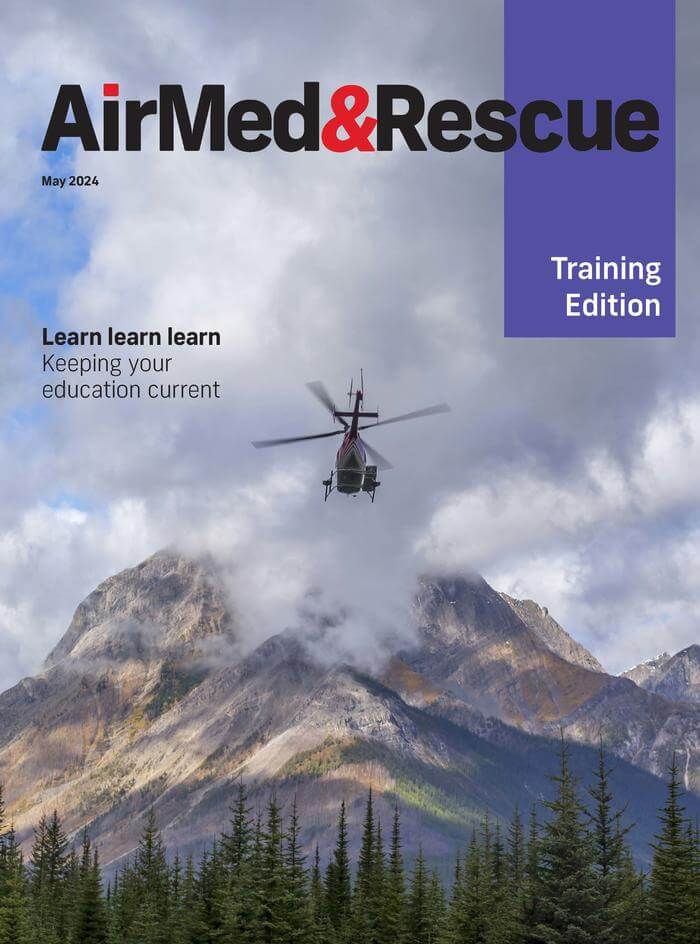
In our special training edition for May, find out how operators of all sizes are using new tools and equipment to train their pilots; discover what is the latest in technology for training hoist and winch operators; learn how air medical crew remain current and up to date with the latest techniques and procedures; and find out what goes into the essential medical kit bags that are carried into the skies; plus more of our regular content.
Terry Miyauchi
Terry Miyauchi serves as the Public Safety Segment Manager for Bell and works exclusively with SAR, fire and police aviation units globally. Recently, he has been instrumental in cementing Bell aircraft as key law enforcement assets throughout aerial units across global markets. Terry started his aviation career in the mid-1980s and served in the US Army as an AeroScout pilot. Over the years, he has worked as a pilot, instructor pilot, standardization pilot, safety officer, regional manager, and, most recently, retired from the Arizona Department of Public Safety, where he was the Aviation Commander.
Terry holds a bachelor’s degree in Professional Aeronautics and master’s degree in Aviation Leadership, both from Embry-Riddle Aeronautical University. He has amassed more than 7,000 commercial helicopter hours in more than 12 helicopter types.