
Industry voice: United States Coast Guard communications

When at distress at sea or inland, the United States Coast Guard is ready 24/7/365 to assist in the rescue. Lt Max Sherno, US Coast Guard MH-65E Pilot, describes how important good channels of communication and technology are to effective rescues
The US Coast Guard Air Station Savannah is located on Hunter Army Airfield in Savannah, Georgia. We operate five Airbus MH-65E helicopters using two crews made up of two pilots, a flight mechanic and rescue swimmer, who are ready to respond 24/7/365 to search and rescue (SAR) missions in our area of responsibility (AOR). Our AOR extends from the border of North and South Carolina all the way south to Melbourne, Florida; that’s over 300 miles of coastline running through four major ports along the east coast (Jacksonville, Brunswick, Savannah and Charleston). This means that we don’t exclusively work with other US Coast Guard units, in fact, it’s quite the opposite. Most of the time we are working with local police, fire and marine rescue units. Everything from initial reports, rescue assists and response coordination can come from these other government agencies (OGA).
Partnerships
The success we share with our agency partners is due to relationships that both sides work very hard to maintain. On an annual basis, we visit dozens of our OGA partners with helicopters and crews to perform critical training exercises to ensure our interagency partnerships are ready to respond to any mission. We conduct live rescue exercises where we will deploy and recover simulated survivors and employ the practices that we discussed during ground briefs. These visits are beneficial in many ways, chief among which is establishing a working knowledge on how other organizations communicate. We are constantly asking questions such as ‘How would you handle this situation?’ or ‘In the past, what could we have done better?’ These questions and face-to-face interactions open a dialog that leads to some great discussions that are beneficial to everyone.
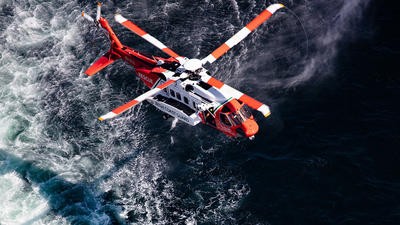
The success we share with our agency partners is due to relationships that both sides work very hard to maintain
Understanding how our rescue partners operate is massively important in order to overcome all the challenges that we face during dynamic rescue operations. Communication can quickly become the primary factor slowing an aviation rescue response. In a perfect world, we would have all the information we need prior to takeoff, but that rarely happens. Within the Coast Guard, we have coded frequencies that we communicate on. These are straightforward, enabling us to talk to other Coast Guard aircraft, Coast Guard Cutters (the commissioned water vessels) and shore units who are responsible for dispatch and coordination. These frequencies are fairly powerful and rely on signal boosting from ground-based antennae. If we are far offshore, we can utilize high frequency (HF) radios that allow us greater than line-of-sight communications. The reason for this is due to the short wavelength of the frequency itself – between 3 and 30Hz – which can be reflected back off the ionosphere layer in the atmosphere, giving us the ability to communicate over much larger distances. This requires a little more effort but is a great tool for when we are over the horizon. All of these methods are primarily for communication with Coast Guard assets only.

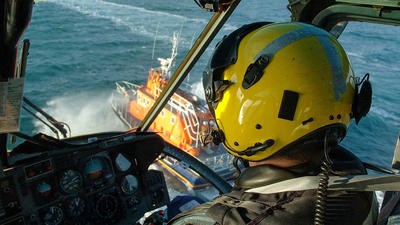
Radio communication
For communication with OGAs and civilians, we have the ability to talk on marine very high frequency (VHF) bands. These tend to have heavy radio traffic and require a little finesse in communications management. With our rescue partners, we will coordinate a working frequency prior to arriving on scene. CH16, the international hailing and distress frequency, is monitored by the Coast Guard 24/7/365 and listened to by whoever is responding to a water-based emergency. Typically this channel is used to hail other vessels and establish a working frequency to switch to so as not to jam this heavily used channel, which tends to be the majority of the traffic. However, mariners in distress can use this for relaying a MAYDAY. Our shore-based watch standers will attempt to establish two-way communication with the distressed vessel and triangulate their position. The innovative system that they use is called Rescue 21. It is a shore-based system that utilizes directional finding capabilities that provide lines of bearing and can triangulate a position for SAR responders. This is an incredibly useful tool especially if the nature of distress is severe enough to where only an initial MAYDAY call can be relayed. While these shore units are able to provide great direction and information to all those on-scene assets, in the aircraft, we monitor CH16 while flying as well. If the distress call is heard by aircrews, our helicopter has the ability to employ directional finding equipment to locate the origin of the call. This is especially useful for searching in bad weather conditions where visibility is poor. If we have positive communications with the vessel in distress, once we are in the general area, we will ask the mariner to count from one to 10 on the working frequency. This prolonged radio transmission will allow the direction finding equipment in the helicopter to gather strong data and put us right over the vessel. These methods work very well when responding to a mariner in distress with good radio communications.
Understanding how our rescue partners operate is massively important in order to overcome all the challenges that we face during dynamic rescue operations
Above and beyond maritime operations
While the Coast Guard specializes in maritime emergencies, we do not exclusively operate in the maritime environment. The inland SAR communications strategy largely depends on where the aviation unit is located. Units in mountainous terrain deal with significantly more challenging environments and work extremely close with local agencies to establish a communications plan. Here on the east coast, we deal with less of a terrain threat but still coordinate with local partners. Coordination prior to departure makes all the difference. Establishing a working frequency will save valuable time and effort, allowing crews to focus on locating and providing care. Some of our aviation units have codes and access to the 800MHz frequency, which use cellphone towers as a repeater. This is an extremely reliable inland communication frequency band that is used by many local and federal law enforcement and fire rescue personnel. Additionally, Sectors (Coast Guard’s version of a dispatch center) have the ability to patch in any phone number into our radios. This is extremely useful when talking with eyewitnesses or directly to the person in distress. We employ this when there are radio issues or no other means of communication.
Communication is more than just devices
With many tools and techniques at our disposal, proactive outreach to our partners is by far the most valuable. We don’t all speak the same language or use the same equipment, but face-to-face interaction and open dialogue puts us all on the same page. We have the unique privilege of working with talented professionals outside our organization with so much experience and knowledge when it comes to search and rescue. Sharing lessons learned and best practices is incredibly valuable.
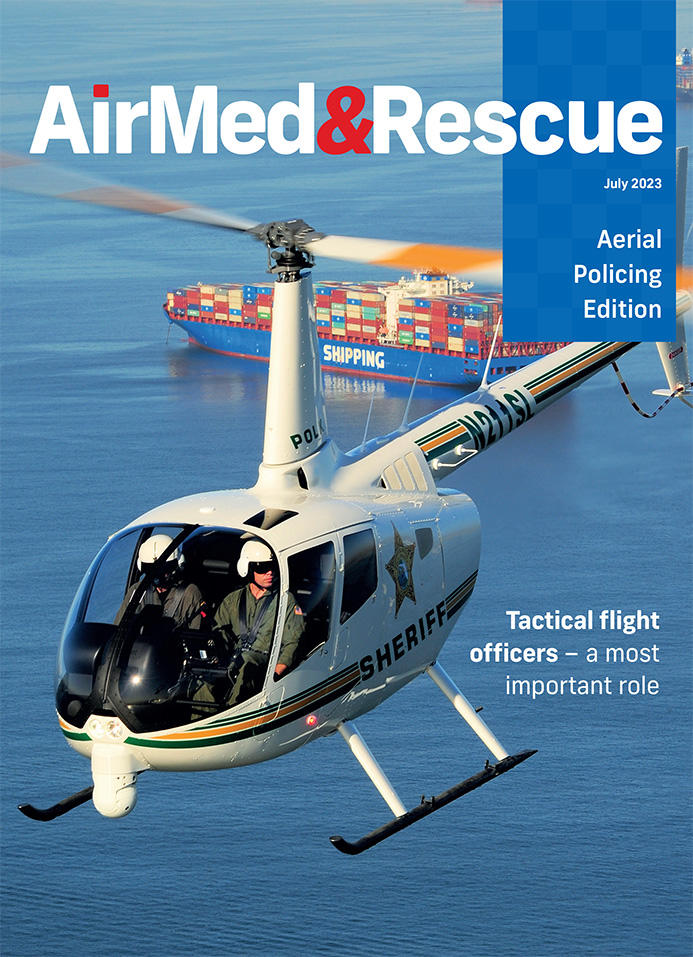
July 2023
Issue
We have a special aerial policing edition, find out how police forces utilize night vision; what the requirements are for police aircraft; how datalinks are used to improve police operations; and discover more about the TFO role; and we cover the why there is a shortage of aerial firefighting crews; plus all of our regular content.
Max Sherno
Lt Max Sherno enlisted in the US Coast Guard in 2013. His first unit was the Marine Safety Unit in Savannah, GA, where he did maritime law enforcement. He was accepted into Officer Candidate School (OCS) and commissioned in 2017. Lt Sherno went to US Naval Flight School after graduating OCS where he flew the T-6 Texan and the TH-57 B/C. Once Lt Sherno earned his wings, he was sent to Coast Guard Air Station Savannah. Lt Sherno is now heading to the Coast Guard Aviation Training Center in Mobile, AL, where he will be an MH-65E instructor pilot.