

Interview: Always faithful

Brandi Rector, Founder and CEO of Semper Fly Helicopters, tells Mandy Langfield what drove her to set up the first female Marine Corps veteran-owned helicopter flight school in the USA
Could you share some of your background in aviation for our readers who might not know your career history?
My aviation journey began in the US Marine Corps, where I served as a helicopter mechanic and aerial gunner on the CH53E, completing two deployments – one in support of combat operations. After transitioning out of the military, I earned my airframe and powerplant (A&P) license and worked as a mechanic and inspector for Trans States Airlines while pursuing both my flight training and a degree in aeronautics.
I then attended Federal Law Enforcement Training Centers (FLETC) with US Customs and Border Protection, followed by a role as a field mechanic for Air Resources. From there, I worked for General Atomics as a UAV sensor operator. Afterward, I earned my master’s degree in Intelligence from Georgetown University.
Eventually, Mike Sanford and I purchased and operated Skyhunter Outfitters, flying helicopter hog hunts and managing the operation together. That experience – along with my extensive aviation and leadership background – led us to found Semper Fly Helicopters, the first female Marine Corps veteran-owned helicopter flight school in the country. We were awarded a contract in 2024 to provide helicopter flight training for the University of Oklahoma, launching the state’s first collegiate rotorcraft program and expanding access to professional helicopter training through a university partnership.
What was it like being a woman in the Marine Corps – was it as tough as you expected?
It was tough in a lot of ways – honestly, even tougher than I expected. Being a woman in the Marine Corps is one thing, but being a woman in such a male-dominated military occupational specialty (MOS) made it a constant uphill battle to be accepted and taken seriously. I went in with a strong mindset, but there were moments that really tested me.
My dad was a huge source of strength during those times – he helped keep me grounded and mentally tough when I was struggling. One thing I’ve never forgotten was something said to me during my first deployment: “You’ll have to work twice as hard to get half as far as your male counterpart.” And that’s exactly what I did.
I pushed myself every single day – not just to prove a point, but to prove to myself that I belonged. That experience shaped who I am as a leader and as a person.
How did you find the transition from military to civilian life?
The transition was tough at first – no way around it. I went from a high-tempo, nine-month deployment straight into civilian life, and the pace shift hit hard. One minute I was fully immersed in a mission-driven environment, and the next, I was standing in a world that felt slower, less directed, and, honestly, a little isolating.
I wasn’t totally sure what I wanted to do, and I struggled to relate to the people around me. I missed the structure, the sense of purpose – even the chaotic, dysfunctional family dynamic that comes with being in the Marine Corps. It was a big adjustment.
But I took it day by day. I started setting small goals, got myself into school, and eventually found my way back into the air. Slowly, things started to fall into place – as much as they could. It wasn’t easy, but it built a kind of resilience I still carry with me today.
You earned your pilot’s license after leaving the military – what made you want to make this transition from being an engineer and door gunner to being a pilot?
I missed being in the air, plain and simple. There’s something about flying that just gets in your blood, and, after leaving the military, I realized I wasn’t ready to let that part of my life go. I also wanted a new challenge. I had already worked as a mechanic and flown as a door gunner, but, deep down, I knew I wanted to be the one at the controls.
To be honest, I’m a bit of a control freak, so being in the back just wasn’t cutting it anymore. I wanted the responsibility, the precision, and the skill that comes with being a pilot. Making that transition felt like the natural next step, and it gave me the chance to combine everything I’d learned on the ground and in the air into something bigger.

What do you enjoy more – being in the cockpit or being an engineer?
I really do love both in their own ways. As a mechanic, there’s something incredibly satisfying about fixing things – taking something apart, troubleshooting the issue, and putting it back together. I love the hands-on work and that sense of accomplishment when something finally runs the way it’s supposed to after you’ve put in the effort.
But flying brings a whole different kind of reward. I love the challenge, the thrill, the focus it requires. I love having a mission, being in control, and constantly pushing myself to be better. For me, it’s not about choosing one over the other – they both feed different parts of who I am.
What services does Semper Fly offer, and what is your mission as a company?
Semper Fly Helicopters specializes in high-quality helicopter flight training, offering everything from private pilot through certified flight instructor – instrument (CFII) under both Part 61 and Federal Aviation Administration (FAA)-approved Part 141 programs. We also provide turbine transition training, simulator instruction, and discovery flights for those interested in getting a feel for flying. While our primary focus is flight training, we’re actively expanding into Part 135 operations to offer additional commercial flying opportunities.
Our goal is to produce well-rounded, safety-minded pilots that companies feel confident hiring. We’re focused on quality over quantity – making sure every student who trains with us leaves with the skills, mindset, and professionalism it takes to succeed in this industry. It’s not just about passing check rides; it’s about building strong, capable pilots who are ready for real-world operations and long-term careers in aviation.
Just as important as the training itself is the culture we’ve built. We want our students and instructors to feel heard, supported, and genuinely happy to be here. We treat our team like family, and we believe people do their best work when they feel respected and valued. Our goal is to create an environment people don’t want to leave – a place where passion for aviation is matched with purpose, support, and a strong sense of belonging.
What assets do you have – fleet, crew, etc?
Our current fleet includes three Guimbal Cabri G2 helicopters, a Bell 206B3, and two FAA-certified Platinum-level simulators, allowing us to provide comprehensive, high-quality training both in the air and on the ground.
We’re proud to be entirely veteran-staffed, bringing a deep sense of discipline, purpose, and commitment to everything we do. Our Chief Flight Instructor is a US Army veteran and a Designated Pilot Examiner (DPE). Our Assistant Chief is also an Army veteran, as are two of our CFII pilots. We have an additional DPE on staff who is a Marine Corps veteran, and our Office Administrator is a US Air Force veteran.
Michael Sanford, our Co-Founder and Business Development Officer, is a retired US Marine with extensive operational and leadership experience, including multiple deployments and time at Marine Helicopter Squadron One (HMX-1). I serve as CEO and President, bringing my background as a Marine Corps helicopter mechanic and aerial gunner, CFII, A&P mechanic, and Georgetown University graduate with a master’s in Intelligence.
Together, our veteran-led team offers not just exceptional training, but mentorship grounded in real-world experience, leadership, and a shared commitment to excellence in aviation.
What do you enjoy most about your current role with Semper Fly?
What I enjoy most about my role with Semper Fly is getting to build something that truly matters from the ground up with people I believe in. I love creating a space where veterans, instructors, and students feel valued, supported, and inspired to reach their full potential. Watching students grow into confident, capable pilots and knowing we had a hand in shaping that journey is incredibly rewarding.
It’s also about the bigger mission changing the face of aviation, raising the standard for helicopter training, and proving that with the right mindset and work ethic, anything is possible. Every day brings new challenges, but being part of something with real impact makes it all worth it.

What is challenging you in your work at the moment – regulations, finances, recruitment?
Right now, one of the biggest challenges is navigating all the regulations and red tape that come with growing a flight school, especially as we expand under Part 141 and prepare for Part 135 operations. It can feel like there’s a mountain of paperwork for every step forward, and balancing that with the day-to-day demands of running the business is a constant juggling act.
Recruitment is another big one – not just finding students, but finding the right instructors who align with our culture and values. We’ve built something special at Semper Fly, and we want to protect that. I’m incredibly proud of our team, but, like many in aviation, we’re always keeping an eye on the pipeline.
And, of course, finances are always part of the equation. We’re investing in growth, aircraft, staff, and that takes careful planning and faith in the long game. It’s a lot to manage, but I believe in what we’re building, and that makes the hard parts easier to push through.
You’re on the Board of Directors for Vertical Aviation International (VAI) – could you tell us what the role involves, and how you’re going to tackle the challenges the industry faces?
Being on the Board of Directors for VAI is an honor and, honestly, a responsibility I take very seriously. It’s not just about having a seat at the table; it’s about using that seat to push for real change in our industry.
The role involves helping shape the direction of VAI as we advocate for rotorcraft professionals, support workforce development, and work through the regulatory and operational challenges that operators, schools, and companies face every day. I bring my perspective as both a veteran and a flight school owner, which gives me a very real, on-the-ground understanding of what’s working and what’s not.
One of the biggest challenges I see is the pilot shortage and the barriers to entry for new talent. Training is expensive and complex, and we need to find better ways to support people who want to fly but don’t know where to start. I also think our industry needs to modernize how we connect with the next generation. We can’t afford to keep doing things the same old way.
I plan to tackle these challenges by staying vocal, staying engaged, and making sure the small-business and training provider perspective is heard. I want to be part of the solution not just for my school, but for the entire rotorcraft community.
August 2025
Issue
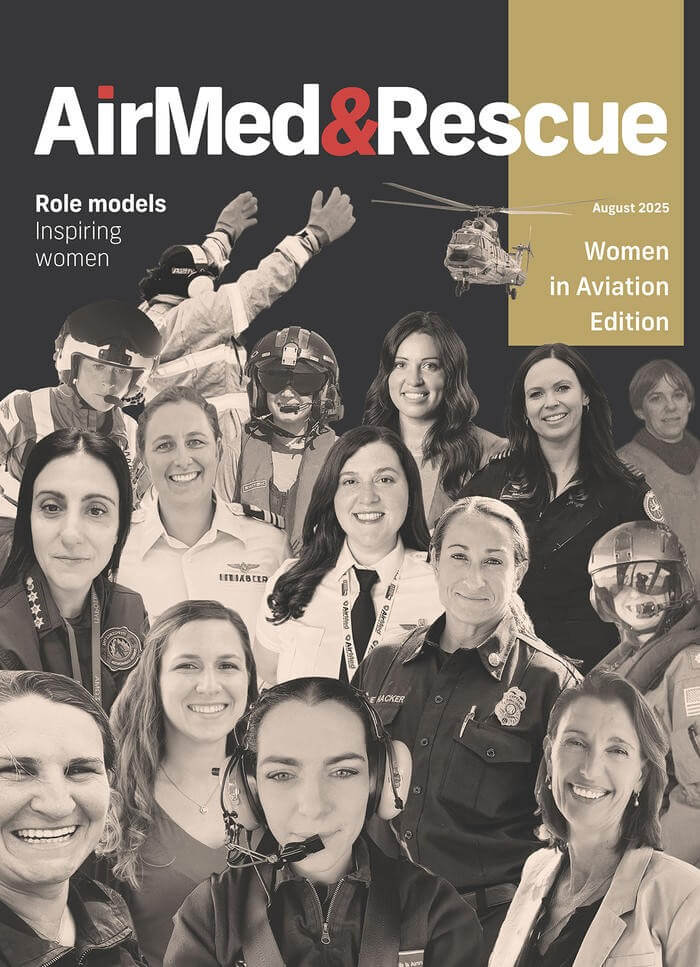
Our August magazine is the inaugural women in aviation edition, highlighting and showcasing female voices from the airborne special missions sector. We have features on blood products used in emergency medical services, challenging hoist rescues, pregnancy while flying, and portable water sources for firefighting. We also have interviews, a gallery, an industry voice, a news analysis piece, and a provider profile, as well as a review of the Paris Air Show.
Mandy Langfield
Mandy Langfield is a Director of Palladium Media Partners and former Publishing Director at Voyageur Group. She has written extensively on international travel and health insurance, medical assistance provision, and air medical transportation. She was Editor of AirMed&Rescue from December 2017 until April 2021. Her favourite helicopter is the Chinook, having grown up near an RAF training ground.