
Interview: Beyond compliance: the evolving role of safety management

Krister Genmark, Senior Vice President of Revenue at Vellox Group, describes how a proactive approach with connected safety management systems helps to make safety processes more accessible, more consistent and easier to maintain over time
Over a six-month period, an air medical operator notices a gradual increase in duty-time extensions across several bases. No single event raises concern and operations continue safely.
At the same time, a small number of fatiguerelated reports are submitted through the organization’s reporting process. Separately, rostering data shows crews are increasingly being called upon to cover operational gaps during periods of high demand.
Individually, none of these observations appear significant. Together, they begin to form a pattern.
This is where modern safety management systems (SMS) are designed to operate. The objective is not simply to investigate incidents after they occur, but to identify emerging risks before they contribute to one.
The expansion of SMS requirements for Part 135 operators in the USA has renewed industry discussion around the role of safety management in aviation. While these regulatory changes are specific to the Federal Aviation Administration (FAA), the broader conversation extends well beyond North America.
Across the industry, safety management is increasingly being viewed as an operational capability rather than simply a compliance obligation. Regulators, customers and operators alike are placing greater emphasis on proactive risk management, organizational accountability and the ability to identify safety trends before they become operational issues.
For air medical and rescue operators, this shift is particularly relevant. These organizations routinely operate in complex environments where aircraft readiness, crew availability, weather conditions, maintenance status and operational risk must all be considered simultaneously. Safety management cannot exist as a standalone process operating alongside the mission. It needs to be embedded within day-to-day operations.
MOVING BEYOND REACTIVE SAFETY MANAGEMENT
Historically, many organizations approached safety management through a largely reactive lens. Incidents were reported, investigations were completed and corrective actions were implemented after an event occurred.
While these activities remain important, modern SMS frameworks are designed to support a more proactive approach. The goal is not simply to document what happened, but to understand why risks emerge and how they can be managed before they escalate.
This principle sits at the heart of the four pillars of SMS: safety policy, safety risk management, safety assurance, and safety promotion. Together, these pillars provide a framework for identifying hazards, assessing risk, monitoring performance and fostering a strong safety culture throughout the organization.
The challenge for many operators is not understanding these principles. It is implementing them consistently across a busy operation.
CONNECTING SAFETY INFORMATION ACROSS THE ORGANIZATION
Safety information rarely exists in isolation. Hazard reports, audits, corrective actions, operational records, training activities and fatigue reports all contribute to an organization’s understanding of risk.
When these activities are managed through disconnected processes, it becomes more difficult to identify relationships between them. Trends can be missed. Reporting becomes more time consuming. Valuable safety insight may remain hidden within individual departments or spreadsheets.
As operators continue to mature their SMS programs, there is growing recognition that safety management benefits from stronger connections between operational and safety data.
When safety reporting, audits, risk assessments and operational information can be reviewed within a common framework, organizations gain greater visibility into how risk develops across the operation. Oversight becomes more proactive and decisionmaking becomes more informed.
BUILDING A SUSTAINABLE SAFETY CULTURE
Technology alone does not create a strong safety culture. Effective safety management will always depend on the engagement of pilots, engineers, operational staff and safety managers.
However, the right systems can support that culture by making safety processes more accessible, more consistent and easier to maintain over time.
As SMS expectations continue to evolve globally, the operators likely to gain the greatest benefit will be those that view safety management as more than a compliance exercise. When safety processes become part of everyday operational decisionmaking, organizations are better positioned to identify risk early, strengthen accountability and support safer outcomes.
For air medical and rescue operators, where operational complexity is unlikely to decrease, that capability may become increasingly important in the years ahead.
July 2026
Issue
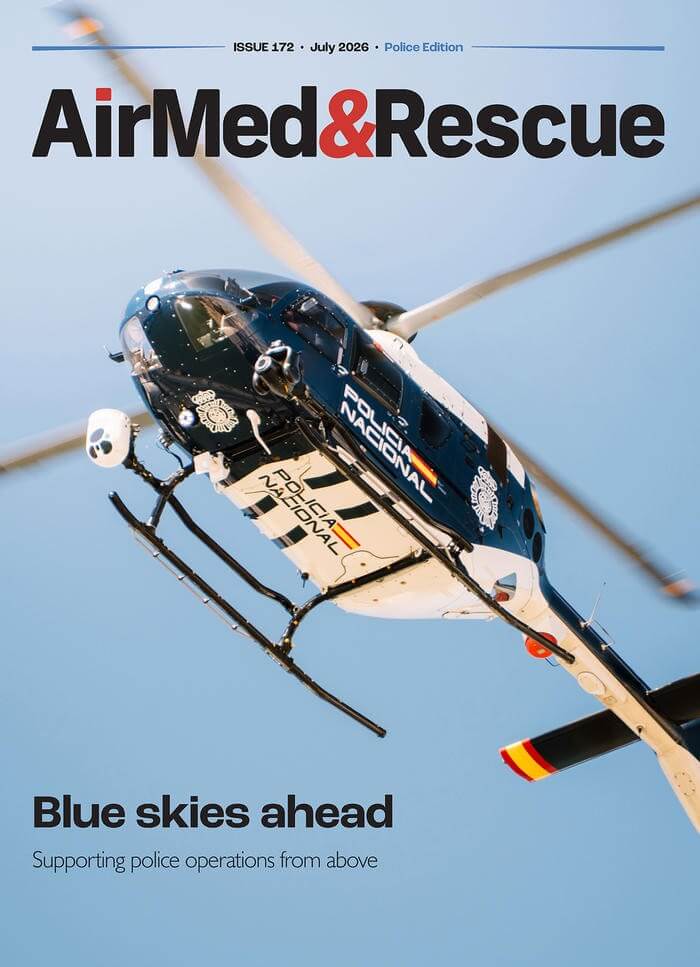
As another July rolls around, it’s wonderful to bring you the airborne policing edition of AirMed&Rescue. We have features on the development and strategies used during aerial missing person searches; the active threats that affect aviation and law enforcement services particularly; the bread and butter of police aviation, the patrol and support operations; and the increasing use of drones as a force multiplier and sometimes as a first responder.
Editorial Team
The AirMed&Rescue Editorial Team works on the website to ensure timely and relevant news is online every day. With extensive experience and in-depth knowledge of the air medical and air rescue industries, the team is ready to respond to breaking industry news and investigate topics of interest to our readers.