
Interview: A distinguished career

Siân Yates talks with Christine Muszalski, Clinical Orientation Manager and Critical Care Transport Nurse at Boston MedFlight, about her work as a flight nurse, her leadership and training roles, and what it was like to receive the BCEN Distinguished CFRN Award
What was your reaction when you found out you had received the Board of Certification for Emergency Nursing (BCEN) Distinguished Certified Flight Registered Nurse (CFRN) Award? What does winning this award mean to you?
Honestly, I was so shocked! Receiving the BCEN Distinguished CFRN Award means a great deal to me because critical care transport has truly been the privilege of my career. I’ve been a nurse for 35 years, including 28 years in critical care transport and over 25 years at Boston MedFlight. I’ve been fortunate to care for some of the sickest patients while working alongside incredible clinicians. This work is always a team effort. What means the most to me is caring for critically ill patients while also teaching and mentoring the next generation of transport clinicians and encouraging certification as a pathway to excellence and patient safety. Seeing those clinicians grow into confident professionals is one of the greatest rewards of my career.
With more than 30 years of experience across emergency departments, intensive care units (ICUs), and critical care transport, what first drew you to flight and transport nursing?
I was drawn to critical care transport because it combined everything I loved about nursing – critical thinking, autonomy, teamwork, and caring for patients during some of the most vulnerable moments of their lives. I always appreciated the challenge and unpredictability of emergency and critical care environments, and transport medicine brought all of those elements together in a very unique way. Earlier in life I was shy and I think part of what drew me to this specialty was wanting to challenge myself and grow into a more confident clinician and leader. I also loved the idea of bringing ICU-level care directly to patients wherever they were. Early in my career, I recognized that transport clinicians needed to be adaptable, calm under pressure, and deeply committed to continuous learning, and that really resonated with me.
You currently work as Clinical Orientation Manager and Critical Care Transport Nurse at Boston MedFlight. What does a typical day look like for you, and how do you balance clinical missions with education and mentorship responsibilities?
One of the things I love most about my role is that no two days are exactly alike. Some days I’m flying clinical missions and caring for critically ill patients, and other days I’m focused on orientation, simulation, curriculum development, mentoring, or working with preceptors and orientees. Education is deeply integrated into our clinical practice at Boston MedFlight, so the balance feels very natural to me. Continuing to work clinically keeps me grounded in the realities of transport medicine and helps ensure that the education and mentorship we provide remain relevant, practical, and patient-centered.
Can you share a mission or patient case that has stayed with you throughout your career, and why it was so impactful?
One patient story that has stayed with me throughout my career involved a woman named Kimberly who survived a devastating hit-and-run accident after she and her husband were struck by a truck while walking near their home. I was the flight nurse on her transport, and she became one of the first patients to receive transfusions as part of our blood program at Boston MedFlight. The severity of her injuries was extraordinary, and it took an incredible team effort across the entire continuum of care to help save her life.
What made the experience especially impactful was everything that happened afterward. I visited Kimberly in the hospital during her recovery. Over time, she, her husband, and I stayed in touch, and we discovered shared perspectives on healing and life, including following the moon cycles. They later visited our base and now volunteer at our annual patient reunion. In critical care transport, we often meet patients during the worst moments of their lives and rarely get to see what happens afterward. Seeing Kimberly’s resilience, recovery, and continued connection to the transport community has been incredibly meaningful and serves as a powerful reminder of why this work matters.
Seeing Kimberly’s resilience, recovery, and continued connection to the transport community has been incredibly meaningful and serves as a powerful reminder of why this work matters
You have been heavily involved in simulation-based training and orientation programs. How important is realistic simulation in preparing clinicians for the unpredictability of air medical and critical care transport missions? What are some of the most exciting innovations taking place in this area?
Simulation is incredibly important in transport medicine because it allows clinicians to safely practice managing rare, high-risk, and rapidly evolving clinical situations before encountering them in real patient care. Transport clinicians work in environments with limited space, noise, vibration, operational hazards, and fewer immediate resources, so realistic simulation helps build not only clinical competence but also communication, teamwork, situational awareness, and decision-making under stress.
One of my favorite parts of orientation education is our scene and flight simulation work. We progressively increase the complexity of scenarios, practicing everything from patient packaging and roadside scene safety to flying in the helicopter environment itself, until I feel confident that a clinician could safely land on a highway and care for a critically injured patient alongside a new team member. Watching clinicians grow in confidence and teamwork during those simulations is incredibly rewarding.
One of my favorite parts of orientation education is our scene and flight simulation work. We progressively increase the complexity of scenarios, practicing everything from patient packaging and roadside scene safety to flying in the helicopter environment itself, until I feel confident that a clinician could safely land on a highway and care for a critically injured patient alongside a new team member
One of the most exciting developments is the increasing use of high-fidelity and immersive simulation that closely recreates transport environments and operational challenges. We are also seeing greater integration of multidisciplinary simulation involving nurses, paramedics, physicians, communication specialists, and aviation teams, which helps strengthen team dynamics and patient safety.
The BCEN award recognizes not only clinical excellence, but also leadership and advocacy for certification. Why do specialty certifications such as CFRN, Certified Emergency Nurse (CEN), and CCRN matter in today’s transport medicine environment?
Specialty certification represents a commitment to clinical excellence, lifelong learning, and professional accountability. In transport medicine, clinicians care for highly complex patients in unpredictable and high-risk environments where strong clinical judgment is essential. I’m actually a big believer in certification – I hold CFRN, CEN, and CCRN certifications and each one has strengthened my knowledge, confidence, and perspective as a clinician.
As an educator and mentor, I encourage certification because it elevates both individual practice and the overall standards of our specialty. It pushes clinicians to continue learning, stay curious, and challenge themselves professionally. I truly believe certification improves patient care, strengthens safety, and helps clinicians grow into more confident members of the transport team.
The medical transport sector is constantly evolving, from advances in ventilator management to increasingly complex patient transfers. What clinical or operational trends do you think will shape the future of critical care transport over the next five to 10 years?
Critical care transport continues to evolve rapidly as patients become increasingly complex and ICU-level therapies expand outside traditional hospital settings. We are seeing more advanced ventilator management, ECMO transport, mechanical circulatory support, and higher-acuity neonatal and pediatric transports. I also think human factors, crew resource management, simulation, and wellness initiatives will continue to play a larger role in improving safety and resilience within transport teams. Operationally, the future will require even greater adaptability, interdisciplinary collaboration, and ongoing education to safely care for increasingly complex patients across diverse environments.
As someone who mentors graduate nursing students, physician fellows, and new transport clinicians, what qualities do you believe make an exceptional flight nurse?
Exceptional flight nurses combine strong clinical knowledge with humility, adaptability, teamwork, and emotional intelligence. Technical skills are incredibly important, but so is the ability to communicate effectively, remain calm under pressure, and support both patients and teammates during difficult situations. Great transport clinicians are lifelong learners who are open to feedback and committed to continuous growth. They also understand that patient care is never about one individual. It’s about the entire team working together safely and effectively.
Exceptional flight nurses combine strong clinical knowledge with humility, adaptability, teamwork, and emotional intelligence
You have experience across helicopter, fixed-wing, and ground critical care transport. How does the clinical approach differ between these environments, and what unique challenges does each present?
Each environment presents unique operational and clinical challenges. Helicopter transport often involves shorter, high-acuity missions where time-sensitive interventions and scene safety are critical. Fixed-wing transport usually involves longer-distance transfers requiring careful planning, resource management, and prolonged critical care in a confined environment. Ground critical care transport can vary significantly depending on geography, traffic, weather, and transport times, and often requires flexibility and adaptability. Regardless of the platform, the goal remains the same: delivering safe, high-quality critical care while balancing operational considerations and patient needs.
Your publication work includes topics such as airway emergencies and mechanical ventilation in critical care transport. How important is ongoing education and research in improving patient outcomes in air medical transport?
Ongoing education and research are essential in transport medicine because our specialty continues to evolve rapidly. Evidence-based practice, simulation, quality improvement, and continuing education all play critical roles in improving patient outcomes and safety. Research helps guide best practices, while education ensures clinicians remain prepared to care for increasingly complex patients and technologies. As both a clinician and educator, I believe one of our responsibilities is to continuously learn, teach, and share knowledge to help advance the specialty and improve care for patients and families.

Critical care transport can be physically and emotionally demanding. How have you maintained resilience and passion for the profession over such a long and accomplished career?
The people have been the biggest source of resilience for me – our crews, our patients, and the incredible teamwork that exists within critical care transport. I’ve also found a great deal of meaning in education and mentorship. Watching clinicians grow in confidence and skill over time is incredibly rewarding. Reconnecting with former patients and seeing the impact of the work we do also reminds me why this profession matters. Transport medicine can absolutely be demanding, but being part of a dedicated team with a shared mission helps sustain both resilience and passion.
The people have been the biggest source of resilience for me – our crews, our patients, and the incredible teamwork that exists within critical care transport
For nurses aspiring to enter the world of flight and critical care transport, what advice would you give to those hoping to follow a similar path to yours?
Focus on building a strong clinical foundation and never stop learning. Seek opportunities to challenge yourself, ask questions, and learn from experienced clinicians. Critical care transport requires not only strong technical skills, but also adaptability, teamwork, communication, and humility. I also strongly encourage nurses to pursue specialty certification because it helps strengthen clinical knowledge and demonstrates commitment to excellence and patient safety. Most importantly, remember that transport medicine is a team sport. Great clinicians are collaborative, supportive, and always willing to continue learning.
Anything else you would like readers to know?
Critical care transport is a very special profession because it brings together clinical excellence, teamwork, education, and compassion in some of the most challenging situations in healthcare. I’ve been incredibly fortunate to spend my career in this field and to work alongside dedicated clinicians who continually inspire me.
I also believe strongly in supporting and mentoring the next generation of transport professionals because the future of our specialty depends on investing in people, education, and a culture of safety and continuous learning.
And I love flying!
August 2026
Issue
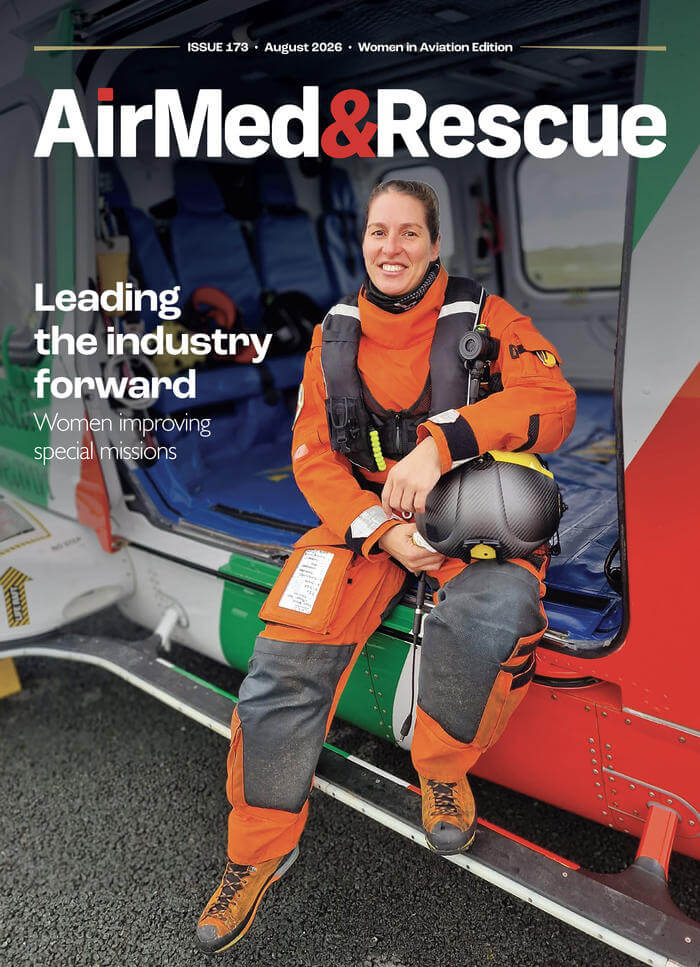
August is a special time of year, and it is my pleasure to present a special Women in Aviation edition of AirMed&Rescue. We have features on the importance of preventing and knowing the early signs of hoist spin; the leadership roles and the value of visibility of women in the industry; the inward-facing and external sensors improving special missions; and the variety and standards that flight suits have to meet.
Siân Yates
Siân Yates is News Editor at Voyageur Group and Editor of International Hospitals & Healthcare (IH&H). She holds a Master’s degree in Journalism, and has written across healthcare, travel, food and beverage, science and technology, and environmental topics. Her passion lies in magazine creation and editorial management.