
Interview: Expert operations for expert care

Mandy Langfield discusses with Darby Wix, VP Aviation Operations and Director of Operations, AirMed International, what got him into aviation and how he manages to balance all the complexities of an air medical organization to keep it operating smoothly
Could you share a bit about your professional background and how you came to be in your current role with AirMed International?
I learned to fly when I was 15, taught by my grandfather. I attended Auburn University to complete pilot certificate and ratings, and obtained a BS in Aviation management. I first became associated with the AirMed International (formerly MEDjet International) certificate in 1997 as a line pilot. Over 20-plus years, I have flown various turboprops and jets to 90-plus countries in six continents. I have held Check Airman letters on each type of aircraft AirMed has operated, served as Chief Pilot from 2003–08 and Director of Operations for the air carrier certificate since 2008.
What does the AirMed fleet comprise and how many staff members are employed?
AirMed International operates three Hawker 800s, two Beechjet 400As, one Citation Bravo, one King Air B200 and one King Air C90A, and employs 180 full-time employees. This includes 119 clinicians, 48 pilots and five Federal Aviation Administration (FAA) licensed dispatchers to assist with our international flight planning and logistics.
What’s the company’s scope and scale of operations – geographically and medically? For example, where in the world are you licensed to fly, and can you perform ECMO, neonatal and critical care transfers?
AirMed has worldwide operational authority (with a few exceptions) and performs all types of medical operations to include extracorporeal membrane oxygenation (ECMO), neonatal and critical care transfers.
With ongoing challenges related to recruitment in both the aviation and medical fields, what is AirMed doing to ensure it attracts and retains the best staff?
We have worked hard on trying to stay competitive with wages balanced with quality-of-life benefits. We have instituted sign-on and retention bonuses to attract the best and reduce attrition. Airline transport pilot (ATP) licensure assistance has helped attract pilots early in their career. We have also provided different crew scheduling options to both medical and pilot staff.
How does the company employ the latest technology to train a) its flight crew and b) its medical crew?
AirMed has always been committed to providing the highest level of simulator training for both pilots and medical staff. Pilots attend aircraft-specific simulator training at least once a year. Our clinical staff are required to do initial clinical competency and annual training using high-fidelity simulators with access to a human cadaver lab for advanced skills training. This leads to our clinicians maintaining the needed skills to take care of our most important customers, our patients, while staying with evidence-based practice.
This leads to our clinicians maintaining the needed skills to take care of our most important customers, our patients, while staying with evidence-based practice

How have the company’s safety management processes changed and been updated over the past few years as the focus on safety has become ever more important?
AirMed International was an early participant in the FAA Voluntary Safety Management System (SMS) program. We have incorporated our SMS into every department and internal audit program; using the information learned to enhance safety at all levels. Consequently, all safety data is shared internally to provide all team members with full transparency to our operations, which has helped build our safety culture.
We have incorporated our SMS into every department and internal audit program; using the information learned to enhance safety at all levels
Fleet maintenance, repair and overhaul (MRO) continues to be a challenge for some operators. How does AirMed manage its MRO processes?
AirMed International has always employed our own maintenance staff to improve our dispatch reliability, perform inspections and conduct repairs in cases of unscheduled maintenance events. Our maintenance staff are factory trained on each aircraft type that we operate, which has reduced our dependence on MRO facilities. We are still working through supply chain issues for parts and components in our post-Covid-19 world.

You work a lot with assistance companies and international insurance companies to perform international air medical transfers. How do you ensure that communication between the different stakeholders is done without compromising patient privacy laws?
AirMed employs a compliance officer to verify we are operating at the highest level of integrity to protect the information of our customers and patients. Our internal systems are designed to provide the appropriate level of privacy to our patients and customers. Our procedures and systems have a regular internal audit performed to ensure that we are in compliance with all US and international privacy standards.
Why has AirMed sought accreditation from the Commission on Accreditation of Medical Transport Systems (CAMTS), the European Aero-Medical Institute (EURAMI) and the US Department of Defense (DoD)? What do these accreditations mean that the company can do that it would otherwise not be able to, and what do they signify for the company in general?
AirMed sees these accreditations as the highest level of industry standards. They provide an indication of our level of commitment to operating at a high standard. These accreditations have provided business and contractual opportunities within the industry to promote our operations.
AirMed sees these accreditations as the highest level of industry standards
What is the biggest challenge the air medical transfer industry faces at the moment?
The current challenge is attrition and attraction of crewmembers. The pilot shortage has reduced the number of future potential crewmembers. The retention of our tenured flight staff is crucial to maintain our high level of operational safety. We have been aggressive in different retention programs and are always looking for new ways to attract the next crewmember. This will continue to be a challenge for the foreseeable future.
Supply chain issues for aircraft parts and components also continue to be a big challenge in providing our service to our patients and customers.
December 2024
Issue
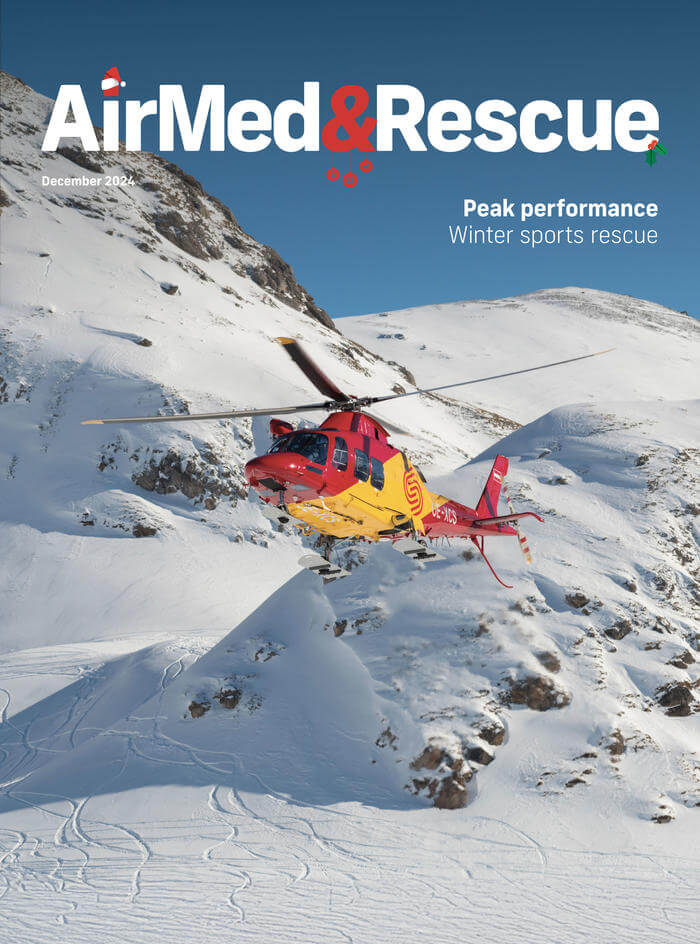
In the December edition, discover what goes into saving people that get into trouble on the ski slopes; find out about drones that are being used for search and rescue; learn about the treatment options for people with fractures; and see what has been happening this year in the realm of avionics development; plus more of our regular content.
Mandy Langfield
Mandy Langfield is a Director of Palladium Media Partners and former Publishing Director at Voyageur Group. She has written extensively on international travel and health insurance, medical assistance provision, and air medical transportation. She was Editor of AirMed&Rescue from December 2017 until April 2021. Her favourite helicopter is the Chinook, having grown up near an RAF training ground.