
Interview: Practicing at the highest level

Mandy Langfield speaks to Jacob Miller, flight/critical care transport (CCT) educator, Clinical Nurse Specialist, and Nurse Practitioner based in the US state of Ohio
What’s your background in the medical sector, and what attracted you to the air medical industry?
My background began with an early career in emergency services, first as a Junior Firefighter during high school, then first responder, Emergency Medical Technician (EMT), and Advanced EMT while I was in nursing school. Once I graduated from nursing school, I immediately enrolled in a paramedic program, and have been licensed as both a nurse and paramedic for the past 15 or so years. For most of my early career, I worked as an emergency room (ER) nurse and a paramedic, and I was drawn to the acuity and complexity of the patients transported by air medical. That factor, combined with the autonomy associated with working in the emergency medical services (EMS) setting, led me to want to pursue this industry. Essentially, I saw the air medical sector as the opportunity to practice at the highest level of my licensure and training. That, of course, has a huge degree of responsibility attached to it, but I absolutely love it!
You are on the Board of Directors of the Air & Surface Transport Nurses Association (ASTNA); what does this role involve, and how important do you think industry advocacy bodies are to further understanding and awareness of our niche in the aviation sector?
ASTNA is indeed a professional organization representing transport nurses, but importantly we’re not typically involved with political advocacy. ASTNA’s mission is to “advance the practice of transport nursing and enhance the quality of patient care through commitment to safety and education”. Within that context, we focus on working collaboratively with other professional organizations in our industry (e.g. those representing physicians, paramedics, pilots, communication specialists, etc.) to focus on clinical and operational education as well as enhance the safety culture of our profession.
That said, I agree there is a need for political advocacy as well. The air medical industry is really unique and doesn’t always fit nicely into the existing ‘commercial aviation’ or ‘healthcare’ boxes where regulators try to place us.
You are also a clinical educator for UC Health Air Care & Mobile Care; and a Nurse Practitioner with the Disaster Medical Assistance Team under the US Department of Health and Human Services. How do you balance your different roles and responsibilities?
My primary, full-time role is working as the Clinical Educator for Air Care & Mobile Care, and that’s where I devote most of my time and effort. Our program strives to practice at the highest level in the region, with the philosophy that we bring the world-class care of the University of Cincinnati (UC) Medical Center to the patient, wherever they may be. As an educator and clinician, that means a need to stay on top of what’s happening in emergency and critical care medicine and translate that knowledge into our daily practice. I’m also fortunate in that our program’s core values include safety, clinical excellence, and industry involvement as leaders, so I’m allowed some flexibility in my schedule to participate on the ASTNA board and other organizations that impact the practice of emergency and critical care.
All DMAT deployments are covered under the Uniformed Services Employment and Reemployment Rights Act (USERRA), similar to military reservists. As you can imagine, these deployments are highly unpredictable, so it means I have to stay on top of everything at my primary job and ensure contingency plans are in place in case I get called away
My work with the Disaster Medical Assistance Team (DMAT) is essentially an on-call responsibility, where our team commander generates a roster of medical personnel for our on-call months, and when activated for a large-scale disaster or other event, we are notified to respond. All DMAT deployments are covered under the Uniformed Services Employment and Reemployment Rights Act (USERRA), similar to military reservists. As you can imagine, these deployments are highly unpredictable, so it means I have to stay on top of everything at my primary job and ensure contingency plans are in place in case I get called away.
How is clinical training fo
r air medical professionals being transformed through the use of technology like virtual reality (VR)?
I’ve really only dealt with some of this newer technology at conferences, but I wish I could bring it back home! Some of the virtual reality technology out there now can almost perfectly recreate the inside of an aircraft, ambulance, or other setting and allow the crews the ability to interact with their environment as they would (or nearly as they would) [in a real-world scenario], without the need to take an aircraft out of service for training or spend time and resources to moulage a simulated casualty.
But even without incorporating VR into the classroom, we regularly use technology like advanced simulation manikins and device simulators (cardiac monitor and ventilator) to train, allowing us to control our ‘patient’s’ response to therapies and encourage our teams to troubleshoot high-risk or low-opportunity situations in a safe environment. In many ways, this is similar to pilots receiving training on emergency procedures in an aircraft simulator without the higher risk associated with performing those same procedures in an actual aircraft.

Recruitment of healthcare professionals is certainly becoming one of an employer’s most difficult tasks at the moment; how can organizations like UC Health ensure that they are a real employer of choice, attracting and retaining the best talent in the market?
This is a difficult question to answer, because invariably trying to create a blanket solution to a complex and heterogeneous problem is never going to work. This starts with creating a safe and respectful culture, but extends into finding out the intrinsic motivation of the existing, and prospective, team members. Certainly, compensation is always going to be a factor – but organizations need to be sensitive to other aspects of value to their employees, like flexible scheduling, paid training opportunities, work-life balance (allowing them to disconnect on days off), and the opportunity to be supported to better themselves in whatever discipline they’re practicing (whether pilots, nurses, paramedics, etc.). At the end of the day, this also revolves around the organizational culture and ensuring a mutual fit between the organization and the candidate. Organizations should have a clear mission, vision, and values that they actually embody (not just words on a paper somewhere) – and, in my opinion, so should their employees and candidates. If you’re working for an air medical program, or hoping to in the future, ask yourself what your core values are, and what your vision of yourself is in the future. That will help identify if an organization is right for you.
Organizations should have a clear mission, vision, and values that they actually embody (not just words on a paper somewhere) – and, in my opinion, so should their employees and candidates

If you could only carry one piece of equipment onboard a medical helicopter with you, what would it be, and why?
There are so many POCUS applications that can be useful in the resource-limited environment of air medical transport, once a clinician has adequate practice, that this has to be high on my list
The obvious answer here is snacks, for hopefully obvious reasons! But all kidding aside, I think the versatility of point-of-care ultrasound (POCUS) has shown that it can easily replace the stethoscope (that’s useless in the aircraft anyhow), and in some instances may be able to replace an X-ray machine, computed tomography (CT) scanner, and even an electrocardiography (ECG) monitor. There are so many POCUS applications that can be useful in the resource-limited environment of air medical transport, once a clinician has adequate practice, that this has to be high on my list.
What do you consider to be the biggest challenges facing air medical operators in the USA right now?
There are a number of challenges, not the least of which is the reimbursement structure under the No Surprises Act. Leaving the political discussion aside, it’s becoming more challenging to recover reasonable costs for providing air medical services. This is compounded by areas overusing air medical teams to transport patients that do not meet the acuity or time-sensitivity demands that most (rotor) air medical programs were designed to support. Unfortunately, the overall healthcare system has become so broken that ground assets may not be available to transport these patients, leaving air medical as a last resort. Lastly, in some areas, the scope of emergency and critical care is evolving faster than state scopes of practice can account for and we’re being asked to transport increasingly complex patients. We need to ensure we’re constantly expanding our knowledge base and matching our patients’ technological demands with airframes capable of supporting their needs (e.g. physical space to secure cardiac support devices, multiple infusion pumps, complex ventilators, and so on).
November 2024
Issue
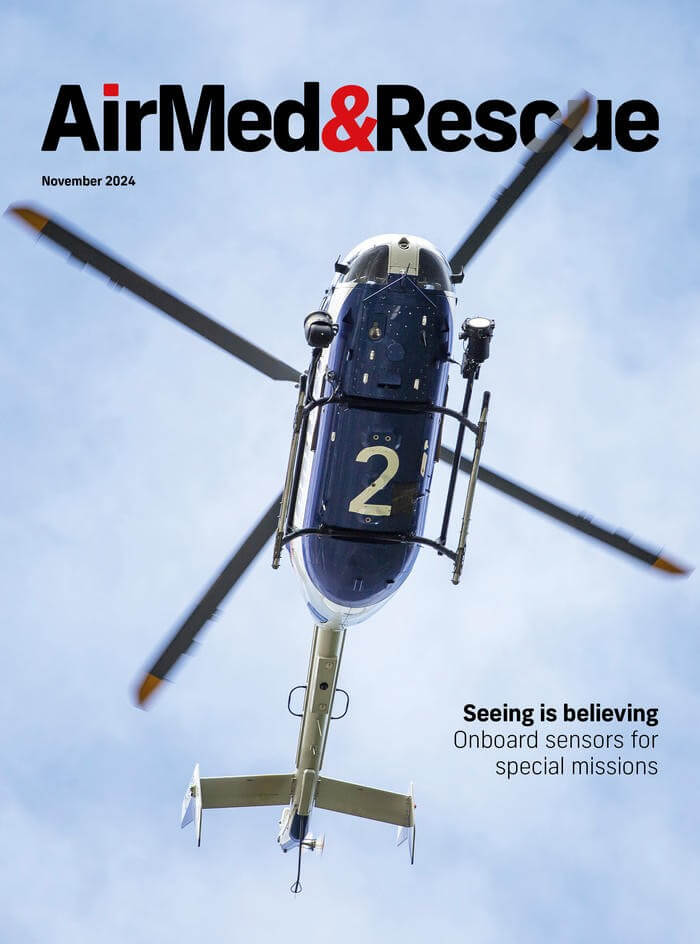
In the AirMed&Rescue November 2024 edition
Special missions often fly in challenging conditions covering large areas, so sensors are used to narrow the search, highlight targets of interest, and perform safer flights, among other benefits; aerial firefighting is facing greater demands upon its resources, so operators and organizations are expanding their assets and abilities with drones that can be flown at a low cost with a high safety margin, allowing the conventional crewed craft to focus on other roles; and the complexity of rear crew winching requires equally complex and involved training to ensure that live missions are conducted successfully and safely.
Plus, we have all of our regular content to keep you informed of the events relating to worldwide special missions.
Mandy Langfield
Mandy Langfield is a Director of Palladium Media Partners and former Publishing Director at Voyageur Group. She has written extensively on international travel and health insurance, medical assistance provision, and air medical transportation. She was Editor of AirMed&Rescue from December 2017 until April 2021. Her favourite helicopter is the Chinook, having grown up near an RAF training ground.