
Interview: Telling the RHC story

It’s been a period of immense activity at Robinson Helicopter Company since David Smith became CEO. He talks to Mandy Langfield about building the team, growing the brand’s presence in Europe, and expanding into drone manufacture
The pace of change at Robinson since the start of your tenure as President and CEO has been breathtaking! What do you think are your most significant achievements so far?
The most significant achievement in my first year at Robinson Helicopter Company (RHC) was to build a world-class team of experienced but hungry executives to cover critical parts of our business, from marketing and fleet sales to customer success, as well as several key internal roles in operations, HR, and finance. These leaders will be with RHC for a long time to come and we will build the future as a team.
The R88 looks like a fantastic machine. What are your hopes for its future in terms of its main roles for operators?
We are especially excited about the air medical and utility roles, which include several new missions for RHC. We also hope to see the R88 take on a larger role in law enforcement and public safety all over the world.
There are over 400 Robinson dealers and service centers available – are you seeking to expand this further to provide better after-sales support to your customers?
Our primary goal for the dealers and service centers is to improve the quality and capabilities of the existing network. We are going to hone our network to a higher standard as we grow RHC.
Our primary goal for the dealers and service centers is to improve the quality and capabilities of the existing network
Robinson’s in-house training resources are also a key part of customer support. What are your current offerings to your customers for training, and do you have any plans to widen the scope of the training you offer?
We have been training customers in our aircraft for nearly the entire history of RHC, but only recently hired full-time instructors to enable a broader catalog of courses, including R66 transition training, instructor standardization, and advanced training for autopilots and avionics. We are excited to continue expanding the course catalog in the years to come.
What plans do you have to grow the company’s reach and brand awareness in Europe?
Our first step is to get much more active in European regulatory and operational matters through increased collaboration with the European Helicopter Association (EHA) and the European Union Aviation Safety Agency (EASA). We are also becoming much more active in trade shows like AERO Friedrichshafen and European Rotors. This will help us better adapt our future products and enhancements for European customers, further growing our share in this very important region.
Our first step is to get much more active in European regulatory and operational matters through increased collaboration with the European Helicopter Association (EHA) and the European Union Aviation Safety Agency (EASA)
Attracting and retaining the right staff is an ongoing challenge for aircraft manufacturers. What are you doing to address this challenge and make Robinson an employer of choice for prospective employees?
We are always working to tell our story to the community around our facilities in Torrance, California, and Wilmington, Massachusetts, where Ascent AeroSystems designs our small UAS platforms. We are also telling the RHC story to students of all ages to help grow our brand with young people before they select their career path. We think this is an important part of growing RHC’s long-term employee roster over the next several decades.
The purchase of drone manufacturer Ascent AeroSystems in 2024 was a bold move by Robinson into the uncrewed aerial vehicle (UAV) space. What are your plans for the future of UAVs at Robinson?
We have several major initiatives to demonstrate the capabilities of collaborative small UAS with manned helicopters to accelerate search and rescue and infrastructure inspection, as well as radically improving aerial public safety missions over large events, large areas, and mass gatherings. The capabilities of an efficient, low-cost drone combine perfectly with an efficient and low-cost manned helicopter like the R66 or R88. This will change our industry in dramatic ways in the years to come.
We have several major initiatives to demonstrate the capabilities of collaborative small UAS with manned helicopters to accelerate search and rescue and infrastructure inspection, as well as radically improving aerial public safety missions over large events, large areas, and mass gatherings
Do you have any concerns about the effects of new tariffs brought in by President Trump and their effect on the manufacturing and sales of aircraft?
We are inherently very well protected from many tariffs since our facility is vertically integrated, and we buy a limited number of things from outside the US, but we are still adversely impacted by all of the global uncertainty that the trade disputes have caused.
What’s next for Robinson in 2025 and 2026?
We are working hard to win the US Army Flight School Next program with the R66.
During that pursuit, we will be certifying the R66 NxG and instrument flight rules (IFR) variants of the market-leading R66 helicopter. We also look forward to the first flight of the R88 and the continued momentum for early deposits and fleet sales in this new product. We expect to continue to grow RHC’s presence in the unmanned domain with more exciting announcements to share. Finally, we are excited to take a major step forward in the future of zero-emissions vertical takeoff and landing (VTOL) flight with the R66 hydrogen fuel cell variant taking shape and achieving numerous milestones over the next couple of years. It is an exciting time to work at RHC!
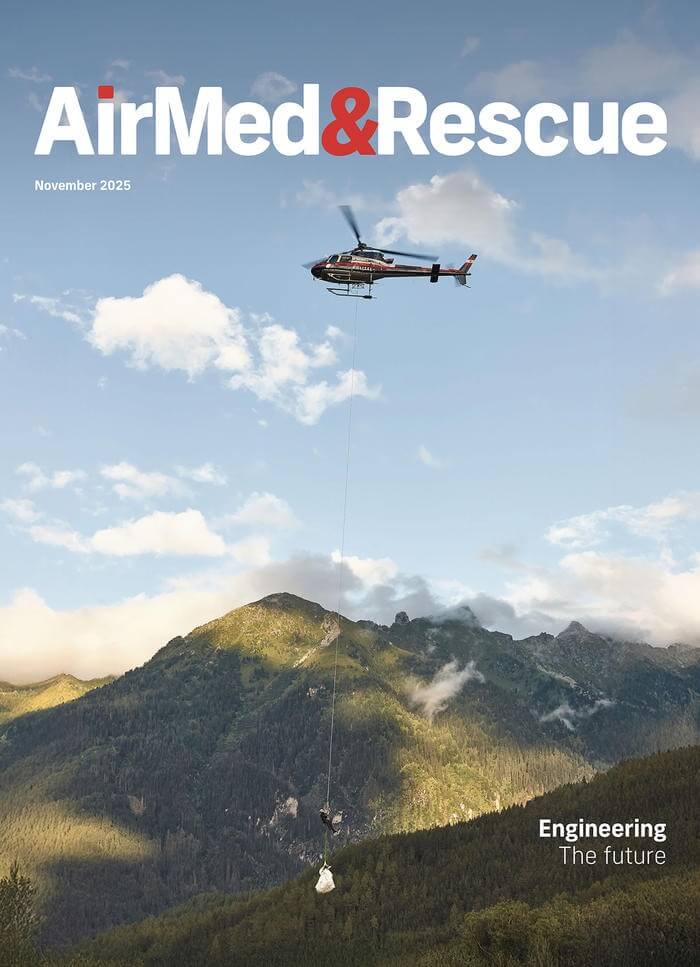
November 2025
Issue
Our November edition is packed with content relating to special missions from around the world. We have features that explore the design and engineering that go into modern rotorcraft; the interactions between ground and air teams on helitack operations; the tools and attire needed for successful water rescues; and the new onboard technology that is revolutionizing special missions by detecting and communicating with cell phones.
Mandy Langfield
Mandy Langfield is a Director of Palladium Media Partners and former Publishing Director at Voyageur Group. She has written extensively on international travel and health insurance, medical assistance provision, and air medical transportation. She was Editor of AirMed&Rescue from December 2017 until April 2021. Her favourite helicopter is the Chinook, having grown up near an RAF training ground.