

It’s snow game: rescuing skiers in trouble

As a sport, skiing has plenty of hazards. These hazards are increased when the skiers go off-piste, away from help, away from controlled and designated slopes, and into the path of avalanches, rocks, cliffs and others sources of injury. Ian Harbison takes a look at mountainous SAR and ambulance operations
In Switzerland alone, tens of thousands of winter sports enthusiasts injure themselves on the slopes each year.
The rescue season for skiers typically lasts from late autumn to early spring, when winter sports activities are most often practiced. On average, AAA Alpine Air Ambulance carries out around 5,000 missions a year. From its base in Balzers, Liechtenstein, which covers the high Alpine areas, it carries out 600 missions a year, 40% of which are ski accidents. Operations are 24/7, missions in darkness being carried out using night vision goggles (NVG).
Rega, meanwhile, flies between 1,600 and 2,100 injured skiers to hospital each year, mainly from October to Easter. With 14 helicopter bases located throughout the country, Rega can reach any location in Switzerland within 15 minutes by air. Its fleet consists of eight Airbus H145 ‘lowland helicopters’, stationed in Zurich, Basel, Berne, Lausanne, Sion and St Gallen, and 11 AgustaWestland Da Vinci ‘mountain helicopters’, based in Untervaz, Locarno, Erstfeld, Samedan, Wilderswil, Mollis, Zweisimmen and Sion. An Airbus EC135 is stationed at the Geneva base. On winter days when the weather is good, Rega’s mountain bases in popular tourist areas are particularly busy, so additional helicopters and crews are deployed there in support.
Flying at altitude
The Rega fleet is due to undergo a full-scale change. Two orders in 2022 for a total of 21 Airbus H145s will see all of the current helicopters replaced by the end of 2026. A single-type fleet will simplify servicing and maintenance and also save money in terms of the procurement and management of spare parts and crew training time.
Although the H145 is informally referred to by Rega as a lowland helicopter, the new fleet will be the updated H145 D3, with five rotor blades and greatly improved performance at altitude.
The current fleet will be sold. Four of the H145s, including their medical equipment, were purchased earlier this year by GCH Aviation, based in Christchurch, New Zealand.
AAA Alpine Air Ambulance operates six Airbus EC135 helicopters itself and has expanded from Birrfeld airfield in the canton of Aargau to Andorra, Bern and the heliport in Balzers. Coverage extends to Liechtenstein and Germany. The focus is on primary and secondary missions, rescues, repatriations, interfacility transfers and organ transports.
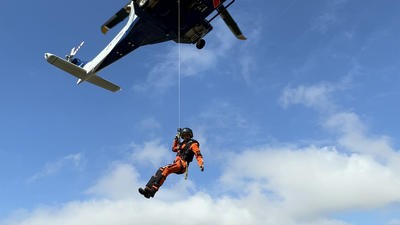
The EC135 is ideal for high-altitude and mountainous environments, its maneuverability enabling it to land practically anywhere. In addition, the helicopters are equipped with a cable winch for use when an accident has occurred in difficult terrain. The flight doctor descends and attaches the patient to the winch in a transport stretcher; both are then pulled into the cabin by the paramedic rescue helicopter specialist (RSH).
Besides skiers, the helicopters are most frequently called out for missions following acute illnesses (heart attacks, strokes, etc.), as well as work, traffic and mountain accidents
Besides skiers, the helicopters are most frequently called out for missions following acute illnesses (heart attacks, strokes, etc.), as well as work, traffic and mountain accidents.

Dispatch and collaboration
At Rega, emergency calls are received at the operations center in Zurich. Flight coordinators mobilize the nearest suitable crew, which is then confirmed via a smartphone app. The coordinates of the accident site are sent directly from the helicopter dispatch system to the navigation device in the rescue helicopter. Additional information, such as the nature of the emergency and the contact person on location, is sent to a tablet computer in the helicopter cockpit, along with flight weather data relating to the meteorological conditions at the accident site, from MeteoSchweiz and Rega’s own weather stations and webcams. Patient registration details are also sent to the destination hospital, including information about the suspected diagnosis and the estimated time of arrival.
AAA Alpine Air Ambulance works in collaboration with ground-based search and rescue (SAR) services, with 90% of its missions carried out with the help of the Pistenrettung (piste rescue service). This integrated approach ensures efficient coordination in emergencies. In the event of an avalanche, AAA works together with the mountain rescue service.
As avalanches are a frequent hazard, during peak season Rega helicopters are always equipped with a RECCO detector for searching for buried victims. Using radio waves, this can locate RECCO reflectors within a range of up to 80m through air and 20m through packed snow, which results in a practical range of 30m in avalanche debris. The current detector weighs 1kg.
If Rega requires backup, whenever its helicopter crews need assistance in rough terrain or when poor visibility makes a rescue by air impossible, the operations center can call on Swiss Alpine Rescue (ARS). This is a charitable foundation that is jointly funded by Rega and the Swiss Alpine Club (SAC). ARS has avalanche dog handlers, canyoning specialists and helicopter rescue specialists, and Rega crews and ARS mountain rescuers train together on a regular basis to ensure that every procedure is followed correctly in an emergency and to maximize safety during a mission.
Sometimes, if the emergency occurs off-piste and the coordinates are not entirely clear, the AAA team may decide to take someone with them from the local mountain rescue team, whose knowledge of the area can reduce the search time. As they may be unused to helicopter operations, they are always accompanied by a crewmember and are only allowed to use the winch under the supervision of trained personnel.
Also partnering with people who may not be used to helicopter operations, Rega holds practice-oriented training courses for emergency organizations, such as the police, fire and ambulance services, as well as for Pistenrettung or Ski Patrols and people with so-called high-risk professions, mainly those involved in forestry and farming.
Prevention is also part of the AAA mission, with safety promotion notices displayed at the ski resorts. It’s common practice to collaborate with ski resorts, as well as local authorities, emergency services, mountain rescue teams and the police, to raise awareness about safety measures and emergency procedures.
It’s common practice to collaborate with ski resorts, as well as local authorities, emergency services, mountain rescue teams and the police, to raise awareness about safety measures and emergency procedures
Another seasonal fit for winter is to equip the helicopters with ‘bear paws’ attached to the wheels or skids. These large plates increase the contact surface and spread the weight of the helicopter, making it easier to position the aircraft on snow and to prevent sinking when snow is deep.
Meteorological conditions
Every year, bad weather prevents around 600 people in Switzerland from receiving emergency assistance by air. Rega, the Swiss Air Force and the Federal Office of Civil Aviation (FOCA) have been working for years to develop the Low Flight Network (LFN) on the Da Vinci fleet. This is a network of instrument flight rules (IFR) routes throughout Switzerland that use linked GPS waypoints to connect to airports, airfields, Rega bases and, in particular, hospitals. Interlaken Hospital was added in July.
The LFN is especially useful in high fog conditions in winter, when the ski resorts are above the fog line in sunshine, while the hospitals on the Central Plateau are below it.
One in four Rega helicopter missions is flown in darkness, but pilots wear NVG and the rescue hoist light or two large landing lights on the fuselage of the helicopter can be swiveled and controlled individually to illuminate a temporary landing site or an accident site.
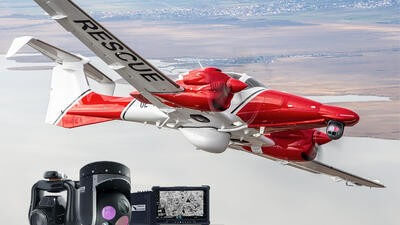
Rega has a dedicated SAR team at the Wilderswil base that determines the optimal means of performing a particular search mission. Located here is a Da Vinci configured as a specialist search helicopter, which is used throughout Switzerland. It is equipped with an electro-optical and infrared (EO/IR) sensor that can detect people in open terrain at a distance of several kilometers. The operator sits at a dedicated console and uses a joystick to track the movement of the EO/IR sensor turret, illuminating the target with a powerful searchlight. A Lifeseeker mobile phone detector is also available for missions carried out on behalf of the police.
Work is now underway to develop the drone’s all-weather capability, with a more powerful platform also being evaluated
Rega has been working for several years on the in-house development of the RGA-UAV-T1A search drone. If poor visibility prevents a helicopter from taking to the air, it can be deployed along with ground-based mountain rescuers from the SAC. The drone, also based at Wilderswil, carries an EO/IR multi-sensor search system and Lifeseeker, and uses GNSS satellite navigation to fly autonomously on a predefined route following the topography of the terrain at an altitude of around 80–100m above ground level. Using artificial intelligence (AI), onboard analysis of the real-time imagery can automatically detect persons in the terrain and relay the data to the drone operator in Wilderswil, who coordinates the search operation and subsequent rescue mission. Work is now underway to develop the drone’s all-weather capability, with a more powerful platform also being evaluated.

Safety on the slopes
As tourism is continuing to increase and winter sports are becoming more popular, people are urged to have the right equipment and to stay within designated areas to help minimize the consequences should an accident occur. Even if someone is in trouble beyond the standard ski pistes, there are technology and tools to find and extract an injured person high up in the mountains. Rescue organizations are on hand to help, and their dedication, training and skills can make all the difference in an emergency.
What happens after an accident? A hypothetical procedure on the slopes from Rega
Considerate skiers and snowboarders stop if somebody in front of them suffers a fall. If the casualty needs help, they should secure the accident site and mark the area by placing crossed skis upright in the snow at a sufficient distance from the casualty, posting someone to give warning. The next step is to ascertain the general condition of the injured person, position them correctly, attend to any wounds, and protect them against the cold.
If the casualty needs help, they should secure the accident site and mark the area by placing crossed skis upright in the snow at a sufficient distance from the casualty, posting someone to give warning
If outside help is required, the piste rescue service should be contacted, reporting the place and time of the accident, the number of casualties and the nature of the injuries. Depending on the nature of the accident and the injuries, the piste patroller decides which means of rescue makes the most sense (rescue sled and ambulance or helicopter). If the rescue helicopter is called out, the emergency flight physician and paramedic provide medical assistance and decide which hospital the patient should be flown to for further treatment.
To establish the facts after an accident, someone should note the names and addresses of those involved and of any witnesses, as well as the place, time and circumstances of the collision, and take account of the terrain, snow and visibility conditions.
In the event of life-threatening situations or avalanches, in Switzerland, Rega can be called out directly via the national 1414 emergency number.
December 2024
Issue
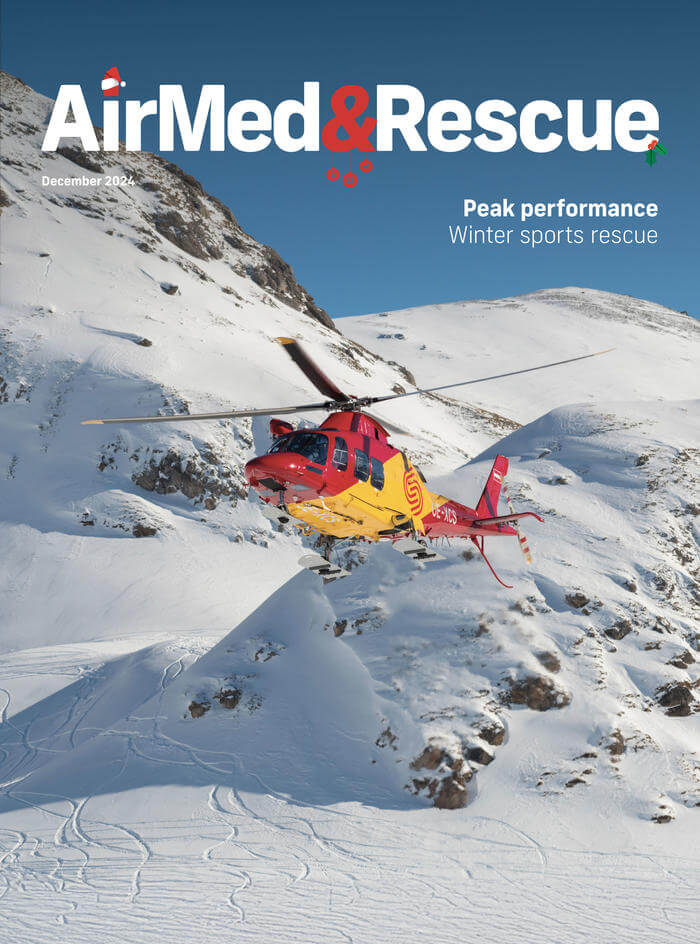
In the December edition, discover what goes into saving people that get into trouble on the ski slopes; find out about drones that are being used for search and rescue; learn about the treatment options for people with fractures; and see what has been happening this year in the realm of avionics development; plus more of our regular content.
Ian Harbison
Ian has had a long career in the defense and aerospace industry, including journalism, PR and market intelligence.
Between 1990–2000, he was at Shephard Press as Editor of Commuter World, later Regional Airline World, and launch Editor of Air Ambulance and Inflight magazines.
From 2004–2020, he was at Air Transport Publications, as Editor of MRO Management, as well as launch Editor of Low Cost & Regional Airline Business, GreenSky - Aviation and the Environment and Aircraft Cabin Management and MRO News Focus newsletter.
From 2000–2004, he variously handled PR for Bombardier Regional Aircraft, was Editor of Offshore Patrol magazine and Airline News Weekly, and freelanced. He is currently freelancing for several publications in the UK and the USA.