
Joining the dots: coordination between stakeholders

Coordination, cooperation and collaboration are essential to aerial firefighting, and the new technology to help battle growing wildfires will only deepen this teamwork. Rob Coppinger delves into the strategies used by the aerial firefighting community
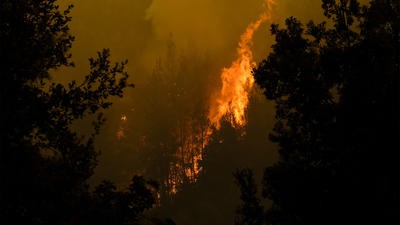
Historically, wildfires have been seasonal and often localized, but in recent years the fire season has become longer, and the fires are spread over much wider areas. Climate change is drying the forests, making woodland that spans across a country’s regions and over nations’ borders more susceptible to fires that are greater in intensity and sometimes international. Well-established rules, agreements, ways of working and contracts between the private and public sector for sharing assets, for example, have been proven to be effective for the coordination, cooperation and collaboration needed with the greater threat. But to ensure the wildfires do not become a greater danger, new technology, including drones, has to be added to the mix to extinguish the threat.
A regional problem, growing
One region that has had many high-profile raging wildfires is the US state of California. The California Department of Forestry and Fire Protection, also known as CAL FIRE, has access to a large fleet of aircraft to tackle wildfires. “We have one of the largest aircraft fleets in the world, between airtankers, helicopters and our air attack ships, which lead the airtankers,” said Jesse Torres, CAL-FIRE Battalion Chief, Communications. “We have our own fleet, but when we’re depleted because of activity across the state, we can also use our exclusive-use aircraft, which are on contract with us.” These are contracted when needed, Torres explained, and “they follow all our rules. They’re on our same communication plan, and they all have all the same radio frequencies. And we’re the ones that will dispatch them to fires.”
The Wildfire Forecast & Threat Intelligence Integration Center (WFTIIC) serves as California’s integrated central organizing hub for wildfire forecasting, weather information, threat intelligence gathering, analysis and dissemination. The WFTIIC also coordinates wildfire threat intelligence and data sharing among federal, state, local agencies, tribal governments, utilities, other service providers, academic institutions and nongovernmental organizations.
Well resourced for the challenge at hand, CAL FIRE is still increasing its fleet to meet the growing threat. “At the end of August, we introduced and had our inaugural flight of our first CAL FIRE C-130, which is a large airtanker, larger than our [current] aircraft that we have that can dump 4,000gal of retardant on a single load of fire. So we’re very happy to bring on that [C-130] to the fleet. And by next year, we‘ll have six more in service to travel throughout the state and assist us.”
In 2021, US legislation created the federal Wildland Fire Mitigation and Management Commission. In turn, the Commission was charged with making recommendations to improve federal policies related to the prevention, mitigation, suppression, and management of wildland fires. Its Aerial Equipment Strategy Report published in January 2023 recommended the need for greater coordination with partners in aviation procurement and a review of the use of military surplus against wildland fires. The emerging importance of drones was also cited.
The report stated that agencies should explore technology to increase operational effectiveness and reduce staffing demands
Another recommendation in the report stated that agencies should “explore technology to increase operational effectiveness and reduce staffing demands”. This exploration was noticed by Smith Myers, the producers of the ARTEMIS systems, which were mainly targeted at the search and rescue sector. Andrew Munro, Managing Director of Smith Myers, explained: “It’s true that the initial deployment of the ARTEMIS systems was focused on search and rescue operations. However, it didn’t take long for professionals in other sectors to recognize the versatility of ARTEMIS. The system was soon adapted for a variety of applications, including border patrol, maritime patrol, and law enforcement. When it came to aerial firefighting, we saw its potential and decided to engage with the firefighting community. We began attending conferences and actively listening to their needs and challenges, which allowed us to understand how ARTEMIS could address their specific priorities.”

Support for neighbors
That large CAL FIRE fleet is also of potential use for neighboring states Oregon, Arizona, Nevada and even Mexico. “In the United States, there is a national coordination system; it’s run by the federal government, the Forest Service, the Bureau of Land Management, the Department of the Interior,” explained United Aerial Firefighters Association Executive Director Paul Petersen. “And it works at the federal, state and local level for … not just aerial resources, but all types of resources to respond to fires. And you have your local dispatch centers to a geographic area, to a national center that coordinates the movement of all of those across the United States.”
Petersen described how states can use the interagency dispatch system to call for aircraft from elsewhere in the USA. “They can just order additional resources in through the interagency dispatch system and if those resources are available, then they get sent to California, for example, and they can come from anywhere. They can come from, you know, Oregon; they can come from Florida, they could come from Colorado… if they’re available to be dispatched, then they would just respond.”
They can just order additional resources in through the interagency dispatch system and if those resources are available, then they get sent to California, for example, and they can come from anywhere
Arriving aircraft typically receive a briefing about where they are going, the altitude they will operate at, and where they need to drop the water or retardant. “And then they come in for a live run and drop their retardant or water and then go back and do it all over again,” he added.
Where Petersen does see a role for technology is the safety of operations with the adoption of Automatic Dependent Surveillance-Broadcast (ADS-B), where aircraft transmit their position, speed and direction. “There is probably room for more technology to come in. With the ADS-B, it certainly has allowed us to see traffic a little bit better,” he said.
In Europe, the coordination, cooperation and collaboration is very similar with government fleets being aided by private aerial firefighters. Antonio Martinez Garcia is a Project Director for European aerial emergency service operator Avincis. Giving Portugal as an example, Martinez Garcia said: “For big fires, they don’t have seaplanes or attack planes or anything [like that] in the Air Force, so what they don’t have they will rent from the commercial operators. The Air Force has a tender and then you send your offers,” he explained. “They have regional centers, of course, but the center of decision-making for the national authority is in Lisbon. The local center will … send the first intervention helicopter with the fire brigade and the Bambi Bucket and that kind of thing.” But after that, it is Lisbon that will call the private providers like Avincis.
Coordination and communication is aided by the Smith Myers technology when rural, remote and austere conditions limit the breadth of communication possible with traditional methods: “ARTEMIS is designed to operate independently of local cellular networks, allowing it to function even in areas where the network is damaged or inoperable, such as during large wildfires,” said Munro. “However, it’s also fully capable of working in regions where a cellular network is present. In both cases, ARTEMIS enables direct communication between individuals in distress and first responders, ensuring reliable connectivity to pass evacuation messages and such.”
Civil protection
In Portugal, while the civil protection authorities manage the aerial firefighting operators, the military provides the necessary logistical support. “The only place where we have the avgas in enough quantities to refuel us is in the Air Force bases,” said Martinez Garcia. “We can go to civilian airports, but they have a very weak pump, so we take a long time to refuel.” He added that the aerial firefighters have to communicate to the civil protection authorities what their avgas status is so they can arrange for the provision of fuel.
Fires do not respect borders, and Spain is happy for aircraft fighting fires in Portugal to use the Spanish lakes that are close to the border. “That works at the government level. We have a protocol we have had for many years,” Martinez Garcia explained. He also pointed to the times when Spain has had a lot of fires at the same time and the European Union (EU) has stepped in to help coordinate a wider European response. But other countries can have their own problems, too. “The people say, ‘Well, we cannot send the aircraft because we have a big fire ourselves,’ and so they will send some other aircraft from Italy or from France. There’s always somebody willing to help us.”
Wieger Ketellapper is the Chief Executive Officer of Aquarius Aerial Firefighting, a new company of Cargolux Airlines International. “At the moment we are working with three of our airplanes in Spain, and we do this for Titan Firefighting, which is an operator in Viver, Spain. And in turn, the contract is with the Spanish government,” Ketellapper explained. “This is quite common. It is very similar to commercial air transport, where you essentially wet lease or do hybrid wet leases between operators.”
As a new operator with a pan-European view, Aquarius’ aircraft are equipped with tactical radios for communications with firefighting coordinators on the ground. “Equipment differs per country – initially we have installed a radio with a frequency band that covers several countries,” Ketellapper said. The technology is not new or sophisticated.
Ketellapper talked about pilots using tablet devices with aviation navigation apps to keep an accurate picture of where they are. These off-the-shelf tablet computers are permitted for use in aircraft. There are currently no mainstream navigation apps or navigation equipment specifically designed to aid aerial firefighting operations.
While there have been efforts to create a more European response to natural disasters, with the EU as a coordinator, there are still language barriers. “In Spain, you would need to have what we call ICAO level four Spanish,” Ketellapper explained. “Portugal is the same situation. Other countries are requesting that one person in the in the formation needs to speak the local language. And then, quite often, dual seaters are coming to use where in the back of the dual seater there is a translator.”
Making the most of a technology that is now ubiquitous, the mobile phone, Smith Myers’ technology allows communication with anyone that has one, enhancing the ability of firefighters in the air and on the ground to report the live behavior of the wildfires, as well as the location of any individual. Munro described the utility of this technology: “End users tell us that ARTEMIS significantly enhances communication and situational awareness for aerial firefighters and their ground-based colleagues. By allowing real-time tracking and messaging, the system enables first responders to accurately determine the locations of individuals in wildfire-affected areas. This information is crucial for ensuring safe and effective evacuation routes, sharing fire spread updates, and coordinating the timing of water or retardant drops. This is critical and ensures that far less ground-based first responders are put at risk.
End users tell us that ARTEMIS significantly enhances communication and situational awareness for aerial firefighters and their ground-based colleagues

“Real-time updates from aircraft to ground teams also enhances coordination, which is especially critical in fast-moving wildfire situations. And the fact that ARTEMIS is fully integrated into CivTAK, ATAK and iTAK makes for better all-round situational awareness.”
The Peak District is the UK’s oldest national park, which covers an area of 555 square miles. It has suffered wildfires burning thousands of acres. Peak District Operations and Partnerships Engagement Ranger Team Leader Jessica Coatesworth is part of the Fire Operations Group. In recent years she has seen a growing number of wildfires in the park. “In the Peak District we’ve got a quite good level of collaboration because we’ve worked together for such a long time – it’s coming up to nearly 30 years,” she said.
Landowners are often the first people who learn of a fire on their property, and they contact the fire service. Discussions between the fire service and landowner can lead to the provision of aerial support, but that is then organized by the landowner. Sometimes that judgement on whether aerial support is needed is not always correct. “We have had incidents where if we’d had aerial support earlier, we probably would’ve reduced the time [duration] of the incident,” said Coatesworth. “When that aerial support arrives, that aerial response is put at the disposal of the fire service. It’s a slightly imperfect process in that one person pays, but another person is using that asset.”
We have had incidents where if we’d had aerial support earlier, we probably would’ve reduced the time duration of the incident
The increase in wildfires is a particular problem for the water company’s reservoirs. Fires in close proximity to the district‘s reservoirs can reduce the quality of the reservoir water. Coatesworth’s view is: “I think the way we are doing it on the ground at the moment is working surprisingly well,” but “we haven’t really got, in the way that they have in other countries for decades, we’re not quite there with the aerial stuff nationally.”
Acting quickly, and efficiently, can make all the difference in a wildfire scenario. Being able to broadcast a targeted message to people affected by or about to be affected by a wildfire can save time and work for emergency crews. “ARTEMIS can communicate with large groups of people simultaneously within a specific location,” said Munro. “The system supports individual communication via voice calls and SMS, allowing first responders to directly contact individuals in distress. Additionally, ARTEMIS can broadcast mass SMS messages to all cell phones within a defined area, including geofenced regions. This capability is especially valuable during these fast-moving emergencies, as it enables the rapid dissemination of evacuation instructions, fire spread updates, or safety alerts to large groups of people in real time. The geofencing feature ensures messages are targeted to those in the affected area, maximizing efficiency and minimizing confusion.”
Furthermore, the use of the technology and the added confidence it gives the users permits different strategies to tackle the blazes that might otherwise be employed, Munro said: “What we also discovered as an important feature is that ARTEMIS provides a higher degree of confidence that no civilians are in danger within a wildfire zone, allowing teams to proceed with aggressive firefighting tactics more quickly than before and without fear of harming people on the ground. This leads to quicker containment.”
He added: “Also, the system’s enhanced situational awareness and communication capabilities are particularly beneficial in this scenario. For example, individuals who are unable to evacuate due to immobility or other reasons can communicate directly with airborne crews, even before ground teams arrive. This not only aids in targeted rescue efforts but also reduces the risks faced by ground-based first responders or smoke jumpers, for instance.”
Coordination, cooperation and collaboration procedures are well established in North America and across the EU. Long-standing agreements for the sharing of assets and cross-border operations allow for the orderly actions needed to fight the unpredictable wildfires. Some new technologies are contributing to the effectiveness of that cooperation, but the trusted method of radios and clear lines of communication are still serving the first responders well. However, what the firefighting community know is that the fire season is becoming longer, and the wildfires spread over wider areas, and this will mean coordination, cooperation and collaboration will have to adapt. The clearest change will be the wider adoption of more and more capable drones, watching for and then fighting the fires that climate change is sparking.
March 2025
Issue
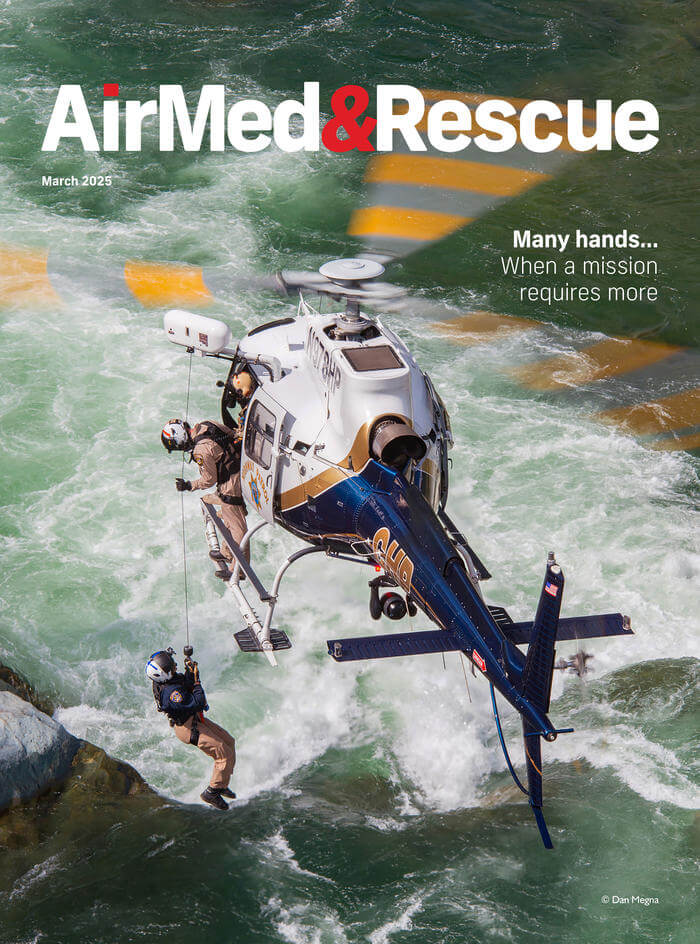
Our March edition has features that let you discover the level of training provided by simulators; learn the ins and outs of medical interiors in aircraft; find out about how health and usage monitoring systems are changing special missions; and see how aerial firefighters communicate and coordinate their missions across multiple agencies and stakeholders; plus more of our regular content.
Rob Coppinger
Rob Coppinger is a veteran aerospace writer whose work has appeared in Flight International, on the BBC, in The Engineer, Live Science, the Aviation Week Network and other publications. He has covered a wide range of subjects from aviation and aerospace technology to space exploration, information technology and engineering. In September 2021, Rob became the editor of SpaceFlight Magazine, a publication by the British Interplanetary Society. He is based in France.